

Asphalt Price Calculator Your Guide to Accurate Paving Costs
When you run the numbers, a standard 10,000 sq ft retail lot in Houston can easily demand a $25,000-$35,000 budget for the base asphalt alone. Getting from a vague guess to a number you can actually bank on means understanding what really drives that final price tag. Let's break down those critical factors so you can build your budget on a solid foundation, not just wishful thinking.
Ditching the Guesswork on Your Asphalt Project Costs
Planning any commercial paving job in Houston requires moving past ballpark figures and adopting a more methodical way of estimating. A solid cost forecast is more than just a number—it’s the strategic tool that keeps your project from going off the rails and over budget. The final price you see on a contractor's invoice always boils down to a combination of materials, labor, and overhead.
Simply relying on a generic price-per-square-foot can be seriously misleading. That kind of shortcut completely ignores the on-the-ground details that can dramatically swing the final cost. For any property manager or business owner, getting a handle on these variables is the essential first step to painting a realistic financial picture before the first scoop of dirt is moved.
The Three Pillars of Paving Costs
Every asphalt project, whether it's a simple pothole patch or a sprawling new parking lot, is built on the same fundamental cost structure. When you understand these core components, the quoting process becomes much clearer, and you'll know exactly what questions to ask.
Here's a quick rundown of the main elements that contribute to your final bill.
Quick Guide to Asphalt Cost Components
| Cost Component | What It Covers | Typical Impact on Price |
|---|---|---|
| Materials | Hot mix asphalt, crushed aggregate base, tack coat (bonding agent), sealants. | Price per ton fluctuates with oil prices and local supply chains. |
| Labor | Skilled crews for grading, excavation, and operating heavy machinery. | Often accounts for nearly 40-50% of the total project cost. |
| Overhead & Equipment | Mobilization fees, fuel, permits, insurance, contractor's profit margin. | Necessary costs for a professional, safe, and insured operation. |
This table simplifies the main cost drivers, but remember that the interplay between them is what truly defines your project's budget.
Materials: This isn't just about the blacktop itself. It includes the crushed rock for the sub-base, the sticky tack coat that bonds the asphalt layers, and any sealants needed. The price of asphalt is a commodity, tied directly to global oil prices and what local suppliers are charging.
Labor: Getting skilled people on site is a major cost driver, often making up almost half of the entire project budget. This covers the crew needed for any demolition, grading the site properly, and expertly operating the heavy pavers and rollers.
Overhead & Equipment: This bucket covers all the necessary logistics. Think mobilization fees (getting heavy equipment to your property), fuel for the machines, insurance, city permits, and the contractor's margin to run a sustainable business. These are the non-negotiable costs of getting a job done right.
Here's a piece of advice I always give property managers: the foundation is everything. The quality of the gravel sub-base and the properly graded soil underneath it is the single most important factor for your pavement's lifespan. Skimping here to save a few bucks upfront is a surefire way to see premature cracks and potholes, leading to much bigger replacement costs down the road.
Why Houston's Market Matters
The global asphalt market is a massive industry, valued at an eye-watering USD 259.10 billion in 2024. That number is only expected to grow, thanks to urbanization and infrastructure projects worldwide. This global activity has a direct ripple effect on what you pay locally for a parking lot in Texas.
For perspective, North American asphalt prices were sitting around $0.64 USD/kg in late 2023, driven by steady demand from commercial construction booms just like the one we're seeing across Greater Houston. These trends make it clear why using an accurate, up-to-date asphalt price calculator is so crucial for adapting to market swings. You can delve deeper into the asphalt market trends to see how they impact your project's bottom line.
Figuring Out Your Core Material and Labor Costs
Now that we've covered the basic cost components, it’s time to roll up our sleeves and get into the numbers that form the heart of any solid estimate. A reliable asphalt cost calculation isn't about guesswork; it's a straightforward process that turns your physical space into real-world material and labor figures. This is how you build the data that drives your budget.
This flowchart shows how the primary cost drivers—materials, labor, and overhead—all come together to create your final project price.
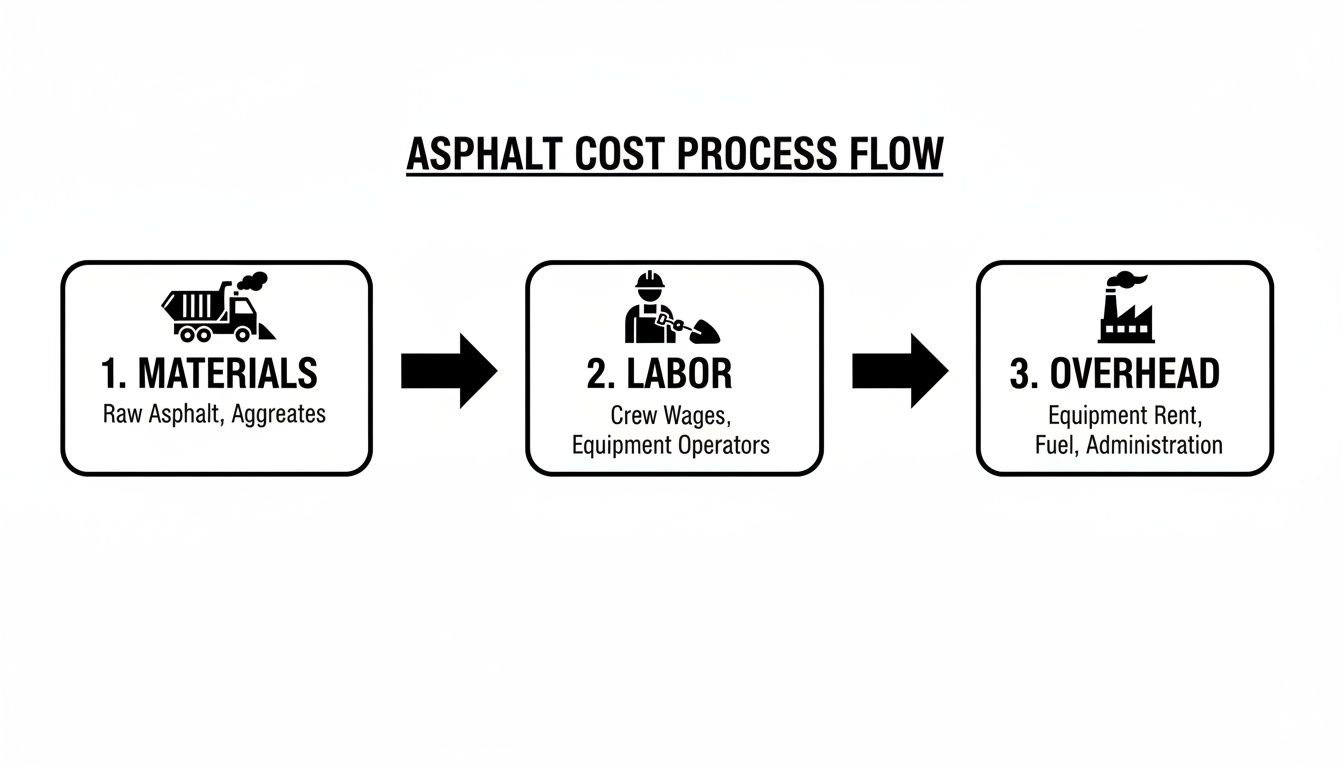
As you can see, a professional quote is a blend of these different categories, and each one is influenced by a unique set of market and project-specific factors.
Nailing Down Your Project Area
First things first: you have to accurately measure the total surface area you plan to pave. Every other calculation hinges on getting this number right from the start.
For a simple rectangular lot, the math is easy: Length (ft) x Width (ft) = Area (sq ft).
But let's be realistic—commercial properties are rarely perfect rectangles. You’ll likely deal with curves, cutouts for landscaping, and other odd shapes. The best way to tackle this is to break the complex area down into smaller, manageable geometric shapes (rectangles, triangles, etc.). Calculate the area of each small section, then simply add them all together for a precise total.
From Area to Volume: Why Thickness Is Everything
Square footage alone only gives you two dimensions. The thickness of the asphalt layer is what turns that flat area into a three-dimensional volume, and it’s the volume of material that you actually buy. This is easily one of the most critical variables in any paving estimate.
The right thickness depends entirely on the traffic you expect:
- Standard Parking Stalls: A 2-inch compacted layer is usually plenty for areas where cars will just be sitting.
- Drive Lanes & Light Traffic: For the main arteries running through your lot, stepping up to a 3-inch depth gives you much better durability.
- High-Traffic & Heavy Loads: For loading docks, dumpster pads, or entrances hammered by heavy trucks, you need a 4-inch layer or even more to prevent early failure.
Trying to save money with a thinner layer in a high-stress area is a classic mistake. It might look good on the initial invoice, but it will almost certainly lead to expensive problems like alligator cracking and rutting sooner than you think.
The most common error I see is underestimating the load requirements. A property manager might budget for a uniform 2-inch lot, completely forgetting that their daily trash and delivery trucks put immense, focused stress on certain zones. A professional assessment ensures the right thickness goes exactly where it's needed most.
Converting Volume to Tons of Asphalt
Once you have the volume figured out, the last step is converting it into tons—the standard unit for buying hot mix asphalt. This calculation uses the material's density.
A reliable industry rule of thumb is that one ton of hot mix asphalt will cover about 80 square feet at a 2-inch compacted depth.
Using this, you can quickly ballpark your material needs. If you double the thickness to 4 inches, that same ton will now only cover half the area, or 40 square feet. This simple relationship shows just how fast your material costs can climb as you add thickness.
Let's put this into a real-world scenario. Imagine you have a 20,000 sq ft section of a retail parking lot that needs a standard 2-inch overlay.
- Calculation: 20,000 sq ft / 80 sq ft per ton = 250 tons of asphalt needed.
Now, let's say a separate 5,000 sq ft area serves as a high-traffic entrance and needs a beefy 4-inch layer.
- Calculation: 5,000 sq ft / 40 sq ft per ton = 125 tons of asphalt for that smaller, more critical section.
This simple math shows why a one-size-fits-all approach just doesn't work. A proper estimate has to account for these different needs across a single property. Mastering these core calculations will help you have much more productive conversations with contractors and build a budget that truly reflects the reality of your project.
Uncovering Hidden Costs and Essential Add-Ons
Getting a handle on your core material and labor figures is a huge step, but a raw tonnage estimate is only part of the financial picture. An experienced contractor's quote includes several other line items that are absolutely critical for a successful, long-lasting project. These "hidden" costs are often what separates a rushed, low-quality job from a professional one built to withstand Houston's demanding climate.
Understanding these add-ons helps you build a truly complete budget that won't leave you with surprise expenses. It’s about seeing the full scope of work, from what happens before the first paver arrives to the final cleanup.
The Foundation of a Durable Pavement
The real secret to a 20-year parking lot isn't just the asphalt on top; it's the carefully prepared foundation underneath. You simply can't skimp on this. Proper site preparation is a non-negotiable investment in your property's longevity.
This process involves a few key stages:
- Grading and Excavation: First, the land must be professionally graded to ensure water flows away from the pavement. This is crucial for preventing pooling and seepage into the sub-base, which is the number one cause of potholes and cracks. Depending on the site’s current condition, this can run anywhere from $1 to $8 per square foot.
- Crushed Aggregate Sub-Base: Next, a layer of crushed stone, usually 4 to 6 inches deep, is laid down and compacted. This creates a stable, load-bearing platform that distributes the weight of traffic and protects the asphalt from ground movement.
- Compaction: This step is vital. Both the soil and the new aggregate base have to be thoroughly compacted with heavy rollers. Skipping this leads to settling and premature failure of the beautiful new pavement you just paid for.
From my experience, the most common reason for premature asphalt failure is a poorly prepared sub-base. A low-ball quote that seems too good to be true often achieves its price by skimping on this foundational work. A solid base is your best insurance policy against future repair bills.
Dealing With Old and Damaged Surfaces
If you're not starting with a clean patch of dirt, you have to account for the old pavement. And let me be clear: this involves more than just paving over the top of existing problems.
Removal and Disposal: The cost to demolish and haul away old, crumbling asphalt can easily add $1 to $3 per square foot to your project total. This is a labor-intensive process that requires heavy machinery and proper disposal at a designated facility.
Edge Milling: For resurfacing projects, we use a specialized machine to grind down the edges where new asphalt will meet existing pavement, like curbs or concrete gutters. This creates a smooth, seamless transition and prevents a weak, raised edge that can easily chip and break apart.
These services are essential for a clean, professional outcome. You can see how a well-prepared surface impacts long-term care in our guide on how to seal coat asphalt.
The "Soft Costs" That Add Up
Beyond the direct site work, there are several logistical and administrative costs that every professional paving operation has to factor into its pricing. Forgetting these can throw a real wrench in your budget.
Here are a few you'll see on any detailed quote:
- Mobilization Fees: This covers the very real expense of getting heavy equipment—pavers, rollers, dump trucks—to and from your job site. It’s a fixed cost that is part of any project, big or small.
- Permit Costs: Depending on your location in the Houston area, you might need a permit from the city or county. These fees can range from $50 to over $500 and are a required part of doing the job correctly and legally.
- Fuel Surcharges: The price of diesel fuel directly impacts the cost of running machinery and transporting materials. Many contractors adjust for this volatility to keep their bids accurate.
Market volatility is another key factor. For instance, in April 2025, asphalt prices saw a synchronized dip globally, with North America at $0.54 USD/kg. By December 2025, the price had rebounded to $0.64 USD/kg, driven by road maintenance demands.
This kind of swing highlights why an asphalt price calculator is so valuable. A mere 1% price change on 100 tons of material can alter your budget by over $1,200. Keeping an eye on these global price trends is just part of staying ahead in this business.
How the Houston Market Impacts Your Final Price
Figuring out the cost of an asphalt project goes way beyond just the square footage and materials. Geography plays a huge role. An asphalt job here in Houston has its own financial DNA, shaped by a powerful mix of industrial might, relentless heat, and explosive growth.
Getting a handle on these local forces is the key to understanding any quote you receive and timing your project for the best possible price.
Unlike a lot of other cities, Houston is the heart of the petrochemical industry. Being so close to a massive network of refineries directly impacts the local supply and base price of liquid asphalt cement—the glue that holds hot mix asphalt together. This can be a double-edged sword; sometimes it gives us price stability, but it also makes the market touchy when it comes to refinery maintenance schedules or shutdowns.
Supply Chains and Logistics
The availability and cost of every single component are tied to Houston's logistical network. The constant stream of goods moving along I-10, I-45, and through the Port of Houston affects everything from the price of crushed aggregate to the delivery fees for the hot mix itself.
A few key logistical factors always come into play:
- Proximity to Quarries: The distance from your job site to the nearest rock quarry has a real impact on the cost of your sub-base aggregate. The farther the haul, the higher the fuel and trucking costs, and that gets passed on to you.
- Hot Mix Plant Location: Asphalt has to be laid while it's still piping hot. That means the travel time from the production plant to your property is critical. It influences not just the material cost but whether the project is even feasible on a given day.
- Traffic Congestion: Houston's traffic is no joke. It can delay material deliveries, which can throw off a crew’s efficiency and the whole project timeline. Any experienced contractor in this town knows to build that risk right into their schedule.
This whole web of supply chain factors is why a seemingly simple project can cost more in Kingwood than it does in Sugar Land.
The Impact of Climate and Growth
Houston's climate doesn't just make us sweat; it dictates the entire paving season. The intense summer heat, while tough on the crews, actually creates the perfect conditions for laying and compacting asphalt. The flip side is that this is peak season, which can drive up labor costs and make it hard to get on a good crew's schedule.
After years in this business, I can tell you that scheduling a big paving project just before or after the peak summer rush can often get you more competitive pricing. Contractors are usually looking to fill their schedules during those shoulder seasons in late spring or early fall.
On top of that, Southeast Texas's constant commercial and residential boom creates a high, steady demand for paving services. In this competitive environment, skilled labor is a premium. All the new retail centers, industrial parks, and subdivisions keep professional crews busy, which directly affects the labor portion of your quote. Even something like hurricane season preparedness can temporarily divert trucks and impact material availability, adding another layer of regional complexity.
A Global Market with Local Consequences
While we're focused on local factors, it’s important to remember that asphalt is a global commodity tied directly to crude oil prices. Market swings on the other side of the world can, and do, affect what you pay for a parking lot right here in Houston.
For instance, back in December 2025, asphalt prices varied wildly by region. It hit $0.64 USD per kilogram in North America while dropping to $0.46 USD/kg over in Northeast Asia. That 30% difference shows how local demand, like the big push for road repairs across Texas, bumps up against global supply.
For a mid-sized Houston project needing 500 tons of asphalt, that North American rate puts material costs at roughly $320,000. It’s a perfect example of why any good asphalt price calculator has to account for these dynamic regional indexes. You can dive deeper into these global pricing dynamics to see the bigger picture for yourself.
Putting It All Together: A Real-World Houston Paving Job
All these formulas and cost factors can feel a bit theoretical. So, let's walk through a realistic scenario to see how a professional estimate comes together. This is where a good asphalt price calculator really shows its value—by turning abstract numbers into a concrete budget.
We'll follow the process for a typical large-scale commercial project right here in the Houston area. By seeing how a contractor builds a quote from the ground up, you'll gain a much clearer picture of what to expect for your own property.
The Project: A Full Replacement for a Houston Commercial Lot
Let's imagine you're responsible for a 50,000-square-foot commercial property. The parking lot is shot—riddled with alligator cracking and clear signs of a failing sub-base. The only sensible long-term solution is a full replacement.
Here’s the scope of work:
- Total Area: 50,000 sq ft
- Old Pavement: Requires complete removal and proper disposal.
- New Sub-Base: Needs a new 4-inch layer of crushed aggregate.
- New Asphalt: To be paved with a 3-inch compacted layer of hot mix asphalt.
Breaking Down the Costs, Line by Line
Here’s how a professional quote would tackle this, using realistic Houston-area cost averages.
Demolition and Disposal
First things first, the old, busted-up asphalt has to go. This is tough, labor-intensive work.
- The Math: 50,000 sq ft x $1.75/sq ft = $87,500
Sub-Base Installation
With the old surface gone, it's time to build a solid foundation. That 4-inch aggregate base is absolutely critical for the new asphalt’s lifespan.
- The Math: 50,000 sq ft x $1.50/sq ft = $75,000
Asphalt Material Tonnage and Cost
Now for the star of the show. We need to calculate how many tons of hot mix asphalt are required for a 3-inch layer over this area.
- Tonnage Needed: 50,000 sq ft / 53.3 (our conversion factor for 3" depth) ≈ 938 tons
- Material Cost: 938 tons x $155/ton = $145,390
Paving Labor
This line item covers the skilled crew, the heavy machinery, and the expertise needed to lay, grade, and compact the new surface perfectly.
- The Math: 50,000 sq ft x $1.25/sq ft = $62,500
Essential "Soft Costs"
Finally, we can't forget the logistical fees that are part of every major project.
- Mobilization Fee: A standard flat rate to get the equipment and crew to your site: $1,500
- City Permitting: An estimated cost for a project of this size in Houston: $500
A key thing to notice is that the raw asphalt, while the single biggest line item, is only part of the story. The labor for demolition and rebuilding the sub-base is substantial and can easily match or even exceed the cost of the paving labor itself.
The Bottom Line: Your Final Estimated Total
When we add it all up, we get a clear, comprehensive project budget.
- Demolition & Disposal: $87,500
- Sub-Base Installation: $75,000
- Asphalt Material: $145,390
- Paving Labor: $62,500
- Mobilization & Permits: $2,000
- Subtotal: $372,390
It’s always wise to add a 10% contingency for unforeseen issues, like discovering poor soil conditions once the old asphalt is removed. That brings our grand total to around $409,629, which works out to be $8.19 per square foot. This is a very realistic all-in price for a full-depth replacement of this size in the Houston market.
Of course, this figure doesn't cover services needed after the paving is done. You can learn more about what comes next by reading our guide on how much parking lot striping costs.
Your Ready-to-Use Calculator Template
To make this guide as practical as possible, we’ve put together a simple calculator template. You can plug in your own project’s numbers—square footage, desired thickness, and local unit costs—to build a reliable budget estimate.
This template is a ready-to-use tool for estimating the total cost of your next asphalt paving project.
Asphalt Project Cost Calculator Template
| Line Item | Your Measurement/Quantity | Unit Cost | Total Cost |
|---|---|---|---|
| Demolition & Removal (sq ft) | $ / sq ft | $ | |
| Grading/Excavation (sq ft) | $ / sq ft | $ | |
| New Sub-Base (sq ft) | $ / sq ft | $ | |
| Asphalt Material (tons) | $ / ton | $ | |
| Paving Labor (sq ft) | $ / sq ft | $ | |
| Mobilization Fee (flat rate) | $ | $ | |
| Permits (flat rate) | $ | $ | |
| Subtotal | $ | ||
| Contingency (e.g., 10%) | $ | ||
| Estimated Grand Total | $ |
Using a tool like this changes everything. It takes you from simply reading information to actively planning your project. When you approach contractors armed with a clear understanding of the costs, you can have a much more transparent and productive conversation.
When Your Calculator Is Not Enough: Trusting a Professional Estimate
Running the numbers with an asphalt price calculator is a fantastic first step. It gives you a solid, data-driven starting point for your budget and helps you understand what goes into the cost. But let's be honest—flawless execution requires an expert eye that can spot things a spreadsheet will always miss.
While a calculator is great with precise inputs, it can't diagnose the hidden problems that often lurk beneath the surface. This is where a seasoned contractor becomes your most valuable asset, turning a good budget into a great, long-lasting final product.
What Your Calculator Can't See
Think of your calculator as a blueprint. It’s an essential guide, but it can’t tell you what the ground conditions are like before you start digging. A professional site assessment is designed to uncover the critical variables that no digital tool can predict.
Here are just a few things a pro will look for:
- Hidden Subgrade Issues: A calculator has to assume the foundation is stable. A professional will actually test for soft spots, poor soil composition, or underlying moisture problems that could cause a brand-new lot to fail in just a few years.
- Complex Drainage Engineering: Managing water is about more than just a simple slope. An expert engineers a real solution that accounts for the surrounding landscape, existing storm drains, and local rainfall patterns to prevent pooling and water damage.
- Navigating Local Codes: A calculator doesn't know the specific fire lane width requirements for a particular Houston-area municipality or the latest ADA specs for ramp slopes. A professional ensures your project is 100% compliant from day one, avoiding costly fines and rework.
These are the factors that separate a project that just looks good from one that is structurally sound, safe, and built to last for decades.
Beyond Paving: Comprehensive Solutions
At Houston Parking Lot Striping, we don't just lay down asphalt. We deliver a complete, turn-key solution for your property. An asphalt surface is only truly functional once it’s properly marked and equipped for safe, efficient traffic flow. This is where our deep expertise really shines.
We offer a full suite of finishing services that bring your new lot to life:
- Precision Striping and Stenciling: We lay down crisp, durable lines for parking stalls, directional arrows, and any custom stencils you need to keep your lot organized and professional.
- ADA and Fire Lane Compliance: We are experts in the specific requirements for handicap-accessible spaces and emergency vehicle access, ensuring you pass inspection without a hitch.
- Traffic Control Systems: We install all the essential safety elements, including car stops, speed bumps, protective bollards, and all the necessary signage to manage vehicle and pedestrian movement effectively.
The real value of a professional estimate isn't just in the accuracy of the paving costs; it's in the comprehensive project plan that anticipates every need, from the sub-base to the final sign installation. This holistic approach prevents costly change orders and project delays down the line.
The takeaway is clear: use the knowledge from this guide to build an informed, intelligent budget. Then, partner with us for an official site assessment and quote. This ensures every variable is accounted for and your project is completed to the highest standard—on time and on budget. For more on protecting your investment, you might be interested in our article on asphalt crack filling.
Your Top Asphalt Cost Questions Answered
When you're trying to budget for a paving project, a few key questions always come up. Even with a solid calculator, some real-world context from the field can make all the difference. Let's tackle the most common ones I hear from property managers and contractors.
What's the Biggest "Hidden" Cost in an Asphalt Project?
Hands down, it’s sub-base failure. What you see on the surface is only part of the story. If the foundation of crushed rock and soil underneath is weak or compromised, no amount of fresh asphalt on top will fix it for long.
Fixing a failed sub-base means digging everything out, hauling it away, and rebuilding the foundation from scratch. This isn't just a minor add-on; it can easily balloon your labor and material costs, sometimes doubling the initial estimate for a simple surface-level job.
How Much Does Asphalt Thickness Really Affect the Price?
It's a direct one-to-one relationship, and it impacts your budget significantly. If you increase the paving depth from 2 inches to 4 inches, you're going to nearly double your material cost. It’s simple math—you're buying twice the amount of asphalt tonnage to cover the exact same square footage.
Is It Cheaper to Resurface or Do a Full Replacement?
In the short term, resurfacing (adding a new layer on top) is always the cheaper option. But this is a classic "pay now or pay much more later" scenario.
If your parking lot has deep, "alligator" cracking or foundational problems, a simple overlay is just a band-aid. A full-depth replacement is the only real long-term solution, making it far more cost-effective over the life of the pavement.
Getting your numbers right is the first step, but a successful project depends on a plan that accounts for every variable—from the dirt below to the final painted stripe.
For a professional site assessment and a quote that leaves no stone unturned, trust the crew at Houston Parking Lot Striping. We'll make sure your paving investment is solid from the ground up. Get in touch with us today to build a parking lot that's truly built to last.