

Concrete Bollard Posts A Guide to Commercial Property Safety
When you look at a row of concrete bollard posts, what do you see? Many people see simple concrete stumps, but for a property manager or business owner, they’re so much more. These are your silent guardians—sturdy, reinforced concrete posts standing watch to protect your property and people from vehicle traffic.
Why Concrete Bollard Posts Are Your Silent Guardians
Imagine having a security detail for your building that works 24/7, never calls in sick, and asks for nothing in return. That's exactly what a well-placed concrete bollard provides. They're not just markers; they're a core piece of any serious site security plan.

Think of a concrete bollard as an anchor for your property's perimeter. Much like an anchor holds a ship steady against strong currents, a line of bollards grounds your site, defending it from both accidental crashes and intentional vehicle threats. It's this dual capability that makes them such a powerful asset.
The Two-Sided Job of a Bollard
At their core, bollards do two things at once. Understanding this is the key to seeing their true value on your property.
- Guiding Traffic and People: First, they’re visual cues. They create an obvious boundary, showing drivers where they can and can’t go. This simple guidance keeps cars out of pedestrian zones, prevents corner-cutting, and stops unauthorized parking.
- Providing Physical Protection: This is where their strength shines. If a vehicle loses control, a concrete bollard is engineered to stop it cold. That impact absorption is what prevents a car from smashing through a storefront, taking out a utility box, or plowing into an outdoor patio.
A well-placed bollard doesn't just stop a car. It protects your business from costly repairs and downtime. More importantly, it can save a life. It's an investment in being prepared, not just reacting to disaster.
A Must-Have for Property Managers
If you manage a bustling commercial center or a busy industrial park, concrete bollards aren't just a nice-to-have feature; they are absolutely essential. They work quietly in the background to head off risks that could otherwise spiral into major financial and legal headaches. A single low-speed crash into a glass storefront can easily cost thousands in repairs and lost business.
It’s no surprise that demand for this kind of protection is on the rise. The global market for vehicle barriers is growing fast, with some projections showing it could hit around $797 million by 2033. As our cities get denser and security becomes a bigger focus, these simple, effective solutions are more important than ever.
These straightforward posts are a foundational part of any smart asset protection plan, giving you traffic control, physical security, and invaluable peace of mind. To get a better sense of all their applications, you can dive deeper into our guide on what bollards are used for.
How to Choose the Right Concrete Bollard for Your Needs
Picking the right concrete bollard post isn’t just a finishing touch for your property. It’s a critical decision that directly impacts your site's safety, day-to-day function, and budget. Thinking all bollards are interchangeable is a common mistake, a bit like using a garden fence to stop a delivery truck. The results are almost always disappointing and can be downright disastrous.
To get it right, you have to start with one simple question: what is my primary goal? Are you trying to add some architectural flair, gently guide foot traffic, or create a formidable barrier that can stop a vehicle dead in its tracks? Each of these goals points to a very different kind of concrete bollard.
The Three Tiers: Decorative, Safety, and Security
The first step in narrowing down your options is understanding the fundamental differences between bollard categories. Concrete bollard posts generally fall into one of three tiers, each defined by its intended purpose and how it’s built.
Decorative Bollards: These are the architect’s choice, selected mainly for their looks. They help define spaces, complement a building’s design, and bring a sense of order to a landscape. They offer almost no real impact resistance—think of them as polite, visual suggestions for drivers to stay away.
General Safety Bollards: This is your workhorse category and the most common type you'll see. These bollards are all about creating a clear physical and visual boundary. They’re perfect for separating walkways from parking lots or protecting sensitive landscaping from low-speed, accidental bumps and scrapes.
High-Impact Security Bollards: When stopping a vehicle is non-negotiable, these are your only real option. These are engineered and often crash-rated posts built with deep embedment and heavy-duty reinforcement. You’ll find them protecting high-risk targets like glass storefronts, government buildings, and outdoor dining patios on busy streets.
The core principle here is simple: match the bollard’s strength to the actual threat. A decorative post is perfectly fine for a quiet courtyard, but protecting a storefront requires a security-rated solution. A mismatch creates a false sense of security, which is often more dangerous than no security at all.
Design and Finish: What Works Best for You?
Beyond its raw strength, a bollard's design and finish play a huge role in its long-term durability, maintenance needs, and how well it blends in with your property. The two most common shapes you’ll encounter are round and square, and each has its own distinct advantages.
Round bollards are often the go-to choice for areas with heavy foot traffic. With no sharp corners, they reduce the risk of injury if someone bumps or falls against one. Square bollards, on the other hand, project a more modern, commanding presence. Their clean lines can also be easier to align perfectly for a crisp, organized look.
The finish is just as important as the shape. A smooth, painted finish offers a clean look and high visibility, especially when painted a bright safety yellow. The downside is that it will likely need repainting every few years to cover up chips and wear. In contrast, an exposed aggregate finish has a textured, natural appearance that does an excellent job of hiding minor scuffs and dirt. This makes it a fantastic low-maintenance choice for busy commercial properties.
Comparing Your Concrete Bollard Options
Choosing the right bollard always comes down to balancing your property’s specific risks with your aesthetic goals and, of course, your budget. To make this easier, we've put together a quick guide to help you weigh the trade-offs.
Concrete Bollard Type Selection Guide
This table compares different types of concrete bollards based on their typical application, security level, aesthetic appeal, and relative cost, helping you choose the right solution for your property.
| Bollard Type | Primary Application | Security Level | Aesthetic Flexibility | Estimated Cost |
|---|---|---|---|---|
| Decorative Bollard | Architectural enhancement, defining pedestrian zones | Low | High (Various shapes, colors, and finishes available) | $$ |
| General Safety Bollard | Traffic delineation, low-speed impact prevention, asset protection | Medium | Moderate (Often standard shapes with paint or aggregate finishes) | $$$ |
| High-Impact Security Bollard | Vehicle crash prevention, anti-ram security, storefront protection | High (Often includes steel reinforcement and deep embedment) | Low to Moderate (Function over form is the priority) | $$$$ |
This comparison highlights a crucial point: as your security needs go up, so does the investment. A high-impact bollard costs more because of its robust construction and the demanding installation it requires. But that upfront cost is a drop in the bucket compared to the potential expense of a vehicle collision—a bill that can include structural repairs, lost inventory, and massive liability claims. By taking the time to assess your site’s specific needs, you can select concrete bollard posts that provide the right blend of protection, appearance, and genuine long-term value.
Understanding Bollard Installation and Structural Strength
When you look at a concrete bollard post, you’re only seeing the tip of the iceberg. Its real strength, the part that actually protects your property, is buried deep underground. A bollard that’s improperly installed is really just a heavy, decorative stump waiting to fail. The installation is where the engineering happens, transforming a simple concrete post into a serious protective barrier.
Think of it this way: the part you see above ground is just for show. The real muscle is its embedment depth—how far it’s anchored into the earth. That deep foundation is what gives the bollard the leverage it needs to absorb and redirect the incredible kinetic energy from a vehicle impact.
This chart walks you through the decision-making process, from simple decorative posts to high-impact security solutions.
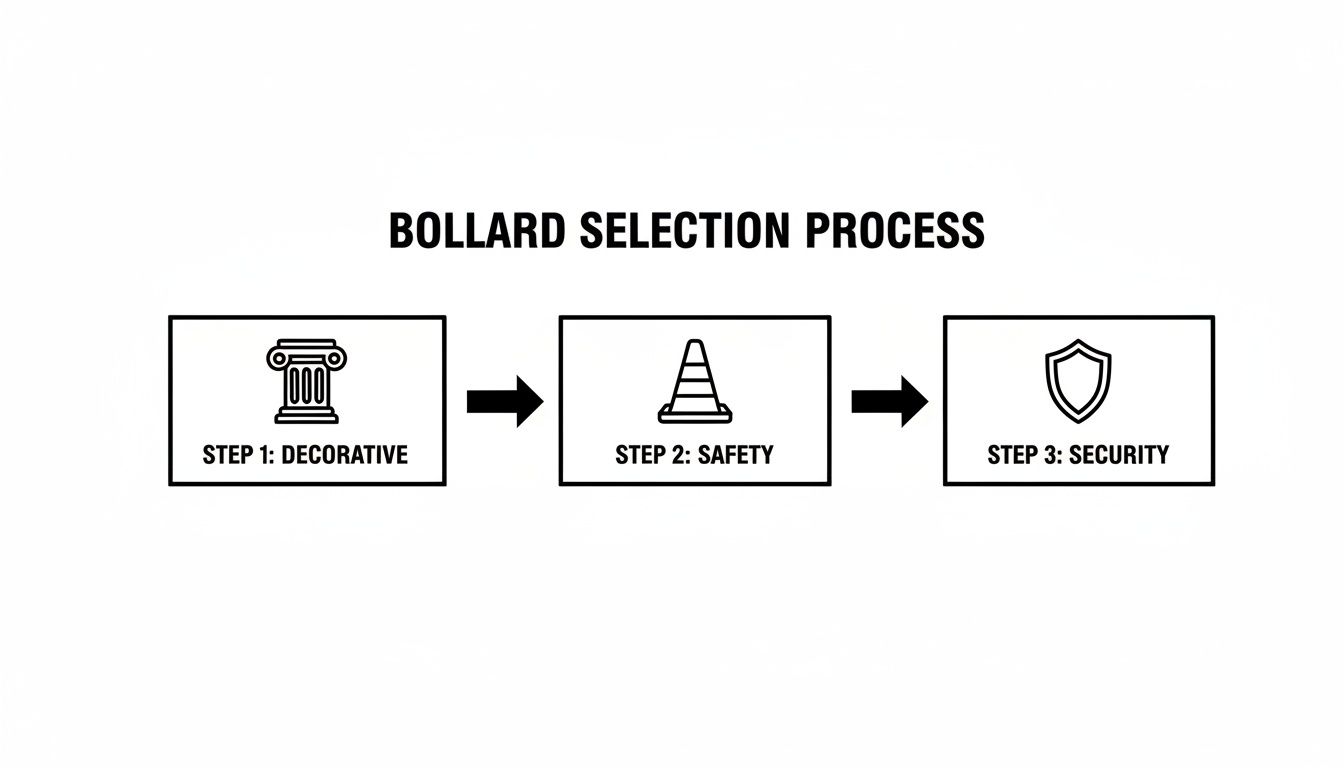
As you can see, the moment your goal shifts from simply guiding traffic to stopping a vehicle, the installation's complexity and structural demands increase dramatically.
Why the Foundation is Everything
Everything comes down to the footing. Time and time again, the most common point of failure for a bollard is a shallow or poorly built foundation. When a car or truck hits a post with an inadequate footing, the bollard just folds over or shears right off at the base. It offers almost no real resistance.
To make sure that doesn't happen, any security-focused installation relies on a few key elements working in concert:
- Deep Embedment: For any real security, bollards need to be buried several feet deep. This depth creates the leverage to fight back against impact forces without being ripped out of the ground.
- Concrete Footing: The post is set inside a massive poured concrete footing. This footing acts like an anchor, spreading the impact load across a huge area of the surrounding soil.
- Rebar Cages: We always integrate steel reinforcement bars (rebar) into the footing. This steel cage gives the concrete immense tensile strength, stopping it from shattering or cracking under the sudden stress of a crash.
Common Installation Methods and Their Uses
The right way to install a bollard really depends on whether you’re starting from scratch on a new site or adding protection to an existing area. Each approach comes with its own trade-offs in terms of strength, cost, and disruption.
Cast-in-Place Installation
This is the gold standard for permanent, high-security bollards. We excavate a deep hole, place a form tube (like a Sonotube), position the rebar cage, and then set the bollard as we pour fresh concrete all around it.
This method creates a monolithic structure—the bollard and its foundation become one solid piece. It offers the maximum possible impact resistance because there are absolutely no joints or weak points at the base to fail.
Core Drilling and Grouting
What if you need to add bollards to an existing concrete sidewalk or inside a parking garage? That’s where core drilling comes in. We use a massive drill to cut a clean, wide hole through the existing slab, place the bollard inside, and then fill the entire gap with a high-strength, non-shrink grout.
While it’s less invasive than a full excavation, this method provides serious strength. It's the go-to choice for retrofitting storefronts or protecting vulnerable building corners on properties that are already developed.
Factors That Influence Structural Performance
Even if you choose the perfect installation method, a few on-site conditions can make or break the final result. Any good contractor will perform a site assessment to account for these variables before a single shovel hits the ground.
- Soil Conditions: The ground itself plays a huge role. Loose, sandy, or loamy soil provides far less anchoring power than dense, compacted clay. If you have poor soil, the footing needs to be engineered wider and deeper to compensate.
- Concrete Curing: Concrete doesn’t get strong overnight. It needs to cure properly over several days, or even weeks, to reach its full compressive strength. Rushing this process or pouring in extreme weather can compromise the concrete forever, leaving you with a weak foundation.
- Drainage: Water is the enemy of any foundation. We have to plan for proper drainage to keep water from pooling at the base. Standing water leads to soil erosion and, in colder climates, can cause devastating damage through freeze-thaw cycles that slowly tear the concrete apart from within.
Strategic Placement for Safety and Compliance
A perfectly installed concrete bollard in the wrong spot is worse than useless—it can create new hazards or completely fail to do its job. Where you place your bollards is just as critical as how they’re embedded. It’s a bit of a balancing act, really, between maximizing security, staying on the right side of the law, and keeping your property functional and welcoming.
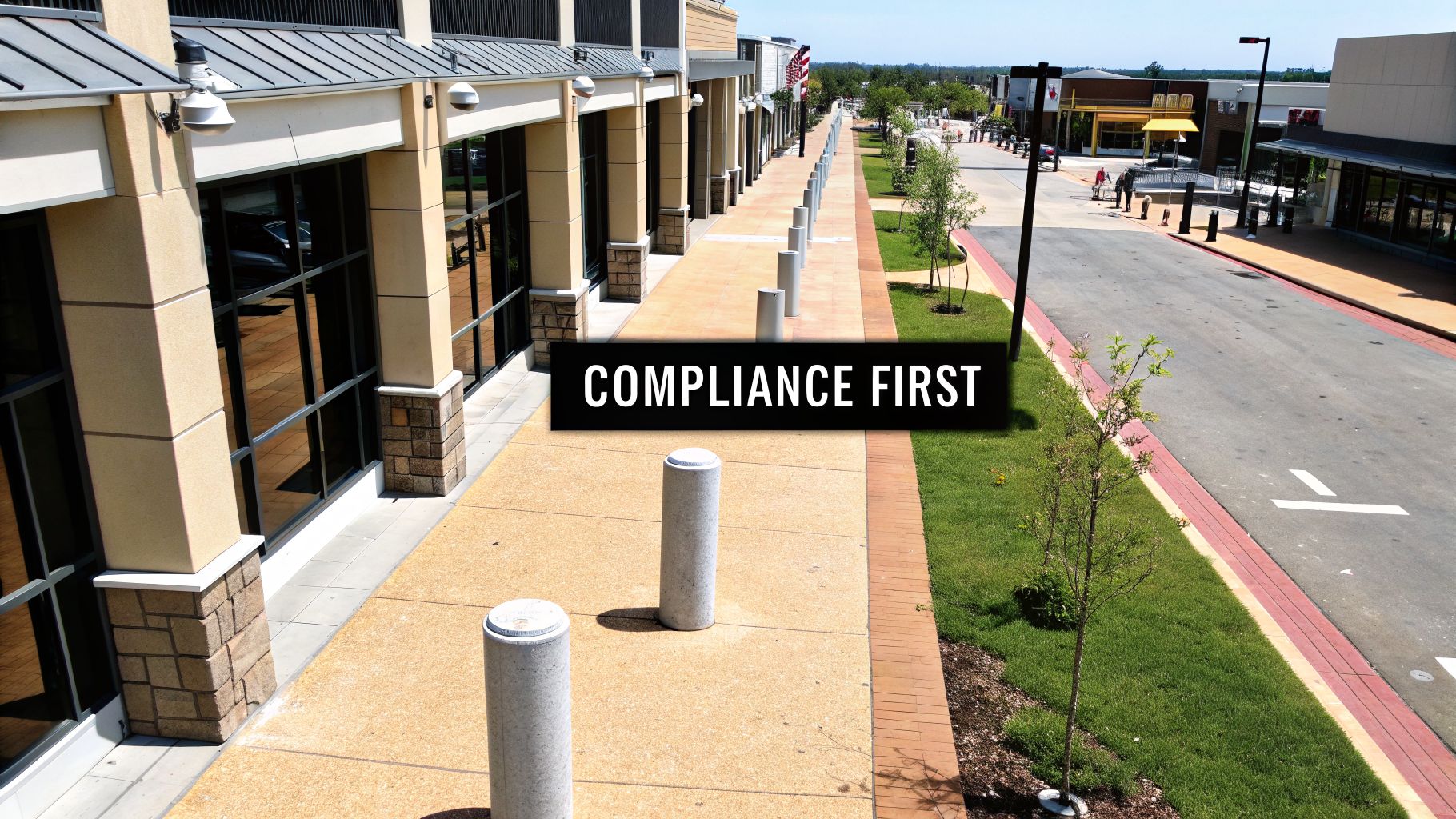
Think of your layout as choreographing the flow of traffic—both pedestrian and vehicular. The goal is to carve out clear, safe paths for people on foot while drawing an impassable line for vehicles where they aren't welcome. Getting this choreography right helps you sidestep hefty fines, potential lawsuits, and the liability that comes with a poorly thought-out plan.
The Foundation of Placement: ADA and Fire Code Compliance
Before you even think about aesthetics or asset protection, you have to start with the non-negotiables: compliance. The two biggest players in the rulebook for bollard placement are the Americans with Disabilities Act (ADA) and local fire lane codes. Get these wrong, and you’re looking at immediate legal trouble and, more importantly, putting people at risk.
The ADA exists to ensure everyone has equal access, including individuals who use wheelchairs or other mobility aids. This brings us to the first hard-and-fast rule of placement:
The minimum clear width between any two bollards must be 36 inches (3 feet). This space is absolutely essential for a person in a wheelchair to pass through comfortably and safely. You have to measure from the widest points of the bollards to make sure you have that full clearance.
This isn't a suggestion; it's a federal requirement. Placing bollards too close together can effectively create a barrier where there shouldn't be one, leading to serious penalties.
On the other side of the coin, fire codes are there to make sure emergency vehicles can get where they need to go, fast. A row of bollards blocking a designated fire lane is a massive safety violation that could have tragic consequences. Always, always check with your local fire marshal on their specific requirements for clear access widths and turning radii.
Finding the Sweet Spot: Bollard Spacing Rules
Once you’ve got your compliance baseline covered, the next step is figuring out the ideal spacing to actually stop a vehicle. It's a common mistake to place them too far apart. If a car can just drive between them, your investment is pointless.
The industry-standard spacing for effective vehicle defense is anywhere between 3 and 5 feet apart, post to post. This range is the sweet spot that balances robust security with easy pedestrian access.
- 3-Foot Minimum: This keeps you compliant with the ADA’s 36-inch wheelchair clearance rule.
- 5-Foot Maximum: This gap is too narrow for even a small car to squeeze through, creating a solid physical barrier.
For most commercial properties—like lining a sidewalk or protecting a storefront—spacing your bollards 4 to 5 feet apart is the go-to solution. It provides a strong visual and physical deterrent while giving people plenty of room to navigate. If you're dealing with a higher-risk area, you might tighten that up to 3.5 or 4 feet to add another layer of security without running afoul of the ADA.
Practical Layouts for Common Commercial Scenarios
Knowing the rules is one thing, but applying them in the real world is another. Let's walk through how to place bollards in a couple of typical commercial settings.
Protecting a Storefront
- Distance from Wall: Position the bollards 3 to 5 feet out from the building’s entrance and glass. This creates a crucial buffer zone that will stop a vehicle well before it can make impact.
- Distance from Curb: Where you have parallel parking, set the bollards back about 1.5 feet from the curb. This leaves just enough room for someone to open their car door without banging it into a concrete post.
Securing Parking Lots and Pathways
- Parking Stall Protection: To keep cars from overrunning sidewalks or rolling into pedestrian zones, place one or two bollards at the front of the parking space. Make sure to center them within the painted stall lines.
- Pedestrian Crossings: Use bollards to clearly mark the entry points to crosswalks. Stick to the 3- to 5-foot spacing to funnel foot traffic safely and prevent drivers from cutting across.
By combining compliance knowledge with these practical spacing guidelines, you can design a layout that protects people and property effectively. And if you're exploring other ways to secure your perimeter, you might find our overview of different barriers for parking lots helpful.
Installation Best Practices and Long-Term Care
A professional installation is what turns a simple concrete post into a genuine protective asset. When it’s done right, your bollards deliver on their promise of security. Just as importantly, a straightforward care plan keeps them strong and looking sharp for years to come. Think of it as a two-part process: getting the groundwork right from the very start, and then protecting that investment over the long haul.
I’ve seen it time and again—projects where the initial steps before installation were rushed, only to cause major headaches later. Meticulous prep and diligent preservation are two sides of the same coin. If you neglect one, you risk premature failure, a rundown appearance, and a barrier that simply doesn't do its job.
The Pre-Installation Checklist
A smooth installation truly begins long before a single bag of concrete is opened. Putting in the effort to create a solid pre-installation plan is the single best way to prevent expensive mistakes and ensure a professional finish. Rushing this stage almost always leads to do-overs and results that just don't hold up.
Here’s a practical checklist to make sure all your bases are covered:
- Conduct a Thorough Site Assessment: Take a hard look at the ground itself. You need to know the soil conditions, where water drains, and what’s hiding underground. If you’re dealing with poor soil, for example, you'll need a larger footing to guarantee stability.
- Mark Utility Lines: This is the most critical safety step, and it's non-negotiable. Always Call 811 Before You Dig to have a professional crew come out and mark all public utility lines. Hitting a gas, water, or electrical line is a dangerous, costly, and entirely avoidable disaster.
- Source Quality Materials: Don't cut corners here. Make sure your concrete mix is rated for the necessary compressive strength and that any steel rebar is the proper grade for structural support. Cheap materials directly compromise a bollard's ability to withstand an impact.
- Confirm Layout and Spacing: Using the placement guidelines we discussed earlier, physically mark the exact spot for every single bollard. Get out the tape measure and double-check everything to ensure you’re meeting ADA requirements and creating an effective vehicle barrier.
Long-Term Care and Maintenance
Once your concrete bollards are in the ground, a simple and consistent maintenance routine is all it takes to preserve their function and appearance. Concrete is incredibly tough, but it isn’t completely immune to the elements. Sun, weather, and the occasional minor bump can take their toll. A little proactive care goes a long way in protecting your investment and keeping your property looking its best.
A bollard that looks neglected sends the wrong message. Routine maintenance isn’t just about preservation; it’s about showing that your property is well-managed and secure. Small, consistent efforts prevent large, costly repairs down the road.
Your maintenance plan really boils down to three key tasks: regular inspections, cleaning, and periodic touch-ups.
Routine Inspections
At least twice a year, take a walk around your property and give each bollard a quick once-over. You’re looking for:
- Structural Shifts: Is the post leaning or loose in its footing? This could be a sign that the foundation is failing.
- Cracks or Spalling: Look for any significant cracks or spots where the concrete surface is flaking or chipping off. Tiny surface cracks might just be cosmetic, but larger ones can let water seep in and destroy the post from the inside out.
- Paint and Finish Damage: Make a note of any peeling paint, major chips, or heavy discoloration.
Cleaning and Sealing
Keeping your bollards clean does more than just make them look good—it removes corrosive pollutants and helps them stay visible. A simple pressure wash once or twice a year is usually all you need. For more stubborn grime, a stiff brush and a detergent made for concrete will do the trick.
If you spot any surface cracks during an inspection, it's important to deal with them quickly. We have some great tips on this in our guide on how to handle concrete crack sealing. For painted bollards, a fresh coat of paint every few years will keep them looking brand new and highly visible. Applying a quality concrete sealer also adds a powerful layer of protection against moisture and UV damage, which can dramatically extend the life of the finish.
Frequently Asked Questions About Concrete Bollard Posts
When you're looking into concrete bollards for your property, a few key questions always come up. It's only natural to wonder about the cost, how long they'll last, and how they stack up against other options. Getting solid answers to these questions is the first step toward making a smart investment in your site's safety.
Let's walk through the most common questions we hear from property owners and facility managers to give you the clarity you need to move forward.
What Is the Typical Cost of Installing Concrete Bollard Posts?
There’s no single price tag for a concrete bollard installation—the final cost really depends on the specifics of your project. For a very basic, non-reinforced bollard in an easy-to-access area, you might be looking at a few hundred dollars. But that's just a starting point.
The price can climb based on a few key variables:
- Bollard Type: A simple precast safety bollard is a world away from a high-impact, crash-rated security bollard packed with steel reinforcement. The stronger the bollard, the higher the cost.
- Installation Method: A simple surface-mounted installation is less involved than one that requires deep excavation, core drilling, and pouring a new footing. The more complex the groundwork, the more it will add to the final bill.
- Site Conditions: If we have to work around tricky soil, navigate underground utility lines, or deal with a site that’s hard to access with equipment, labor and time costs will naturally increase.
- Finishes and Extras: Custom colors, architectural finishes like exposed aggregate, or practical additions like reflective tape will also influence the price per post.
The only way to get a truly accurate number is to have a professional assess your site and provide a detailed quote.
How Long Do Concrete Bollards Typically Last?
This is where concrete really shines. One of the biggest reasons people choose concrete bollard posts is their incredible longevity. When they're installed correctly and taken care of, a quality concrete bollard can easily last for 20 to 30 years, and sometimes even longer.
This durability comes from the nature of the material itself. Concrete doesn’t rot, it isn’t bothered by insects, and it’s fire-resistant. As long as it's properly sealed, it holds up beautifully against punishing weather, from scorching sun and heavy rain to harsh freeze-thaw cycles. The only things that tend to shorten a bollard's life are a major vehicle impact or severe neglect that lets water seep in and rust the internal rebar.
Can Concrete Bollards Be Repaired if Damaged?
Yes, but it really depends on the kind of damage we're talking about. The answer isn't always a simple yes or no.
- Minor Damage: Small chips, surface-level cracks, and scuff marks are usually no problem. We can fix these with a concrete patching compound, sand it smooth, and then repaint or reseal it to blend right in.
- Major Damage: If a bollard has deep structural cracks, large chunks missing (spalling), or has been smashed by a high-speed vehicle, a simple repair just won't cut it. In these cases, the entire bollard needs to be removed and replaced to guarantee it can still do its job.
Patching a structurally compromised bollard is a bad idea—it just creates a false sense of security. If the rebar inside is bent or the foundation itself is cracked, that post will fail on the next impact. Replacement is the only safe and responsible choice.
Are Concrete Bollards Better Than Steel Bollards?
This is a classic question, and the honest answer is: it depends entirely on your goals. Neither one is universally "better"—they're just different tools for different jobs.
Concrete Bollards Are a Great Fit For:
- Visual Weight and Deterrence: Their sheer size sends a clear "do not enter" message.
- Architectural Versatility: We can pour concrete into all sorts of shapes and apply different finishes to match your building's aesthetic.
- General Safety at a Good Price: For everyday traffic control where you don't need a crash rating, concrete often delivers a tough, long-lasting solution for a lower upfront cost.
Steel Bollards Have the Edge In:
- Engineered Stopping Power: When it comes to high-security and certified crash-rated protection, concrete-filled steel pipe bollards are the industry standard.
- Slimmer Profile: You can get incredible strength without the bulk of a massive concrete post, which is perfect for areas where space is tight.
- Easier Cosmetic Repairs: If a steel bollard with a cover or sleeve gets dented, you can often just replace the cover to make it look brand new without a major construction project.
Often, the best solution is actually a hybrid: a steel pipe bollard filled with concrete, giving you the best of both worlds.
Do I Need a Permit to Install Bollards?
Almost always, yes. For most commercial properties, installing concrete bollards is considered a form of construction, which means you'll need a permit. Because the job involves digging, pouring concrete footings, and potentially altering walkways or public right-of-ways, your local city or county building department needs to sign off.
Permits ensure the work is done safely and meets all the relevant codes, from ADA accessibility rules to fire lane access requirements. A good professional contractor will handle the entire permitting process for you, making sure your project is fully compliant from day one. It’s a non-negotiable step for managing risk as a property owner.
This focus on safety and site protection is a growing trend. The global market for barrier systems, which includes concrete bollard posts, was valued at $21.1 billion in 2023 and is expected to hit $25.5 billion by 2028. This shows a serious, ongoing investment in strengthening safety measures. You can read more about the rising demand for barrier systems on marketsandmarkets.com.
Ready to secure your property with professionally installed concrete bollard posts? The experts at Houston Parking Lot Striping have the experience and equipment to deliver a durable, compliant, and visually appealing solution. We manage every detail, from site assessment and permitting to final installation.
Request your free estimate today at houstonparkinglotstriping.com!