A Guide to Parking Lot Restriping Cost in Houston
When you're looking to refresh your parking lot, the typical cost for restriping a small to mid-sized lot usually lands somewhere between $500 and $1,000. Of course, the final number on your invoice will hinge on a few key things: the sheer size of your lot, the complexity of its design, and the specific type of paint you choose.
Decoding Parking Lot Restriping Costs in Houston
A freshly striped parking lot is more than just a cosmetic upgrade. It's an essential part of keeping your property safe, directing traffic smoothly, and staying compliant with local regulations. For property managers and business owners here in Houston, getting a handle on the costs involved is the first step to budgeting smartly for this critical maintenance.
Think of it this way: restriping a small, straightforward retail lot is like painting a single room in a house. But tackling a sprawling corporate campus with custom stencils, directional arrows, and multiple garage levels? That’s like painting the entire house, inside and out. Both jobs use paint and labor, but the scale, materials, and time involved are worlds apart.
Let's break down the common ways striping contractors price their work so you know what to expect.
Common Pricing Models
In the world of parking lot striping, contractors generally use one of a few standard methods to build their quotes. Each one is suited to a different type of job.
Here's a quick look at the most common pricing models and what they generally cost in the Houston area.
Estimated Parking Lot Restriping Costs at a Glance
| Pricing Model | Typical Cost Range (Houston) | Best For |
|---|---|---|
| Per Stall | $5 – $20 per space | Standard parking spaces; easy to budget for lots with a known stall count. |
| Per Linear Foot | $0.20 – $1.00 per foot | Long, continuous lines like fire lanes, curbs, and directional arrows. |
| Per Hour | $75 – $150 per hour | Complex jobs, detailed stencil work, or projects with unknown variables. |
| Per Square Foot | $0.06 – $0.16 per foot | Large, solid painted areas like ADA cross-hatching or blackout zones. |
Understanding these models is the first step, but remember that these are just starting points. The final cost will always depend on the specifics of your property.
Most simple repaint jobs, often called a "re-stripe," are priced either per stall or per linear foot. This makes it easy to calculate a ballpark figure. For instance, repainting a standard parking space might cost anywhere from $5 to $20. For longer lines, like the ones marking a fire lane, you'll likely see a quote ranging from $0.20 to $1.00 per linear foot.
A well-maintained parking lot is your property's first handshake. Faded, cracked lines suggest neglect, while crisp, clear markings communicate professionalism, safety, and attention to detail before a visitor even steps out of their car.
Getting familiar with these pricing basics helps you ask the right questions and understand the quotes you receive. It empowers you to have a productive conversation with a contractor, ensuring you get a fair price for quality work that keeps your property safe, compliant, and looking sharp. In the next sections, we'll dig deeper into the specific factors that can push these numbers up or down.
How Contractors Calculate Your Restriping Quote
When you start gathering proposals for a restriping project, you'll likely notice that no two quotes look exactly alike. One might break everything down by the number of parking spaces, while another lists charges based on length. This isn't a red flag—it's just a reflection of the different ways professionals scope and price the various elements on your lot.
Knowing how these pricing models work is the key to truly understanding what you're paying for. Each method is tailored to a specific type of work, ensuring the price fairly represents the materials and labor needed. Let's pull back the curtain on the three main ways a contractor will build your parking lot restriping cost estimate.
Cost Per Linear Foot
Think of the "per linear foot" model like buying trim for a room—you pay for the total length required. This method is the standard for long, continuous lines where counting individual items just wouldn't make sense. It's the most logical way to price the markings that run across your property.
You’ll typically see this pricing used for:
- Fire Lanes: These crucial access routes often snake around the entire perimeter of a building.
- Curb Painting: Whether it’s a yellow "no parking" zone or a red fire lane, the cost is based on the total distance painted.
- Stop Bars: The thick white lines at stop signs are measured end-to-end.
This approach gives you a clear, transparent cost for all the long-running markings that guide traffic and keep your property compliant.
Cost Per Stall
This is the one you'll see most often. The "per stall" model is the simplest and most common way to price standard parking spaces. It acts as an all-inclusive price, bundling the cost of painting the two or three lines that define a single parking spot into one easy figure. This makes budgeting a breeze, especially when you know your lot's exact stall count.
For instance, if a contractor quotes $7 per stall and your lot has 100 spaces, you can quickly ballpark that part of the job at $700. This pricing usually covers standard 90-degree or angled parking spots and really simplifies the estimate for what is often the biggest part of any restriping project.
This diagram helps visualize how each pricing model applies to different parts of a parking lot.
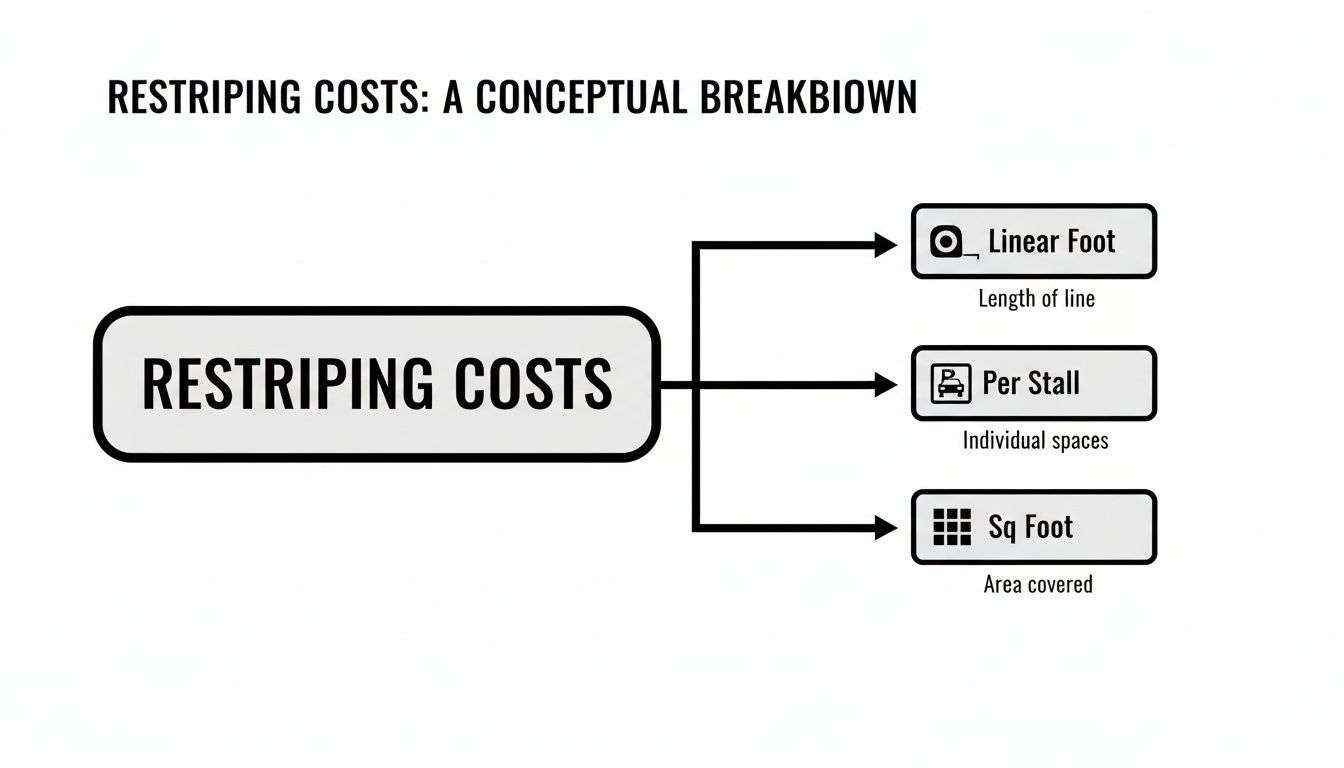
As you can see, each method is chosen to best fit the job at hand, making sure the final quote is a true reflection of the work being done.
Cost Per Square Foot
So, what about those large, solid-painted areas? For those, contractors shift to a "per square foot" model. This is reserved for sections where pricing by the line or by the stall is completely impractical. It’s a lot like buying turf for a yard; the price is all about the total area that needs to be covered.
This pricing method is almost always for specialty markings that demand a ton of paint. It ensures the higher material cost for filling in big zones is accurately accounted for.
You’ll see this model used almost exclusively for:
- ADA Cross-hatching: The blue and white striped "no parking" areas next to accessible stalls.
- Loading Zones: Large, solid rectangles, often with text like "LOADING ONLY."
- Blackout Patches: Sometimes, the easiest way to get rid of old, confusing lines is to just paint over them with black asphalt paint.
By getting familiar with these three pricing models, you can look at any proposal and know exactly what's behind the numbers. It gives you the confidence to compare bids accurately and understand how your total parking lot restriping cost was calculated.
What Really Drives Your Final Project Cost?
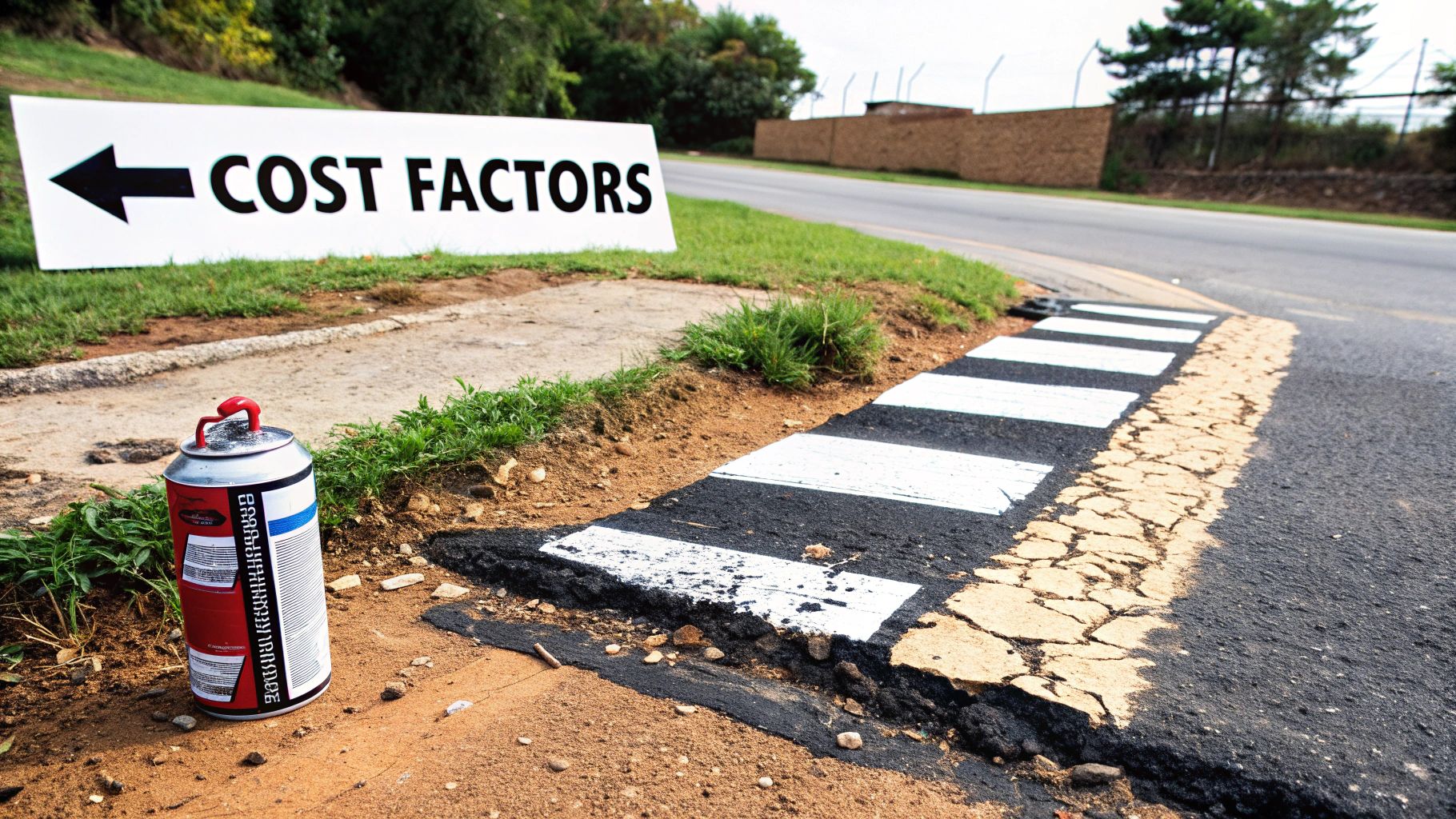
While the pricing models we've covered give you a great starting point, they don't paint the full picture. Several key factors can dramatically shift your final parking lot restriping cost, turning a ballpark figure into a detailed, project-specific proposal. Think of it like buying a car—the sticker price is just the beginning. The features you add and the condition it's in determine the real cost.
These variables are all about the unique character of your property. We're talking about everything from the current state of your asphalt to the specific markings required by law. Getting a handle on these factors is the best way to budget accurately and avoid any last-minute surprises.
Pavement Condition and Prep Work
The single biggest cost driver is the condition of your parking lot's surface. It all comes down to this: a clean, smooth surface grips paint properly and makes the job last. On the other hand, a neglected lot requires a lot of prep work, and that adds both time and labor to the bill.
It's like trying to paint a dusty, cracked wall versus one that's been properly primed and cleaned. The effort and the final result are worlds apart. The same logic holds true for your asphalt.
Here's what that prep work often involves:
- Power Washing: Essential for blasting away the dirt, oil spots, and grime that prevent new paint from bonding to the asphalt.
- Crack Filling: We have to seal up any small cracks to stop water from seeping in, which can destroy both the paint and the pavement underneath.
- Line Grinding/Removal: If your old paint is flaking off or you're changing the layout, the old lines have to be ground away or blacked out. This is a tough, labor-intensive job.
Simply put, a lot that needs a deep clean and serious repairs will cost more to restripe than one that's already in great shape.
Layout Complexity and Custom Stencils
Not all parking lots are a simple grid of rectangles. The more complex and intricate your layout, the more time and skill it demands from the striping crew. A straightforward lot full of 90-degree stalls is a much quicker job than one with angled spaces, multiple crosswalks, and specific traffic flow patterns.
Custom stencils are another element that adds to the cost. Standard markings like "NO PARKING" or the handicap symbol are part of the routine. But when you need something unique, it requires special attention.
Every custom touch, from a "RESERVED FOR CEO" stencil to a branded logo in your visitor spots, needs to be custom-made and applied with precision. That extra work and material will show up on the final invoice.
For instance, a retail center that wants its company logo painted in prime visitor spots will face a higher cost than a property using only standard, universally understood markings. The more unique your design, the more you should expect to invest. To get a better sense of the techniques involved, you can explore a detailed guide on how to stripe parking lots here.
ADA and Fire Lane Compliance
This one is non-negotiable. Following the rules set by the Americans with Disabilities Act (ADA) and local fire codes is an absolute must. These markings are more than just paint on the ground; they are legally required safety features that have to meet strict specs for size, color, and placement.
- ADA Stalls: These require specific dimensions, specially marked access aisles (often priced by the square foot), and proper signage.
- Fire Lanes: Have to be a specific color (usually red or yellow) and width, and often need stenciling that reads "FIRE LANE – NO PARKING."
Getting these wrong can lead to some hefty fines, which is why hiring a pro is so important. The precision, extra materials, and specialized knowledge required mean these compliant markings are priced higher than standard parking lines.
Paint and Material Types
The type of paint you select directly influences both your upfront cost and how long the job will last. It's the classic trade-off: save money now, or save time and money on future maintenance.
| Material Type | Upfront Cost | Durability/Lifespan | Best For |
|---|---|---|---|
| Water-Based Traffic Paint | Low | 1-2 Years | Standard restriping, budget-conscious projects. |
| Solvent-Based Traffic Paint | Medium | 2-3 Years | Higher traffic areas, better resistance to oil. |
| Thermoplastic | High | 5-8+ Years | High-traffic intersections, crosswalks, stop bars. |
Going with a basic water-based paint keeps the initial parking lot restriping cost low, but be prepared to repaint more often. Choosing a heavy-duty material like thermoplastic costs more out of the gate but gives you a much longer service life, meaning fewer repaint jobs down the road.
Real-World Cost Examples for Houston Properties
Theories and pricing models are great, but nothing beats seeing how the numbers play out in the real world. To give you a solid feel for your potential parking lot restriping cost, I've put together three common scenarios you'd find right here in the Houston area.
Think of these as benchmarks. By comparing your property to these examples, you’ll get a much clearer picture of where your project might land on the cost spectrum. Each one highlights different challenges, from a simple repaint to a complex layout with heavy compliance requirements.
Sample Houston Restriping Project Cost Estimates
Here's a quick side-by-side comparison of estimated costs for three typical commercial properties in Houston. This table shows just how much size, layout, and special markings can influence the final price tag.
| Property Type | Parking Stalls | Key Features | Estimated Cost Range |
|---|---|---|---|
| Small Retail Strip | 30 | Standard stalls, 2 ADA spaces, fire lane curb. | $450 – $750 |
| Medium Corporate Campus | 200 | 8 ADA spaces, crosswalks, directional arrows. | $1,800 – $3,200 |
| Large Industrial Facility | 150 | Heavy-duty truck lanes, loading zones, walkways. | $3,500 – $6,000+ |
As you can see, it's not just about the number of stalls. The complexity of the job—from ADA compliance to heavy-duty industrial markings—plays a massive role in determining the final investment.
Scenario 1: Small Retail Strip in Montrose
Picture a small retail strip or a quick-service restaurant with a parking lot that's seen better days. The lines are faded from the Texas sun and constant traffic, making the lot look a bit neglected and confusing for drivers.
- Scope of Work: Repainting the existing layout of 30 standard parking stalls.
- Key Features: This includes restriping 2 ADA-compliant accessible spaces with access aisles and refreshing a small "NO PARKING" fire lane curb. The pavement is in good shape, so only light power washing is needed to prep the surface.
- Estimated Cost Range: $450 – $750
For a property this size, the cost is driven mostly by the per-stall price. The ADA markings and fire lane add a little to the total, but the job is straightforward. It’s a perfect example of routine maintenance that delivers a huge visual impact for a relatively small investment.
For small business owners, regular restriping is one of the most cost-effective ways to boost curb appeal. A clean, well-marked lot sends a clear message of professionalism and care before customers even walk through the door.
Scenario 2: Medium Corporate Campus in the Energy Corridor
Now, let's look at a medium-sized office building or corporate campus. The lot here is much larger and more complex, built to handle a steady flow of employees and visitors every day. This project is about more than just stalls; it's about guiding traffic safely and efficiently.
- Scope of Work: Restriping 200 parking stalls, including designated visitor and employee sections.
- Key Features: The job involves repainting 8 ADA stalls, multiple crosswalks for pedestrian safety, and several directional arrows. It also requires refreshing the stop bars at key intersections within the lot.
- Estimated Cost Range: $1,800 – $3,200
Here, the project scope expands significantly. The stall count is a major factor, of course, but the numerous stencils (like arrows) and the linear footage of the crosswalks and stop bars really start to add up. This isn't just a simple refresh; it's about maintaining a complex traffic management system.
Scenario 3: Large Industrial Facility near the Ship Channel
Finally, imagine a large warehouse or industrial facility where safety and logistics are everything. These lots handle heavy-duty traffic, including semi-trucks, and need durable, highly visible markings to prevent accidents and keep operations running smoothly.
- Scope of Work: Restriping 150 standard employee stalls along with a host of specialized logistical markings.
- Key Features: The complexity here comes from the specialized needs: wide, heavy-duty truck lanes, designated loading dock zones, pedestrian safety walkways, and custom stencils like "TRUCK ENTRANCE." Because of the constant wear from heavy trucks, a more durable, solvent-based paint is a must.
- Estimated Cost Range: $3,500 – $6,000+
In this industrial scenario, the parking lot restriping cost is all about the heavy-duty nature of the work. Even though the stall count is lower than the corporate campus, the cost per linear foot for those robust truck lanes, plus the price for custom stencils, makes it a much bigger project. Opting for premium paint that can withstand industrial traffic also adds to the overall investment.
Viewing Restriping as an Investment, Not an Expense
It's tempting to see a quote for restriping and mentally file it under "another expense." But if you're a property manager, shifting that perspective is one of the smartest moves you can make. Fresh, clear lines aren't a cost center; they’re a strategic investment in your property's value, safety, and reputation.
Think about it: your parking lot is the very first thing people see. It’s the handshake before they even walk through the door. Faded, cracked, or confusing markings instantly create a poor first impression, suggesting a lack of care before a customer or tenant even steps inside. On the other hand, crisp, professional striping sends a clear message of quality, organization, and a commitment to safety.
Protecting Your Biggest Asset
Let's not forget the substantial cost to build a parking lot in the first place. When you look at it from a long-term perspective, the price of routine maintenance like restriping is just a tiny fraction of that foundational investment, but it plays a huge role in protecting it.
Economic studies on parking supply show that constructing a single surface parking space can cost anywhere from $4,282 to $8,000, once you factor in land and construction. Restriping that same space might only cost between $5 and $20 every few years. That’s a tiny price to pay to maintain an asset worth thousands. You can explore more on the economic value of parking maintenance and its lifecycle costs.
This proactive approach does more than just protect the physical asphalt; it safeguards your property's overall value and appeal.
A well-maintained parking lot is a direct reflection of how you manage the entire property. It's a small detail that has a massive impact on perception, tenant satisfaction, and customer confidence.
The Tangible Return on Investment
Beyond just looking good, the ROI of regular restriping shows up in several critical areas of your day-to-day operations. Each of these benefits directly contributes to a healthier bottom line and significantly reduced risk.
Here’s where you’ll actually see the return:
- Enhanced Safety and Reduced Liability: Clear markings for traffic flow, pedestrian crosswalks, and stop bars are essential for preventing accidents. This clarity minimizes the risk of everything from minor fender-benders to serious pedestrian incidents, all of which can lead to costly insurance claims.
- Maximized Parking Capacity: When lines are faded, drivers get sloppy. They park at odd angles and take up more than one spot, wasting valuable space. Well-defined stalls ensure you're using every square foot of your lot, maximizing the number of cars you can accommodate.
- Compliance and Fine Avoidance: The penalties for not complying with ADA and fire code regulations can be staggering. A single fine for an improperly marked ADA space or a blocked fire lane can easily cost more than the entire restriping project itself.
- Improved Curb Appeal: A sharp-looking lot is a magnet for business. For retail centers, it creates a welcoming environment that encourages customers to pull in. For commercial or multi-family properties, it helps attract and retain the high-quality tenants you want.
Ultimately, seeing the parking lot restriping cost as a proactive investment is a fundamental mindset shift. It’s a predictable, manageable expense that pays for itself over and over by protecting your property, mitigating risks, and making your business more efficient and inviting.
How to Get a Fast and Accurate Restriping Quote
Getting a solid, reliable quote for your parking lot project shouldn't be a drawn-out headache. With a little bit of prep work on your end, you can give a striping contractor everything they need to nail down a precise estimate. This avoids the frustration of vague numbers and surprise costs later on.
Think of it this way: you wouldn't ask a mechanic for a repair quote without telling them the make, model, and what the car is doing. The more details you provide upfront about your parking lot, the faster and more accurately a pro can diagnose the job and write up a quote you can trust.
Step 1: Document Your Project Details
Before you even make a call, take a quick walk around your property. A simple inventory of what’s there is the bedrock of any good quote and immediately tells a contractor the scope of your project. The more specific, the better.
Try to jot down these key numbers:
- Total Number of Stalls: Get a quick count of all the standard parking spots.
- ADA Spaces: Note how many handicap-accessible stalls you have, as these have special requirements.
- Special Markings: List out everything else—directional arrows, "NO PARKING" stencils, crosswalks, you name it.
- Linear Footage: If you can, estimate the length of any fire lanes or curbs that need a fresh coat of paint.
Having these details ready makes the whole process smoother and helps calculate your initial parking lot restriping cost with far greater accuracy.
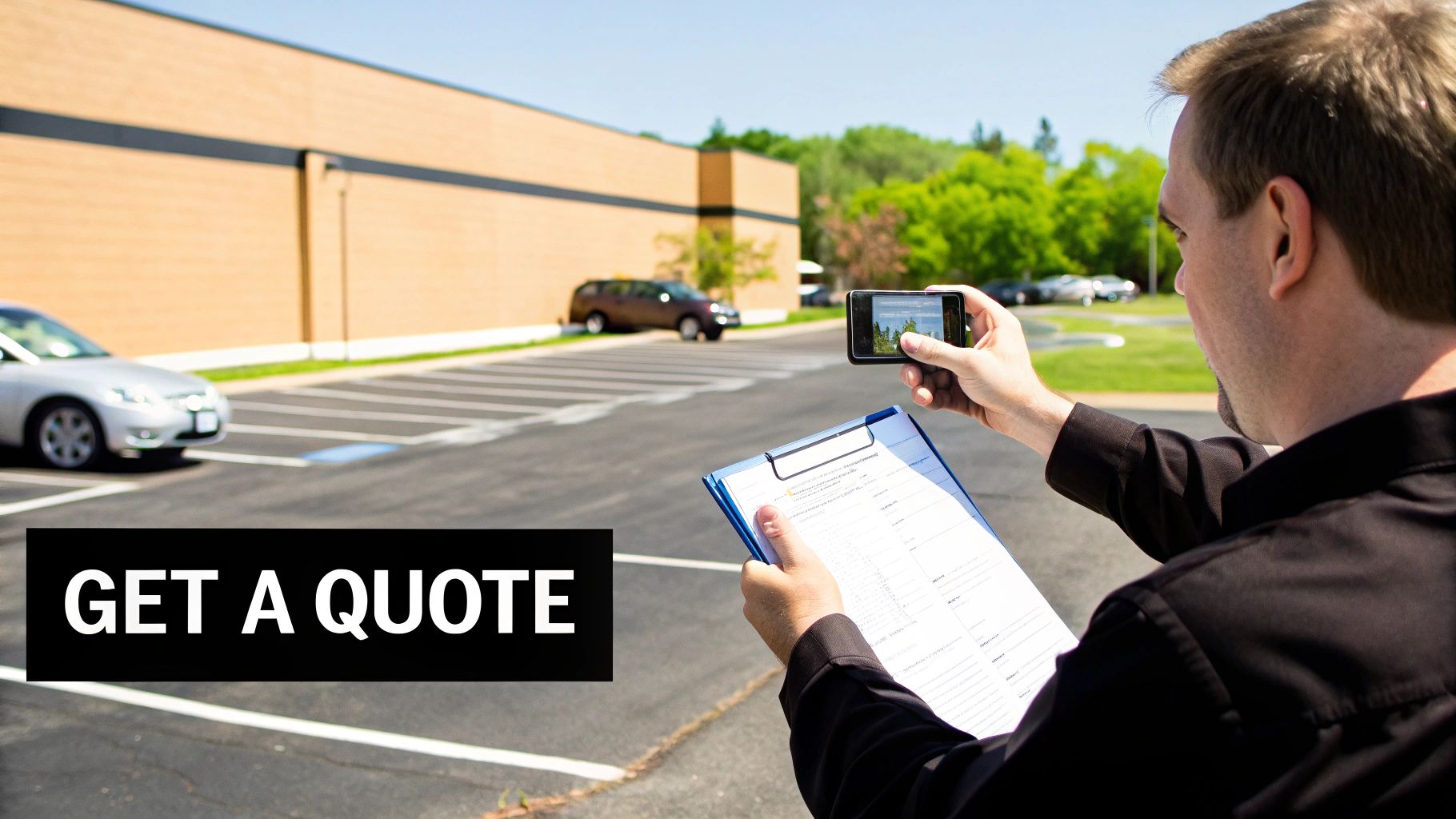
Step 2: Capture Clear Photos of Your Lot
When it comes to assessing pavement, a picture is absolutely worth a thousand words. Good photos can tell a contractor almost everything they need to know about the prep work involved, which is a huge part of the final price.
Grab your smartphone and snap several pictures. Make sure you get wide shots of the whole lot and then zoom in on any problem areas.
Providing clear, well-lit photos of your lot—including close-ups of cracked paint, oil stains, or faded lines—is the single best way to get a fast and accurate remote estimate without needing an immediate site visit.
Be sure to capture any peeling paint, faded lines, significant cracks, or nasty oil stains. This visual evidence helps a contractor see what they're up against and determine if power washing, grinding, or other surface prep is needed for the new paint to stick.
Step 3: Define Your Project Goals
Finally, get clear on what you actually want to accomplish. Is this just a quick touch-up, or are you looking for a complete overhaul? Knowing your end goal helps the contractor recommend the right materials and plan of attack. You can see the full range of possibilities on our pavement marking services page.
Ask yourself a few key questions:
- Is this a simple re-stripe? Are you just looking to trace over the existing, faded lines to make them pop again?
- Do you need a new layout? Are you trying to reconfigure the space to improve traffic flow or squeeze in a few more parking stalls?
- Are there compliance issues to address? Do you need to add or modify ADA stalls or fire lanes to get up to current code?
By gathering these details, taking a few photos, and defining your goals, you’ve done most of the heavy lifting. You're now ready to have a truly productive conversation with a contractor and get a quote that is both fast and perfectly matched to your needs.
Got Questions About Restriping Costs? We've Got Answers.
Even after breaking down the numbers, you probably still have a few questions about your specific project. That's completely normal. Here are some straightforward answers to the most common things we get asked by Houston property managers.
How Often Should I Be Restriping My Lot?
A good rule of thumb is to restripe your parking lot every 18 to 24 months. But let's be realistic—that's just a starting point.
Think about a busy retail center baking in the Houston sun. That lot might need a fresh coat every year to stay sharp and safe. On the flip side, a quiet office park with minimal traffic could easily go three years. The real test? Just look at your lot. If the lines are faded and hard to see, it’s time to call in the pros, no matter what the calendar says.
Does the Time of Year Change the Price?
It sure can. The season affects not just the cost but the quality of the job itself. Here in Houston, spring and fall are prime time for striping. You get those perfect moderate temperatures and lower humidity, which is exactly what paint loves. For the best results, you need the asphalt to be over 50°F and a clear forecast for at least a day.
Trying to stripe in the dead of a Houston summer can make the paint dry too fast and not bond correctly. In the winter, the cold can keep it from curing at all. While you might find some flexibility on price during the off-season, the weather is the one thing you can't compromise on.
Can I Just Paint Over the Old, Peeling Lines?
You can, but you'll regret it. Just slapping a new coat of paint over cracked and flaking lines is throwing money away. New paint needs a solid, clean surface to grab onto.
If your old lines are failing, they have to be removed first, usually by grinding or water blasting. Yes, this adds to the initial parking lot restriping cost, but it's a non-negotiable step for a job that lasts. If you paint over a bad foundation, your new lines will start peeling off right along with the old ones, and you'll be right back where you started in a few months.
Is it Cheaper to Stick with the Same Layout?
Without a doubt. A simple "re-stripe" over the existing layout is always your most budget-friendly option. It's a clean, efficient process where the crew just traces the faded lines. It keeps labor time and prep work to a minimum.
Things change when you want to alter the layout—maybe to squeeze in more stalls or fix a traffic flow issue. This involves blacking out or grinding off the old markings and then meticulously laying out the new design from scratch. It’s a much more involved job that naturally comes with higher labor and material costs.
Why Can't I Just Handle the ADA Markings Myself?
ADA compliance is a minefield of hyper-specific rules. We're talking exact dimensions for stalls, access aisles, and precise placement for signage. It’s not something you can just eyeball.
Getting it wrong can lead to hefty fines and serious legal headaches. A professional striping company lives and breathes these federal and local ADA codes. They ensure your property is compliant, safe, and accessible for everyone. It’s a small investment to protect yourself from major penalties and show your community you care.
Ready to get a clear, accurate quote for your property? The team at Houston Parking Lot Striping has the experience to handle projects of any size, ensuring your lot is safe, compliant, and professional. Contact us today for a free, no-obligation estimate!
Article created using Outrank