
Fire lane signage: Essential Guide to Safety and Compliance
Fire lane signage is far more than a bureaucratic box to check—it’s a critical lifeline that gives first responders immediate, clear access when seconds count. Properly marked fire lanes can drastically cut down emergency response times, which is often the deciding factor between a minor incident and a full-blown catastrophe. For property managers, business owners, and contractors, understanding and implementing these regulations is a non-negotiable part of ensuring public safety and avoiding significant liability.
Why Clear Fire Lane Markings Are Non-Negotiable
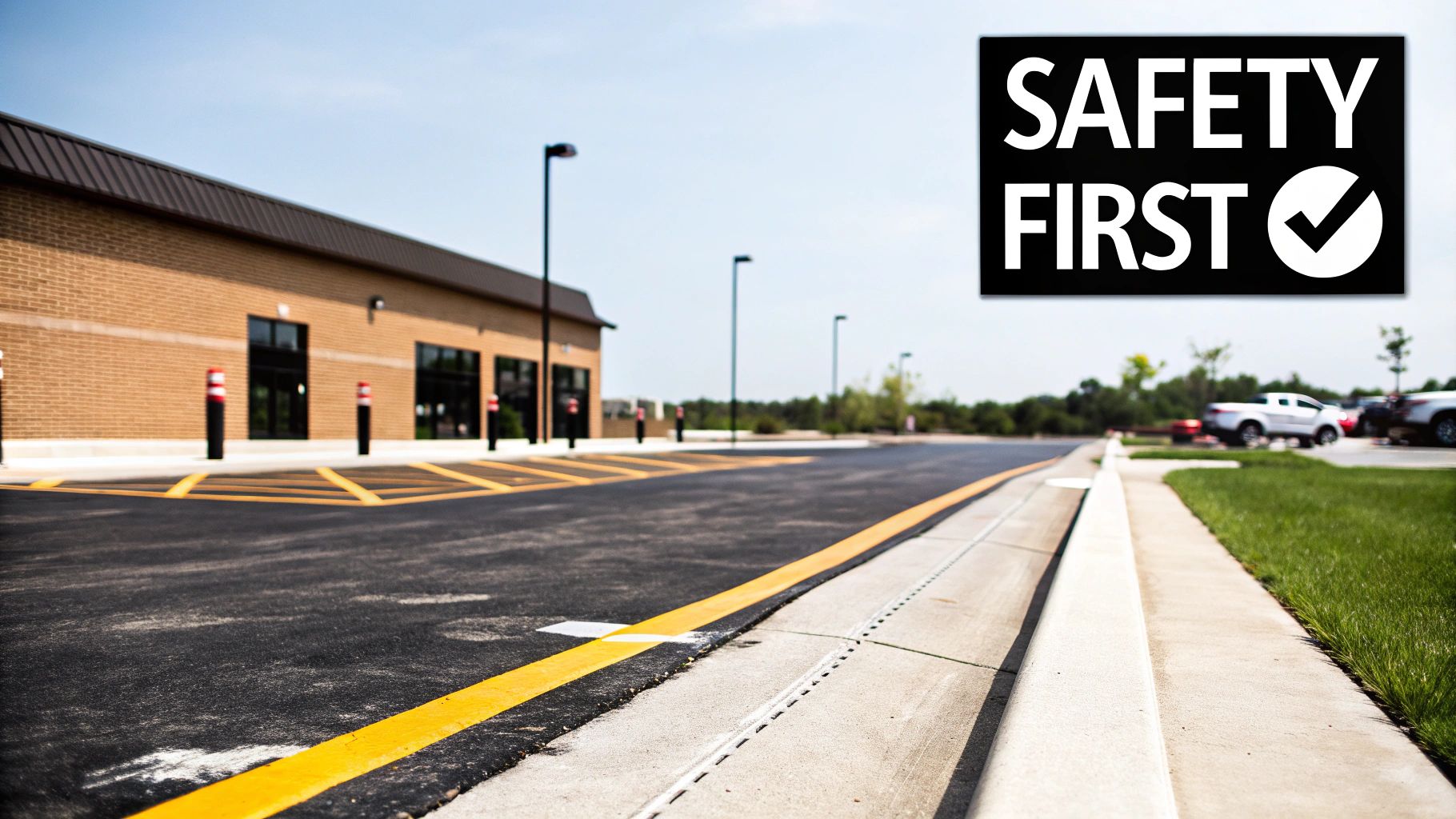
When an emergency call goes out, every moment is critical. Fire trucks, ambulances, and police cars need a guaranteed, unobstructed path to get to the scene. A fire lane is that dedicated access route, making sure first responders aren't held up by a delivery truck, a carelessly parked car, or any other blockage.
Think of it as the property's emergency artery. If it’s clogged, the entire response is put in jeopardy. This goes way beyond avoiding a simple parking ticket; it's a fundamental piece of any building's safety infrastructure, and its proper implementation is a legal requirement. A well-designed and clearly marked fire lane system is the first line of defense in protecting lives and property.
Beyond Fines: The Real Risks of Non-Compliance
While fines and having vehicles towed are the most obvious penalties for ignoring fire lane rules, the real costs can be far more devastating. A blocked fire lane directly delays emergency response, which puts tenants, employees, and customers in real danger. The legal and financial ramifications for a property owner can be catastrophic if negligence is proven.
Just imagine the potential outcomes:
- Delayed Medical Aid: Paramedics might have to haul heavy equipment across a parking lot on foot, losing precious time during a heart attack or other medical crisis.
- Increased Fire Damage: When firefighters can't get their truck close to a building, they lose critical time and pressure deploying hoses. A small, containable fire can quickly escalate into a massive, destructive blaze.
- Serious Liability: If a blocked fire lane is found to have contributed to injury, significant property damage, or even loss of life, the property owner can face staggering legal and financial consequences, including lawsuits and increased insurance premiums.
When an emergency hits, first responders don't have time to weave through a maze of parked cars. A clearly marked and enforced fire lane is a silent promise that you've given them the access they need to do their jobs and save lives.
An Essential System for Property Safety
Effective fire lane markings create an intuitive visual system that communicates clearly to both the public and emergency personnel. It's not enough to just stick a sign in the ground; the entire designated area needs to be unmistakably defined to prevent any confusion and ensure full legal compliance.
This system relies on a combination of powerful visual cues:
- Highly Visible Signs: Signs posted at regular intervals must explicitly state "NO PARKING – FIRE LANE" to eliminate any ambiguity. These are the primary legal notification to drivers.
- Distinct Pavement Markings: Bright red curbs or bold, stenciled lettering painted directly on the pavement create a clear visual boundary for the restricted zone, reinforcing the message of the signs.
- Unobstructed Clearance: The lane itself must remain completely clear of any physical barriers, from overgrown trees to dumpsters, ensuring there's enough vertical and horizontal space for the largest emergency vehicles to pass through safely.
Ultimately, investing in proper fire lane signage isn't an expense—it's an investment in safety, compliance, and peace of mind. It shows a genuine commitment to protecting your property and, more importantly, the people who rely on it every single day.
Getting the Sign and Material Specs Right
When it comes to fire lane signs, there's no room for guesswork. Choosing the right one isn't like picking from a catalog; you're dealing with specific, non-negotiable details that are critical for legal compliance and, more importantly, for safety during an emergency.
Every single element—from the exact dimensions to the reflective coating—is there for a reason. These specs are born from safety science, designed to be seen and understood under the worst possible conditions. Getting it wrong isn't a small mistake. A non-compliant sign is a weak link in your property's safety chain, one that will get you flagged by a fire marshal and could be missed by first responders when seconds count.
The Anatomy of a Compliant Sign
A proper fire lane sign has a specific look, and every detail is intentional. The design isn't about aesthetics; it's about immediate recognition and legibility, whether it's broad daylight or the middle of a stormy night. Think of it as a universal language for emergency crews.
The classic red-on-white color scheme, for instance, isn't just a tradition. It's one of the highest-contrast combinations possible, making the text leap out from a distance.
Here’s what you need to look for:
- Standard Dimensions: The go-to size is 12 inches wide by 18 inches high. This is the sweet spot—large enough to be spotted from a moving vehicle but not so big it becomes a clunky obstruction.
- Color Scheme: The lettering must be a bold, unmistakable red on a clean white background. No exceptions. This provides the contrast needed for quick reading.
- Required Text: You’ll almost always see "NO PARKING – FIRE LANE". Depending on your local jurisdiction, you might also need to include towing warnings or other specific language to make the rules crystal clear.
These standards are spelled out in fire codes to create uniformity and eliminate any confusion on the ground. The International Fire Code (IFC), for example, is very particular about this. Section 503 of the IFC requires that fire lanes provide access within 150 feet of all parts of a building's exterior—a rule directly tied to the reach of a standard fire hose. You can learn more about these foundational regulations that ensure firefighter access.
Why Material and Reflectivity Are Deal-Breakers
Beyond the visual specs, the actual materials your sign is made from will determine its lifespan and effectiveness, especially in a place like Houston. If you opt for the right materials from day one, you avoid the premature fading, rust, and cracking that can make a sign useless and non-compliant in no time.
The material choice is directly linked to visibility. A sign that disappears at night or during a heavy Texas downpour is as good as no sign at all.
A non-reflective sign might save you a few dollars upfront, but it creates a huge safety liability. During a nighttime emergency, firefighters scanning the property with spotlights need signs that shine back, instantly confirming their access route.
Here are the material factors that really matter:
- Substrate Material: The industry standard is rust-proof aluminum, and for good reason. It’s light, tough, and stands up to Houston’s humidity without corroding. Cheaper plastics get brittle and crack under our intense sun, and steel signs will rust the second their coating gets scratched.
- Reflective Sheeting: This isn't optional—the sign's background must be reflective. At a bare minimum, you need Engineer Grade sheeting. But for high-traffic areas or properties with tricky layouts, I always recommend upgrading to High-Intensity Prismatic (HIP) sheeting. It offers far better visibility from wider angles, ensuring the sign catches headlights and emergency lights effectively.
Choosing quality materials means your investment in safety and compliance will actually last. A good aluminum sign with high-grade reflective sheeting can serve you well for years, while a cheap one might need replacing after just a season or two. This same long-term thinking should apply to your pavement markings, where durable options like thermoplastic striping will always outperform standard paint.
Mastering Sign Placement and Pavement Markings
A perfectly spec'd sign is a great start, but it's only half the battle. If it’s mounted too low, hidden behind a newly grown hedge, or spaced too far apart, it simply won't do its job. A truly effective fire lane is a complete system where your signs and pavement markings work together to create an undeniable, legally enforceable boundary.
This is where the boots-on-the-ground details really matter. We’re not just putting up signs; we're strategically mapping the entire fire lane to eliminate any confusion for drivers and, more importantly, for first responders in an emergency. Every single element, from the sign's height off the ground to the width of the paint on the curb, is a critical piece of the puzzle.
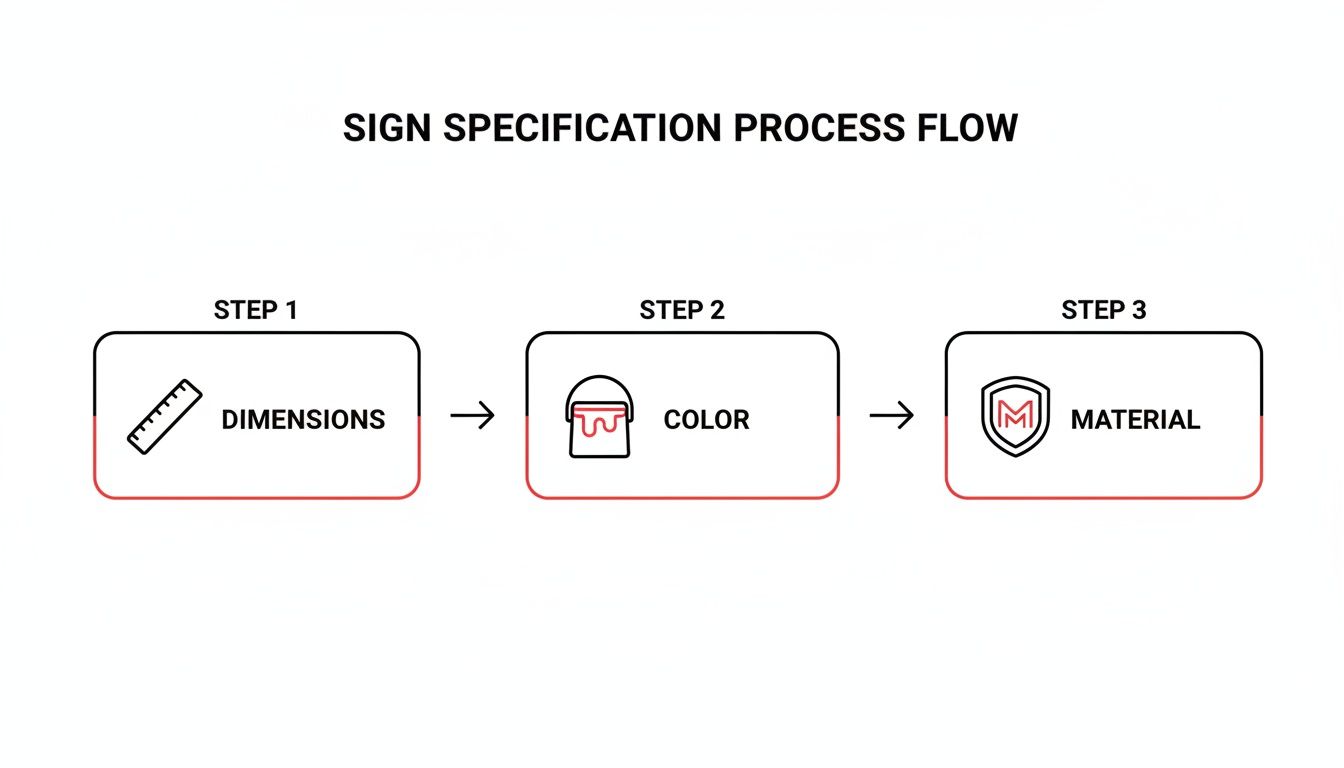
This process shows how the core specs—dimensions, color, and material—build on each other. Getting these right is the foundation for a sign that’s visible, durable, and ready for installation.
Strategic Sign Placement Rules
Where you put your signs is just as important as what they say. The rules are all designed around one thing: maximum visibility from the driver's seat. Picture a busy retail center on a Saturday afternoon; your signs have to cut through the noise and be impossible to miss.
Here are the non-negotiable placement rules I always follow:
- Consistent Spacing: Signs need to be posted at regular intervals along the entire length of the fire lane. The standard is typically every 25 to 50 feet. This ensures that no matter where someone might think about stopping, a clear warning is always in their line of sight.
- Clear Height Requirements: The bottom edge of the sign must be 7 feet above the ground or curb. This specific height puts it well above most parked cars and makes it easy to see for drivers in everything from a small sedan to a large delivery truck.
- Proximity to Curb: Always place signs within a few feet of the fire lane's edge. This direct physical association reinforces the boundary you've established with your pavement markings.
A sign placed 100 feet from the last one creates a dangerous gray area. In that gap, a driver can plausibly claim they didn't see a sign. Tight, consistent spacing removes all doubt and makes the no-parking rule absolute.
Creating an Unmistakable Visual Boundary
Pavement markings are the other half of this critical safety system. While signs provide the explicit "thou shalt not" warning, the paint on the ground creates the bold, physical line that no one can ignore. These markings have to be bright, crisp, and uniform to be effective.
Think about it like this: when laying out a fire lane for a new property, the first thing we do is establish a continuous, unbroken line that follows the entire designated route. This includes navigating around corners and across driveways.
Your essential pavement markings must include:
- Red Curb Painting: A solid 6-inch wide red stripe painted along the top and face of the curb is the gold standard. That vibrant color is universally recognized as "do not enter, do not stop."
- Stenciled Lettering: In addition to the red curb, large stenciled letters spelling out "NO PARKING FIRE LANE" must be painted directly on the pavement. These letters should be at least 4 inches tall and spaced at regular intervals, often between your posted signs. Repetition is key for enforcement.
This powerful one-two punch of signs and markings creates a complete communication system. It clearly tells every driver, "This space is reserved for emergency vehicles only." For a deeper look into the techniques for applying these markings, check out our guide on how to stripe parking lots.
To help you stay on track, I've put together a quick checklist that covers the key placement requirements based on the International Fire Code (IFC) and includes a few practical tips I've picked up over the years, especially for properties in Houston.
Fire Lane Signage and Marking Placement Checklist
| Requirement | IFC Standard Specification | Houston Pro-Tip |
|---|---|---|
| Sign Spacing | Signs posted at intervals not exceeding 50 feet. | I recommend aiming for 25-30 feet in high-traffic commercial lots. It leaves zero room for excuses. |
| Sign Mounting Height | Bottom of the sign must be 7 feet above the grade. | Always measure from the surface the sign is over. If there's a curb, measure from the top of the curb, not the street. |
| Curb Marking | Curbs painted a continuous red color. | Use high-quality, traffic-rated acrylic paint. Cheaper paint will fade in the Texas sun within a year and you'll be repainting. |
| Pavement Stencils | "NO PARKING FIRE LANE" in 4-inch (or larger) white or red letters. | Position stencils where headlights will illuminate them at night. Placing one directly across from a lot entrance is always a good move. |
This checklist is a great field reference to ensure your layout is compliant before the final inspection. Keeping these points in mind from the start saves a lot of headaches later.
Tackling Tricky Spots in Your Layout
Of course, not all fire lanes are simple, straight lines. I’ve seen it all—tight corners, intersecting driveways, and landscaping that seems designed to block sign visibility. These tricky spots require some extra thought to maintain a clear, continuous, and compliant path.
Here’s how to handle common layout challenges:
- Corners and Curves: Don't let the markings get sloppy here. Ensure the red line follows the curve tightly. Crucially, place a sign at the beginning of the curve and another at the end. This prevents drivers from thinking the fire lane designation stops at the turn.
- Entrances and Exits: A fire lane must remain unbroken, even across access points. Use dashed red lines to continue the boundary across driveways. This maintains the visual continuity without impeding normal traffic flow.
- Hydrant Zones: The area around a fire hydrant is sacred ground. Mark out a 3-foot radius around the hydrant with red paint or hash marks to keep it completely clear of any obstruction.
By carefully addressing these problem areas, you ensure your entire fire lane is functional, not just the easy straightaways. This is the kind of attention to detail that keeps a property truly safe and ready for any emergency.
Meeting the Fire Marshal: Houston's Local Codes and Inspections
While national standards like the International Fire Code (IFC) give you a solid baseline, it’s the local fire marshal who has the final word on your property. Here in Houston, that means knowing the specific interpretations and enforcement priorities of the Houston Fire Department (HFD). They aren't just ticking off boxes on a form; they’re ensuring the code works in the real world, and their approval is the only one that truly matters.
Think of the IFC as the textbook. The local fire marshal? They're the professor who writes—and grades—the final exam. Their entire job is to guarantee the intent of the code is met, which is to provide completely unobstructed emergency access on your specific property. This is exactly why a cookie-cutter approach to fire lane signage and markings almost always fails.
What Houston Fire Marshals Really Look For
After years of working directly with HFD inspectors, I can tell you they have an incredibly sharp eye for details that most people would walk right past. They're trained to see your property through the eyes of a first responder arriving at a chaotic emergency scene. It isn't just about having signs up; it's about whether those signs and markings create a clear, foolproof system that works under pressure.
Here are a few of the non-negotiables that are always on their checklist:
- Precision is Everything: They will show up with a tape measure. A sign mounted at 6 feet 10 inches instead of the required 7 feet is an automatic failure. A fire lane that narrows from a compliant 26 feet to 24 feet even for a short stretch will be flagged immediately.
- Don't Forget to Look Up: Inspectors always check for vertical clearance. Overhanging tree limbs, low-hanging awnings, or architectural features must provide at least 13.5 feet of clear space for the full height of a ladder truck.
- A Clear, Continuous Path: They will walk the entire fire lane from entrance to exit. Any abrupt dead ends, confusing turns, or breaks in the striping are major red flags that signal a failed inspection.
A fire marshal's mindset boils down to one critical question: "If I arrived here at 2 a.m. in pouring rain with sirens blaring, could I get my largest vehicle to any point of this building without a moment's hesitation?" If the answer isn't a definitive "yes," you won't pass.
The Permit and Inspection Process
For any new construction or significant parking lot redesign in Houston, your fire lane plan is a mandatory part of the site plan you submit for permits. Both the city's planning department and the fire marshal's office review these blueprints before a single cone is set out. Trying to install a fire lane without getting that initial sign-off is just asking for expensive rework down the road.
Once the striping and signage are installed, you have to schedule the final inspection. This is the moment of truth. The fire marshal will walk the property to verify that what was built perfectly matches the approved plans and meets every local code requirement.
To keep things moving smoothly, make sure you have your paperwork in order.
Your Inspection Day Checklist:
- Approved Site Plans: Have a clean copy of the city-stamped plans on-site.
- Permit Number: Keep your permit information handy and ready to go.
- Material Specs: For larger jobs, it’s a good idea to have the spec sheets for your paint and sign materials to prove they meet durability and reflectivity standards.
Passing this inspection is a critical milestone for receiving your Certificate of Occupancy. A failure means delays, and for any commercial project, delays mean money. Getting these details right from the start isn't just about compliance—it's the most cost-effective way to get the job done. This level of scrutiny applies to other markings as well; you can see a similar focus on detail when it comes to handicap parking signage requirements.
Avoiding Common Violations and Keeping Your Property Compliant
Getting your fire lane painted and signs installed is a huge milestone, but the job isn't over. Think of fire lane compliance as an ongoing responsibility, not a one-and-done project. Day after day, the elements, vehicle traffic, and even landscaping work to quietly turn a perfectly compliant lane into a violation just waiting for a citation.
Staying on top of this is about more than just dodging fines—it’s a fundamental part of keeping your property safe. A faded sign, a chipped curb, or an overgrown tree branch can create just enough confusion to cause a dangerous delay during an emergency. By getting ahead of these common issues, you ensure your property remains accessible for first responders when every second counts.
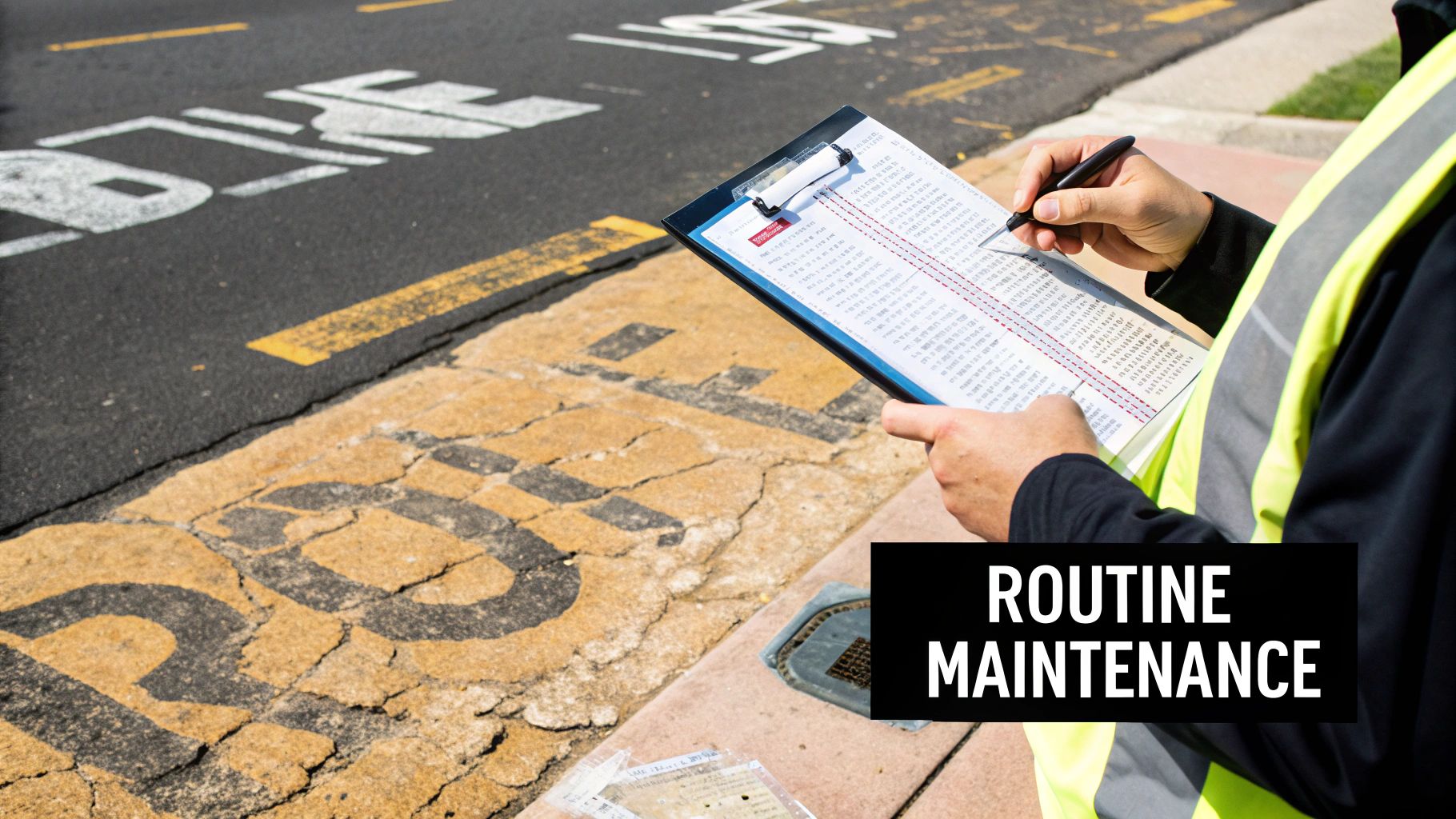
Uncovering the Most Frequent Violations
From my experience in the field, most violations aren't intentional. They almost always boil down to simple neglect. These are the small oversights we see constantly that can lead to failed inspections and serious safety risks.
- Faded and Damaged Signs: The Houston sun is brutal. It can bleach a vibrant red sign to a dull, barely-visible pink in just a few years. On top of that, signs get bent, covered in grime, or vandalized, making them completely useless.
- Obscured Markings and Signage: This is a classic "out of sight, out of mind" problem. A new shrub planted too close to a sign can swallow it up in a single growing season. Piles of leaves, construction debris, or mud can completely hide pavement stencils and red curbs.
- Incorrect Sign Mounting Height: This one sneaks up on people. A sign that was once perfectly compliant can become a violation over time. Settling soil can cause a post to sink, dropping the sign below the required 7-foot clearance. Likewise, repaving a parking lot can raise the ground level, which has the same effect.
The good news is that these are all easily preventable with a solid maintenance plan. When you know what to look for, you can catch these problems long before a fire marshal does.
The Real Cost of Non-Compliance
Ignoring fire lane maintenance has serious consequences for both your wallet and your liability. The data doesn't lie—there's a direct link between clear fire lane signage and better outcomes in an emergency. The International Fire Code (IFC), which is the standard in over 45 states, mandates specific 12×18-inch reflective signs for a reason: 100% visibility at night is non-negotiable.
Here in Houston, letting a 20- to 26-foot lane fall out of compliance can lead to tow fees averaging $500 per violation. We've also seen insurance carriers raise premiums by up to 15% after repeated infractions. For warehouses and HOAs, the stakes are even higher. Poorly marked lanes can increase emergency response times by as much as 25%, turning a manageable incident into a multi-million dollar disaster. You can dive deeper into the specific codes driving these statistics by reviewing the Sunland Park Fire Department's detailed guidelines.
Building a Proactive Maintenance Checklist
The best defense is a simple, repeatable inspection routine. Instead of waiting for a violation notice to land on your desk, use this checklist to stay ahead of the game.
Your Biannual Fire Lane Inspection Checklist:
- Walk the Entire Lane: Start at one end and walk the whole thing. Try to see it through the eyes of a driver and a first responder. Are the boundaries obvious and unbroken?
- Inspect Every Sign:
- Visibility: Is the sign faded, covered in dirt, or hit with graffiti?
- Condition: Do you see any bends, dents, or other damage?
- Height: Pull out a tape measure. Is the bottom edge of the sign still at least 7 feet off the ground?
- Obstructions: Are tree branches, bushes, or anything else blocking a clear view of the sign?
- Assess Pavement Markings:
- Color: Is the red curb paint still bright? Is the stenciled lettering crisp and easy to read?
- Condition: Is the paint chipping, peeling, or worn thin from traffic?
- Clarity: Is the lane itself covered by dirt, leaves, or other debris?
- Check for Obstructions:
- Are there any dumpsters, storage pods, or illegally parked cars in the lane?
- Has landscaping crept into the required width of the lane?
- Is the vertical clearance—that crucial 13.5 feet—completely clear of low-hanging branches or wires?
Proactive maintenance is always cheaper than reactive repairs. A scheduled walk-through twice a year can save you thousands in fines, towing fees, and the potential cost of a delayed emergency response.
By documenting what you find and scheduling repairs right away, you create a system that works. This simple habit transforms fire lane maintenance from a stressful, reactive headache into a manageable part of your property's routine, ensuring you stay safe and compliant year-round.
Common Questions We Hear About Fire Lane Signage
When you're dealing with the nitty-gritty of fire lane signage, a lot of questions pop up. Property managers and contractors often hit the same roadblocks, whether it's figuring out maintenance or navigating the permitting process. Here are some straightforward answers to the questions we get asked all the time.
How Often Should I Inspect My Fire Lane Signs and Markings?
I always tell my clients to do a thorough inspection at least twice a year. Here in Houston, the combination of blistering sun and heavy downpours just wreaks havoc on signs and paint. Things fade, chip, and peel a lot faster than you'd think. Catching these small issues early saves you from a much bigger headache and a potential compliance violation down the road.
It's also a good practice to do a quick walk-through after a big storm. You'll be able to spot any immediate damage and make sure your property is always ready for emergency responders.
Can I Install Fire Lane Signage Myself to Save Money?
I understand the temptation to go the DIY route to cut costs, but with fire lane signage, the risks usually aren't worth the savings. The fire code is incredibly precise—we're talking exact sign heights, specific material reflectivity, and placement intervals measured down to the inch.
A single mistake, no matter how small, can lead to a failed fire marshal inspection. That often means redoing the entire job on your own dime and possibly facing fines, which completely wipes out any money you thought you saved. Professional installation ensures it’s done right the first time.
What’s the Biggest Mistake People Make with Fire Lanes?
By far, the most common mistake is thinking of signs and pavement markings as two separate things. A compliant fire lane is a complete system. You need both the clear, reflective signs and the brightly painted curbs or stenciled pavement working together.
One without the other is a recipe for failure. A property with brand-new signs but no painted red curb will not pass inspection because it leaves room for confusion.
Do I Need a Permit for Fire Lane Striping in Houston?
That really depends on the project's scope. If you're looking at new construction or a major parking lot redesign, you absolutely need a permit. The entire site plan, including the fire lanes, has to be reviewed and approved by the fire marshal before you can even start.
For routine maintenance, though—like simply re-striping faded lines or swapping out an old sign with a new one in the exact same spot—you typically don't need a separate permit. But if you're ever unsure, the safest bet is to call the Houston Fire Department and ask. It's always better to be certain.
We're Your Partner in Fire Lane Safety and Compliance
When it comes down to it, keeping your property’s fire lanes compliant is a heavy responsibility. It’s about protecting people, your assets, and the first responders who need immediate access when every second counts. As we’ve covered, getting it right means understanding everything from material science and precise placement rules to the nuances of local codes.
This is a lot more than just painting some lines and putting up a few signs. It's about creating a complete, legally enforceable safety system that will hold up under the worst-case scenario. It can feel like a lot to take on, but you don't have to figure it all out by yourself.
More Than Just a Striping Company
We're not just another pavement marking contractor. Think of us as your dedicated consultants, focused on solving these exact challenges for property managers, general contractors, and business owners across the Houston area. Our team brings over 15 years of direct, hands-on experience to the table, translating complicated fire codes into practical, on-the-ground solutions that work.
I’ve personally seen how a clearly marked fire lane can make all the difference in an emergency, just as I’ve seen how a poorly marked one creates serious risks and liabilities. Our entire goal is to take the guesswork and stress out of this process. We’ll handle the technical details so you can get back to managing your property with total confidence.
Choosing a partner for your fire lane signage and markings is all about trust. You need a team that not only knows the regulations inside and out but also understands how to apply them efficiently to your specific property, ensuring you pass inspection the first time.
A Proven Process That Guarantees Compliance
Our entire approach is built on precision. We follow a systematic process that ensures nothing gets missed, from the first site walk-through to the final sign-off. This method guarantees that every sign, stencil, and curb we paint meets the stringent standards of the Houston Fire Department.
Modern fire lane standards didn't just appear overnight; they're the result of decades of lessons learned from urban fires, which is why both pavement markings and signs are now required for full compliance. In fact, fire department audits show that properly signed lanes can cut down on illegal parking by an impressive 40-50%. With our deep experience serving Greater Houston, we make sure critical access points, like Y or T-shaped turnarounds, are clearly marked to protect commercial properties from violations. You can discover more insights about building access requirements and their history.
We’re firm believers that being proactive is always the best strategy. By catching potential issues before they become violations, we save our clients time, money, and the massive headache of failed inspections.
Let's Make Your Property Safer, Together
Successfully navigating fire lane compliance takes a sharp eye for detail and real expertise. Whether you're developing a new site, managing an existing one, or just getting ready for an upcoming inspection, our team is here to help. We bring the knowledge and skill needed to make sure your fire lanes are clear, compliant, and ready for anything.
If you're ready to get your property up to code, it’s time to talk. Reach out for a consultation, and let’s work together to create a safer environment for everyone.
Ready to guarantee your fire lanes are compliant and inspection-ready? Contact Houston Parking Lot Striping for a free, no-obligation estimate and let our experts handle the details. Visit us at https://houstonparkinglotstriping.com to get started.