

Subcontractor Agreement Template Construction: Protect Projects & Cut Risk
Relying on a handshake deal or a simple one-page invoice just doesn't cut it in today's construction world. To truly protect your projects, manage liability, and make sure everyone is on the same page before the first boot hits the ground, you need a formal, detailed subcontractor agreement template for construction.
Why Your Old Subcontractor Agreement Is a Liability
It wasn't long ago that many general contractors and paving specialists could get by on trust and basic paperwork. A quick scope of work and a price seemed to be enough. Those days are gone.
Relying on outdated or overly simple agreements is one of the biggest financial risks your construction business can take, especially here in a competitive market like Houston. It's a gamble you can't afford to make.

A huge part of this shift is being driven by insurance carriers. They are looking much more closely at how general contractors manage and document their relationships with subs. This isn't just about ticking boxes; it's a direct response to a major industry trend. We're seeing a fundamental change in how risk is managed, with insurers putting a massive emphasis on proper contracts and compliance.
The Rising Tide of Subcontractor Claims
Think about this: recent industry data shows that a shocking 41% of all liability claims in construction now trace back to subcontractor work. That single factor now dominates liability issues. This alarming number has forced insurance carriers to completely overhaul their approach, demanding ironclad contracts and much stricter oversight. You can get a better sense of this by exploring the construction market outlook and the factors driving these changes.
A vague contract leaves you wide open. Let’s walk through a real-world scenario. A GC is building a new retail center and hires a subcontractor for the parking lot striping. The agreement is bare-bones, just saying "stripe parking lot per plan."
When the job is "done," the property manager flags several major problems:
- The ADA handicap stalls don't meet current local codes.
- The fire lanes are missing the required "NO PARKING FIRE LANE" stencils.
- The paint is already fading and peeling after the first big rainstorm.
The subcontractor pushes back, arguing they followed the blueprints they were given and that paint specs and specific stencils were never mentioned. The GC is left holding the bag, forced to pay another company to fix the mess, which blows up the schedule and kills their profit margin.
A well-drafted subcontractor agreement shifts the conversation from "Who is to blame?" to "What does the contract require?" It replaces ambiguity with clarity, protecting all parties involved.
Protecting Your Business Is Non-Negotiable
This example isn't just a story; it shows the real, tangible consequences of a weak agreement. Without spelling out the scope, materials, code compliance, and warranties, you're essentially gambling with your project and your company's finances.
For general contractors, property managers, and paving specialists in the Houston area, upgrading your contracts isn't just a good idea—it's essential for survival. A solid subcontractor agreement template for construction is your first line of defense against financial loss, legal battles, and a damaged reputation. It sets clear expectations from day one and gives you a legal framework to resolve problems when they pop up.
Your Free Construction Subcontractor Agreement Template
In this business, a solid contract isn't just a legal formality—it's your project's foundation. A well-drafted subcontractor agreement is the difference between a smooth job and a costly, drawn-out dispute. It ensures everyone is on the same page about their roles, responsibilities, and rights before a single piece of equipment rolls onto the site.
Think of it this way: a strong contract doesn’t just protect you when things go sideways; it actively prevents misunderstandings in the first place. That's why we're not just giving you a template; we're breaking it down piece by piece, so you understand the why behind every clause.
This template is your starting point. You can grab a customizable version below to start building a better, more professional process for hiring your subs.
- Download Your Free Subcontractor Agreement Template – Word Doc
- Download Your Free Subcontractor Agreement Template – PDF
Now, let's get into the guts of this agreement and see how to make it work for you.
Defining the Parties and Project Details
First things first, let's get the basics down on paper. It might seem obvious, but you’d be surprised how often simple errors in identifying the parties or the project create massive legal headaches later. Ambiguity here is a recipe for disaster.
Your agreement has to clearly state the full legal names and addresses for your company (the General Contractor) and the sub you’re hiring (the Subcontractor). A "Doing Business As" (DBA) name is fine to include, but the official legal entity name is what makes the contract enforceable. I also always recommend adding the primary contact person, their phone number, and their email for each side.
Next, you have to pin down the project details with absolute clarity. This means including:
- Project Name: The official title, like "The Shops at Cypress Creek – Phase II."
- Project Location: The full street address of the job site.
- Property Owner: The name and contact info for the owner of the property.
This information creates a direct, undeniable link between the subcontractor's work and a specific project and location. This is non-negotiable for things like lien rights and insurance claims.
Crafting a Bulletproof Scope of Work
If there's one section you absolutely cannot afford to get wrong, it's the Scope of Work. This is where you spell out, in painstaking detail, exactly what the subcontractor is being paid to do. A vague scope is the number one reason for disputes, unexpected change orders, and blown deadlines.
A detailed Scope of Work transforms a contract from a defensive document into a proactive project management tool. It aligns expectations and provides a clear yardstick for measuring performance and completion.
Get rid of generic phrases like "paint parking lot." Be specific enough that someone unfamiliar with the project could read it and understand the job completely. Your scope should be a set of instructions, covering the methods, materials, and standards you expect.
For a pavement marking specialist, this kind of detail is critical. Let's walk through a real-world example of a solid Scope of Work for a commercial parking lot restriping job. Notice how it turns a simple task into an actionable, measurable plan.
Sample Scope of Work: Commercial Parking Lot Restriping
Project: Westheimer Retail Center – Parking Lot Refresh
Location: 1234 Westheimer Rd, Houston, TX 77077
The Subcontractor agrees to furnish all labor, materials, equipment, and supervision required to perform the following pavement marking services:
Surface Preparation:
- Clean all designated striping areas using high-power pressure washers to remove all dirt, grease, and loose material.
- Mechanically grind and remove all existing, failing paint lines to ensure proper adhesion of the new coating.
- Confirm the surface is completely dry and free of any contaminants before applying paint.
Layout and Striping:
- Re-stripe approximately 250 standard parking stalls (9’x18’) using 4-inch white traffic paint.
- Lay out and stripe 12 ADA-compliant handicap stalls, complete with access aisles and required symbols, using blue and white paint.
- Mark 2 "No Parking / Fire Lane" zones with 6-inch red traffic paint, stenciling "NO PARKING FIRE LANE" in 12-inch white letters every 25 feet.
Materials Specifications:
- All traffic paint must be a high-quality, oil-based alkyd resin paint appropriate for the harsh Texas climate.
- A sample of the specified paint must be submitted to the General Contractor for approval no later than 48 hours before work begins.
Compliance and Standards:
- All work must be in strict compliance with current Americans with Disabilities Act (ADA) guidelines.
- All fire lane markings must meet the requirements of the City of Houston and the local fire marshal.
- The Subcontractor is responsible for verifying all field measurements against the provided site plan (Exhibit A).
With this level of detail, there's no room for guessing games. The sub knows exactly what you expect when it comes to prep, materials, and legal standards. That's how you build a smooth, successful project from the ground up.
Navigating the Clauses That Really Matter: Payment and Liability
While a solid scope of work is your first line of defense against disputes, the real battleground is often found in the clauses covering payment and liability. This is where the money is, and more importantly, it's where you define who's on the hook when things go wrong. Getting these terms right in your subcontractor agreement is the bedrock of protecting your business.
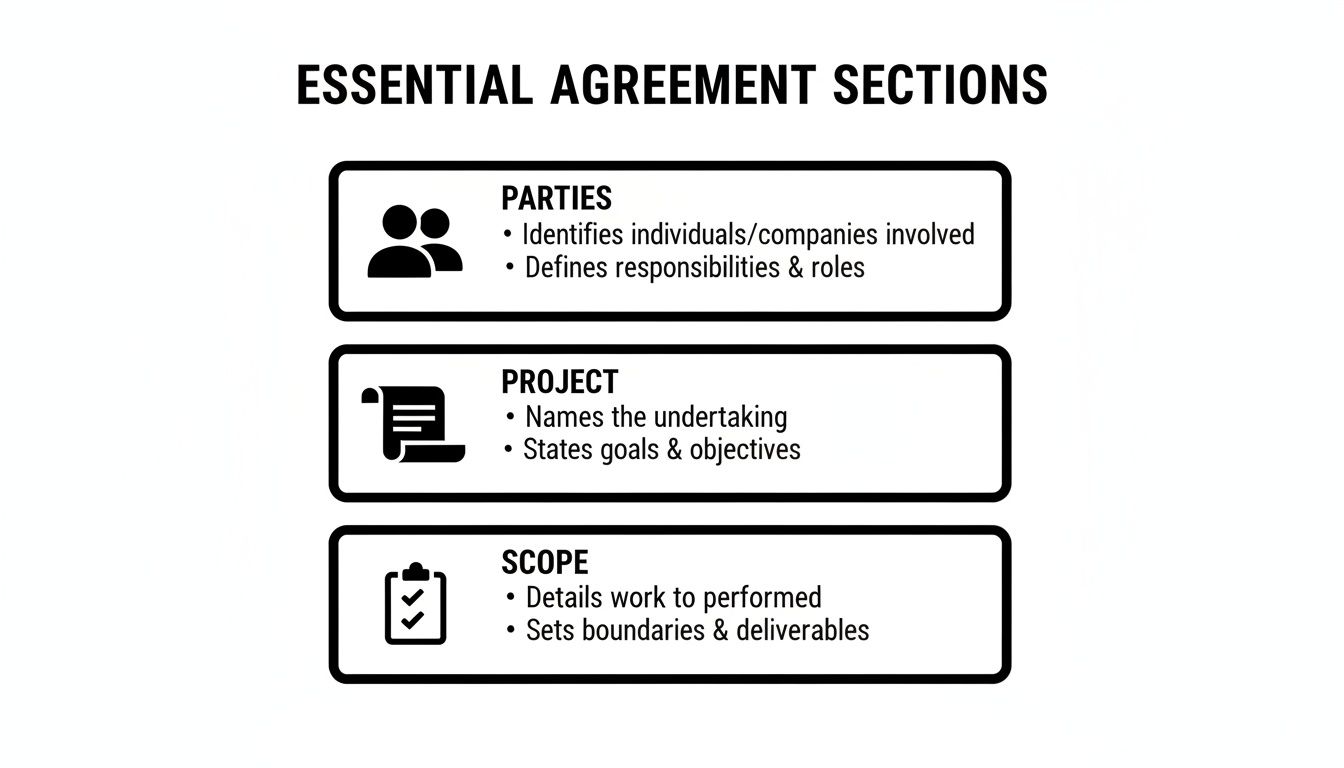
Think of the Parties, Project, and Scope as the foundation. Now, let's build the structure that protects you financially.
Getting Paid: Nailing Down the Payment Terms
Clear payment terms aren't just about cutting checks; they're about keeping the project moving and maintaining good faith. If your terms are vague, your sub's cash flow suffers, and that quickly turns into your performance problem.
One of the most common—and often misunderstood—terms is the "pay-when-paid" clause. In simple terms, it means you don't have to pay your subcontractor until the property owner pays you. These are generally enforceable here in Texas, but it's a detail you absolutely need to be upfront about.
Then there's the lien waiver. This is a crucial piece of the payment puzzle. With every payment, your sub should sign a conditional lien waiver. This basically says they agree to waive their right to file a lien for that payment amount, as long as your check clears. For the final payment, they sign an unconditional final waiver, fully releasing their lien rights on the property for good.
Finally, your agreement needs a rigid, non-negotiable process for change orders. Any work that falls outside the original scope requires a written change order. It must be signed by both of you before the extra work starts, clearly outlining the new scope, the cost, and any impact on the schedule. No exceptions. This is how you avoid the "he said, she said" arguments that kill profits and relationships. To get a better handle on how these costs are broken down, you can see our guide on what parking lot striping actually costs.
The Shield: Understanding Insurance and Indemnification
This is where your agreement transforms from a simple work order into a powerful shield for your business. The insurance and indemnification clauses are designed to do one thing: transfer risk from your company to the subcontractor and their insurance carrier. You can't afford to get this part wrong.
The indemnification clause is often called a "hold harmless" agreement. It's a promise from the subcontractor to cover any losses you face because of their work. For instance, if their crew damages a light pole while striping, this clause makes it their financial problem to fix, not yours.
A strong indemnification clause, backed by the right insurance, ensures that a subcontractor's mistake doesn't become your financial catastrophe. It is one of the most powerful risk management tools in your contract.
Of course, a promise to pay is only as good as the bank account—or insurance policy—backing it up. That's why verifying your sub's insurance coverage is absolutely critical.
Why "Additional Insured" is a Non-Negotiable
Just getting a Certificate of Insurance (COI) isn't enough. It's just a snapshot in time. You must insist that your company be named as an "additional insured" on their general liability policy. This isn't just paperwork; it gives you direct rights under their policy, putting you in a much stronger position if a claim is filed.
Let’s walk through a real-world scenario. Your striping sub’s employee slips on some spilled paint and gets seriously injured. He decides to sue everyone in sight, including you as the GC.
- Without an additional insured endorsement: You’re on your own. You have to call your lawyer, file a claim with your own insurance, and watch your premiums go up. Then, you'd have to turn around and try to enforce the indemnification clause against your sub—a long, expensive fight.
- With an additional insured endorsement: You simply hand the lawsuit over to the subcontractor’s insurance company. Their policy now has to defend you, becoming the first line of defense and covering legal fees and any potential settlement. It’s a game-changer.
The days of just accepting a basic COI are long gone. The insurance world now demands specific endorsements to match the risks GCs are taking on. As industry-watcher TrustLayer notes, there have been critical shifts in what insurance carriers expect from subcontractors, making proper documentation more important than ever.
To help, here’s a quick-reference guide to the essential insurance coverages and endorsements you should require from every subcontractor before they set foot on your site.
Subcontractor Insurance Checklist
| Coverage Type | Minimum Limit (Example) | Key Endorsement/Requirement |
|---|---|---|
| Commercial General Liability | $1,000,000 per occurrence | Your company named as Additional Insured |
| Automobile Liability | $1,000,000 combined single limit | Coverage for all owned, hired, and non-owned vehicles |
| Workers' Compensation | Statutory Limits | Waiver of Subrogation in favor of your company |
| Umbrella/Excess Liability | $2,000,000 per occurrence | Must follow form over underlying policies |
Remember, these are just examples. Always run your contract's insurance requirements by your own insurance broker. They can confirm the limits and endorsements are right for your specific projects. This diligence is what separates the pros from those who are just one bad incident away from a major financial hit.
Tailoring Your Subcontractor Agreement for Pavement Marking in Houston
A standard subcontractor agreement template for construction is a decent starting point, but it's far from ready for the unique challenges of a pavement marking job in the Houston area. Think of it as a bare-bones framework. It simply doesn't account for the Gulf Coast's brutal sun and flash floods or the intricate web of Texas laws and local Houston codes.
Getting this right is what separates the pros from the amateurs. A generic contract leaves you exposed. A well-tailored one, on the other hand, becomes your best risk management tool, protecting your project, your reputation, and your bottom line. Just like you'd outfit a new work truck with the right toolboxes and equipment for a specific job, you need to customize your agreement with clauses that address the on-the-ground realities of striping work in Texas.
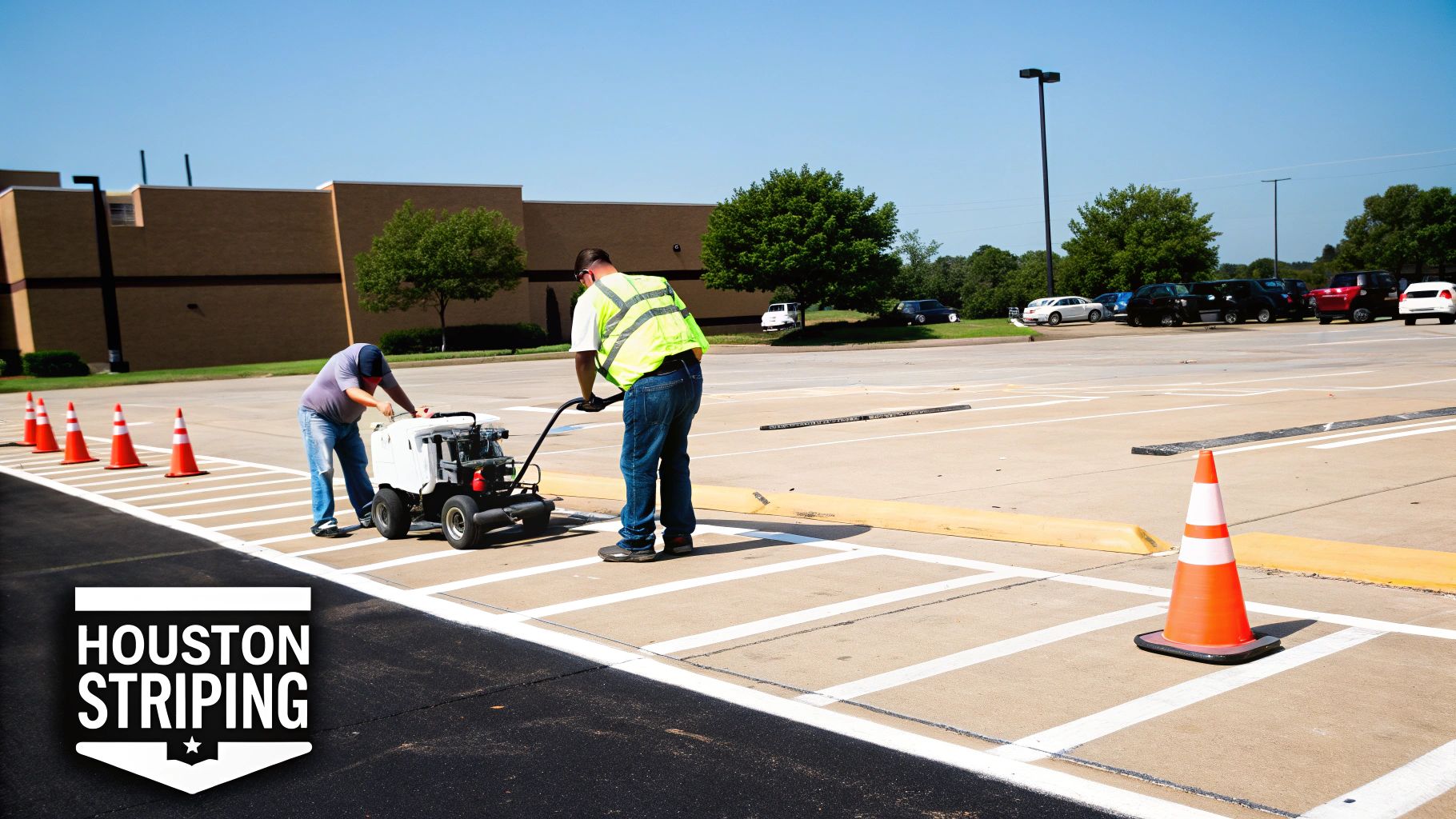
Customizing Clauses for Houston's Climate and Site Conditions
Your agreement needs to get granular about the realities of working outdoors in Harris County. A vague "scope of work" is a recipe for disaster when a project’s success hinges on weather, materials, and local regulations.
First up, you absolutely need a specific Weather Clause. Houston's weather can turn on a dime. A sudden afternoon downpour will wash away thousands of dollars in fresh paint, and the notorious humidity can cripple the curing process. Your contract must spell out what qualifies as a weather delay, who makes the call to stop work, and how the schedule gets adjusted without pointing fingers or incurring penalties.
Next, get serious about Material Specifications. The intense summer heat and UV radiation here will obliterate low-quality traffic paint in a single season. Don't leave it to chance. The agreement should name the exact type of paint required—whether it’s chlorinated rubber, waterborne, or thermoplastic—and even specify the required thickness in mils. This eliminates any ambiguity and ensures the client gets a durable, long-lasting product.
Finally, hammer out the details of Site Access and Surface Preparation. Is the general contractor responsible for clearing the lot of vehicles, debris, and other trades? Put it in writing. The contract should clearly state that your subcontractor isn't liable for delays from an unprepared site. It should also assign responsibility for crucial prep work like power washing oil spots and dirt, which is non-negotiable for proper paint adhesion.
Navigating Texas Lien Laws and Local Rules
Beyond the job site itself, your agreement must be built on a solid legal foundation specific to Texas. The Texas Property Code has notoriously complex rules for mechanic's liens that catch out-of-state and inexperienced contractors all the time. Your payment clauses and lien waiver forms have to align perfectly with these statutes to be worth the paper they're printed on.
A contract that ignores the specifics of the Texas Property Code is a contract that will fail you when you need it most. Ensuring your entire lien waiver process is bulletproof according to state law is a critical risk management step for any contractor in Texas.
Don't forget the local codes, either. ADA requirements, fire lane layouts, and even the required reflectivity of the markings can vary by jurisdiction. Your contract must obligate the subcontractor to comply with all current ordinances from the City of Houston and Harris County. This places the burden of code compliance squarely where it belongs. Backing this up with a detailed construction quality control checklist is a great way to ensure these contractual requirements are met in the field.
To help you focus on these essential local adjustments, the table below breaks down the key legal and practical points to include in your Houston-area agreements.
Houston & Texas Specific Contract Considerations
| Consideration | Why It's Important | Sample Clause Note |
|---|---|---|
| Texas Lien Law Compliance | The Texas Property Code has strict, complex deadlines and notice requirements for perfecting a lien. Generic forms often fail to comply. | Include language requiring the subcontractor to provide lien waivers that conform specifically to Chapter 53 of the Texas Property Code. |
| Material Durability | Houston’s high humidity and intense UV exposure can cause premature paint failure. | Specify a high-durability, climate-appropriate paint type and require the subcontractor to submit a product data sheet for approval. |
| Weather Delays & Protocols | Afternoon thunderstorms and high humidity can halt work and ruin fresh paint, leading to disputes over costs and scheduling. | Define what constitutes an excusable weather delay and outline a clear protocol for rescheduling work without financial penalty. |
| Local Ordinance Adherence | City of Houston and Harris County have specific fire lane and ADA parking regulations that must be followed precisely. | Add a clause stating that all work must comply with the latest local, state, and federal regulations, including ADA and fire marshal codes. |
Getting these Texas-specific details right from the start prevents misunderstandings, protects you from liability, and ultimately helps ensure a successful and profitable project.
Building Partnerships Beyond the Contract
A solid subcontractor agreement template for construction is critical, but let's be honest—the paperwork is just the start. I’ve learned over the years that the best projects aren't built on iron-clad contracts alone. They’re built on real partnerships with skilled, reliable subcontractors who you can actually trust to get the job done right.
Think of the contract as the blueprint for your relationship. True success comes from what you do after the ink is dry. It's about having a system in place for managing every sub you bring onto a job. This isn’t about micromanagement; it’s about being proactive to protect yourself from shoddy work, project-killing delays, and legal headaches.
The Vetting Process: A Checklist for Finding the Right Partners
Before you even think about sending a contract, you have to do your homework. This is where you weed out the talkers from the true professionals. I can't tell you how many times a thorough vetting process has saved me from a major disaster down the line. It's a step you just can't afford to skip.
Here’s what my own vetting checklist looks like:
- Dig into Their References: Don't just settle for a list of contacts they hand you. Ask for their last three projects, specifically. Talk to those GCs or property managers and get into the details. How was their communication? Did they stick to the schedule? Most importantly, how did they handle it when something went wrong?
- Verify Their Insurance—Personally: A Certificate of Insurance (COI) is just a piece of paper. I always call the insurance carrier listed on the form to confirm everything. Is the policy actually active? Are the coverage limits what they claim? And did they really add our company as an additional insured? That quick phone call is one of the best risk-management moves you can make.
- Scrutinize Their Past Work: Ask for a portfolio. When I'm looking at a pavement marking sub's photos, I'm looking for the details. Are the lines sharp? Are the ADA stalls laid out to code? Are the fire lane stencils crisp and correctly placed? The photos will tell you a lot about their standards.
A rigorous vetting process isn't about mistrust; it's about due diligence. It establishes a baseline of professionalism and ensures that any subcontractor you bring onto your job site is qualified, insured, and capable of meeting your standards.
On-the-Job Communication and Management
Once you’ve found a good sub and they're signed on, the focus has to shift to communication and day-to-day management. A great contract doesn't do you any good if it just collects dust in a folder.
Always kick things off with a pre-construction scope review on-site. Walk the job with their foreman or project manager, with the scope of work in hand. This is your chance to spot potential problems—like access issues or conflicts with other trades—before they turn into expensive change orders.
During the project, keep the lines of communication open. A simple weekly check-in call or a quick email can stop small misunderstandings from blowing up. It shows you’re engaged and fosters a collaborative spirit instead of an adversarial one. For more insight on how quality craftsmanship directly affects financial outcomes, check out our guide on ways to increase property value.
Finally, have a clear sign-off procedure. When the sub says they're done, do a final walkthrough with them. Use the scope of work as your checklist and tick off every item together. This confirms everything is done to spec before you release that final payment and get the unconditional lien waiver. It’s a simple step that prevents arguments and closes out the job cleanly.
Common Questions About Subcontractor Agreements
Even with the best construction subcontractor agreement template, you're bound to run into questions. Every job and every subcontractor is a little different, and navigating the fine print can feel tricky. Let's tackle some of the most common questions GCs and property managers ask, so you can handle these situations like a pro and avoid some classic mistakes.
What Should I Do If a Subcontractor Refuses to Sign My Agreement?
This is a huge red flag. A seasoned, professional subcontractor knows that a well-written agreement protects everyone—including them. If they balk, your first move should be to open a dialogue.
Ask them what their specific hang-up is. Maybe they don't understand the insurance requirements or have a question about the payment schedule. Often, a quick, good-faith conversation can clear things up. A simple clarification might be all it takes.
But what if they insist on working with just a simple invoice, their own one-page quote, or—worst of all—a handshake? It’s almost always best to walk away. This kind of resistance is a tell-tale sign of someone who isn't professional or, more worryingly, isn't willing to be held accountable for their quality, safety, or insurance coverage. A solid contract is the bedrock of a professional partnership; it's non-negotiable.
Can I Use This Agreement Template Outside of Texas?
While this template is packed with universal best practices that are valuable anywhere, it's been specifically fine-tuned for Texas law. We’ve included clauses that address Texas-specific mechanic's lien laws, local Houston regulations, and even material suggestions suited for the Gulf Coast climate. Construction law, particularly when it comes to payment and liens, varies wildly from state to state.
If you use a Texas-centric document in, say, Florida or California without a legal review, you're taking a major gamble. Important clauses could be unenforceable, leaving you exposed to risks you thought you had covered.
Expert Tip: Before you use any template in a new state, you absolutely must have it reviewed by a local attorney specializing in construction law. They'll make sure it's tailored to that state's statutes and gives you the full legal protection you need.
How Often Should I Update My Subcontractor Agreement Template?
Think of your agreement as a living document, not a "set it and forget it" file. A yearly review is a great rule of thumb. This keeps your contract current with evolving laws, new insurance requirements, and changing industry standards.
For instance, the insurance landscape has shifted dramatically in recent years. Carriers now often demand very specific endorsements and documentation for subcontractor risk that they didn't require before. A quick annual check-in with your lawyer and insurance agent ensures your agreement is not just compliant but truly protective in the current environment.
It’s also smart to revisit the template anytime you take on a new type of project or expand your business into a different city or region.
Does a Signed Agreement Guarantee I Won't Have Disputes?
If only it were that simple! A well-crafted agreement is your best tool for preventing disputes, but it can't magically guarantee a conflict-free job. Its real power lies in eliminating ambiguity. It forces everyone to get on the same page about scope, payment, and quality standards right from the start.
When disagreements pop up—and sometimes they just do—the contract gives you a roadmap for resolving them. Instead of getting bogged down in a "he said, she said" battle, you can point directly to the clauses you both agreed to. It changes the conversation from personal gripes to contractual obligations. While it won't stop a difficult person from being difficult, it gives you the legal high ground and a clear path forward.
A strong contract is your first and best line of defense on any construction project. At Houston Parking Lot Striping, we build our professional relationships on a foundation of clarity and trust, and that starts with a clear, comprehensive agreement. If you’re looking for a reliable, fully insured pavement marking partner who gets the details right, we’re here to help.