The Ultimate Guide to Commercial Parking Lot Paint
Parking lot paint isn't just paint. It’s a vital part of your property's safety, compliance, and curb appeal. The right paint and a professional application create the crisp, clear markings that guide traffic, prevent accidents, and make a great first impression on every single visitor.
The First Impression Your Pavement Makes
Think about it: your parking lot is the very first physical touchpoint a customer, tenant, or employee has with your business. It's the "welcome mat" for your entire property. If that welcome mat is covered in faded, cracked, or confusing lines, it sends a message of neglect. That can turn people away before they even get to your front door.
On the other hand, a well-maintained lot with bright, easy-to-understand markings instantly communicates professionalism and a real commitment to safety.
This guide is for property managers and business owners who need to make smart decisions about their parking lot paint. We'll walk through everything from the different types of paint and ADA rules to choosing materials that can actually survive the brutal Houston heat. The key is to see this not as just another expense, but as a strategic investment in your property's value and safety.
Why Quality Parking Lot Paint Matters
The importance of good striping goes way beyond just looking nice. It's a core piece of a safe, functional property. Here’s why investing in the right paint and professional application isn't something you can afford to skip:
- Enhanced Safety: Clear lines for parking stalls, directional arrows, and pedestrian crosswalks are the silent traffic cops of your lot. They guide drivers and walkers, drastically cutting down the risk of fender-benders and other accidents.
- Regulatory Compliance: Having properly marked fire lanes and ADA-compliant handicap spaces isn't optional—it's the law. Getting it wrong can lead to hefty fines and serious liability issues.
- Maximized Space: A smart layout with clearly painted stalls ensures you're using every square foot of your lot efficiently. This prevents chaotic parking and lets you fit in more vehicles.
- Improved Traffic Flow: Good directional markings create a logical traffic pattern, which helps stop frustrating bottlenecks at entrances and exits, especially during your busiest times.
The image below shows exactly what you want to see: a freshly striped lot where the bright white lines pop against the dark asphalt, making them impossible to miss.
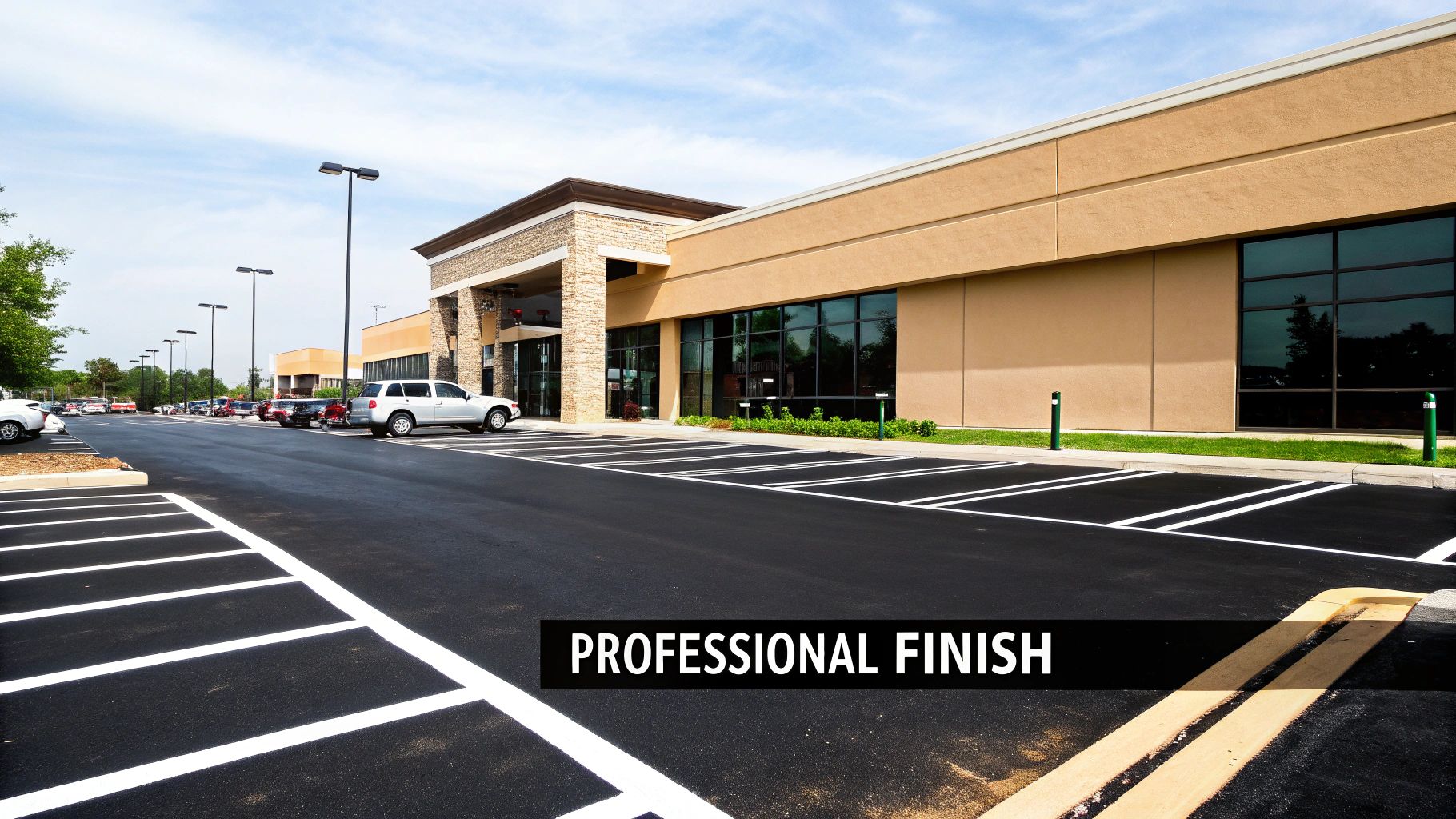
That clean, sharp finish is the gold standard for any commercial property. It’s what creates that positive first impression and keeps your lot running smoothly and safely.
The Growing Market for Professional Pavement Markings
As cities like Houston continue to grow, the demand for durable, high-visibility markings is bigger than ever. The global market for parking lot paint was valued at USD 1.2 billion in 2024 and is expected to more than double to USD 2.5 billion by 2034.
This isn't just about appearances. The industry has recognized that faded, unclear lines are a major liability. In fact, professionally marked lots can reduce parking accidents by as much as 30%.
Your parking lot is a silent ambassador for your business. Its condition speaks volumes about your attention to detail, commitment to safety, and the overall quality of your establishment. A professional striping job is one of the most cost-effective ways to boost curb appeal and protect your investment.
Getting these kinds of results requires a solid understanding of the entire process, from prep work to the final coat. You can dive deeper into the technical details in our comprehensive guide on how to stripe parking lots.
Choosing the Right Type of Parking Lot Paint
Picking the right paint for your parking lot is one of the most important calls you'll make for your property. This isn't just about slapping on a coat of white or yellow; it’s a decision that directly affects how long your markings last, how much you'll spend, and how often you'll need to do it all over again.
Think of it like choosing tires for a car. You wouldn't put standard street tires on a heavy-duty dump truck, right? The same logic applies here. A bustling retail center with cars constantly coming and going needs a paint that can take a beating. A quiet office park, on the other hand, might need something that stands up best to the relentless Houston sun. Getting this choice wrong means you’ll be dealing with faded, chipped, and cracked lines far sooner than you should be, leading to another expensive re-striping job.
Let's break down the main players in the world of parking lot paint so you can match the right product to your property's real-world demands.
Water-Based Acrylic and Latex Paints
For most standard parking lots, water-based acrylic paint (often just called latex) is the workhorse of the industry. It's the go-to for a reason: it's easy to work with, dries relatively quickly, and is much friendlier to the environment. Because it has low levels of volatile organic compounds (VOCs), it’s a safer choice all around.
These paints stick well to both asphalt and concrete and hold up nicely in areas with low to moderate traffic. They're also great at resisting UV damage, which is a huge plus in sunny climates where lesser paints can fade in a hurry. However, for your busiest zones or areas prone to chemical spills, they just don't have the grit to last and will wear down faster than tougher options.
Solvent-Based Alkyd and Chlorinated Rubber Paints
When you absolutely need your lines to last, professionals often reach for solvent-based paints like alkyds or chlorinated rubber formulas. Instead of water, these paints use chemical solvents that evaporate, leaving behind an incredibly tough and durable film. This makes them a fantastic choice for high-traffic environments—think busy shopping malls, loading docks, and industrial lots.
The biggest advantage here is their incredible resistance to oil, gas, and other vehicle fluids that can eat away at weaker paints. The trade-off? They contain more VOCs, which means a stronger smell during application and stricter handling requirements. They also take a bit longer to fully cure compared to water-based paints.
The market data backs this up. The parking lot marking industry was valued at a hefty USD 529.8 million in 2024. While greener water-based paints command a 45% market share, the sheer toughness of solvent-based options keeps them holding a strong 30%. You can dig deeper into traffic coating market trends to see how the industry is evolving to meet these different needs.
Epoxy Coatings for Maximum Durability
For the absolute toughest jobs—think indoor parking garages, warehouse floors, and industrial zones—epoxy coatings are in a league of their own. Epoxy isn't really a paint; it's a two-part system with a resin and a hardener. When you mix them, they trigger a chemical reaction that cures into a rock-solid, chemical-resistant surface.
Epoxy creates a thick, protective shell that stands up to heavy machinery, chemical spills, and constant abrasion far better than any traditional paint. It's also perfect for indoor floor striping because it leaves a smooth, high-gloss finish that’s a breeze to clean. The main downsides are the higher price tag and a more complex application that's very sensitive to temperature and requires meticulous surface prep. This is a job for the pros, no question.
Thermoplastic and Preformed Markings
At the very top of the durability mountain, you'll find thermoplastic markings. This isn't a liquid paint at all. It’s a specialized plastic material that gets heated to over 400°F and bonded directly to the pavement. As it cools, it fuses with the asphalt, creating a thick, highly reflective line that is incredibly long-lasting.
Because it can last 3 to 5 times longer than standard paint, thermoplastic is what you see on public roads, highways, and critical markings like crosswalks and stop bars in major parking facilities. The upfront cost is certainly higher, but when you factor in its extended lifespan, it often ends up being the more economical choice in the long run.
Key Takeaway: The "best" parking lot paint doesn't exist in a vacuum. The right choice is a careful balance of your traffic flow, climate, budget, and how often you want to deal with maintenance. An experienced professional can help you weigh these factors to pick the product that truly delivers the best value for your property.
To help you visualize the differences, here is a quick side-by-side look at the primary paint types.
Parking Lot Paint Comparison Chart
This chart compares the most common types of parking lot paint, breaking down what they’re good for, how long they last, and what you can expect to pay.
| Paint Type | Best For | Durability (Lifespan) | Pros | Cons | Avg. Cost / Sq. Ft. |
|---|---|---|---|---|---|
| Water-Based Acrylic | Low-to-moderate traffic lots, re-striping existing lines | 1-2 Years | Eco-friendly, fast-drying, low odor, easy cleanup | Lower durability, susceptible to chemicals & heavy wear | $0.25 – $0.50 |
| Solvent-Based Alkyd | High-traffic retail, industrial zones, loading docks | 2-3 Years | Excellent durability, resistant to oil/gas, great adhesion | High VOCs, strong odor, slower drying time | $0.40 – $0.75 |
| Epoxy Coating | Indoor garages, warehouses, heavy industrial floors | 3-5+ Years | Unmatched durability, chemical resistant, high-gloss finish | Expensive, complex application, temperature sensitive | $1.00 – $3.00 |
| Thermoplastic | Highways, major crosswalks, high-volume stop bars | 5-8+ Years | Extremely durable, highly reflective, long-term value | Highest initial cost, requires specialized equipment | $1.50 – $3.50 |
Ultimately, this table illustrates the classic trade-off between cost and performance. While a simple water-based paint is perfect for a quick and affordable refresh, investing in something like thermoplastic can save you money and headaches over the long haul in a high-demand environment.
Getting ADA and Fire Lane Regulations Right
Your parking lot's paint job is more than just a guide for traffic; it's a legal document written on asphalt. When it comes to ADA accessibility and fire lane access, getting the details right isn't optional. It's about protecting people, ensuring your property is welcoming to everyone, and shielding your business from some very real liability.
Think of these markings as a non-negotiable part of your property's risk management. One poorly measured stall or a faded fire lane isn't a small mistake—it's a potential lawsuit or a hefty fine waiting to happen. This is exactly why a professional striping job, using the correct parking lot paint, is one of the smartest investments you can make.
Decoding ADA Parking Specifications
The Americans with Disabilities Act (ADA) lays out crystal-clear standards for accessible parking. These aren't loose guidelines; they are precise measurements designed to give individuals with disabilities the space they need to enter and exit their vehicles safely.
A standard accessible parking space must be at least 96 inches (8 feet) wide. But the space itself is only half the equation. It must be paired with a dedicated access aisle, which is a strictly no-parking zone. For cars, this aisle needs to be at least 60 inches (5 feet) wide.
Van-accessible spots have even more specific rules. You can either have a space that is 132 inches (11 feet) wide with a 60-inch access aisle, or a standard 96-inch wide space next to an extra-wide 96-inch access aisle. In every case, these aisles must be marked with hash marks to make it obvious that they are not for parking.
As you can see, every inch is critical for compliance. For a complete breakdown of all the nuances, you can check out our guide on ADA handicap parking space requirements.
Fire Lane Requirements and Color Codes
Just as crucial as ADA stalls are the fire lanes. In an emergency, every second counts. Firefighters and other first responders need a clear, unobstructed path to your building, and that’s what a properly marked fire lane guarantees.
While the exact rules can shift slightly depending on your local Houston-area jurisdiction, some standards are nearly universal. Fire lanes must be wide enough for large emergency trucks, which typically means a minimum width of 20 feet. You’ll also need bold stenciling on the pavement, like "NO PARKING FIRE LANE," to leave no room for confusion.
Color is a key communicator here. You'll almost always see curbs painted a vibrant red to signal a hard "no-parking" zone. The stencils and boundary lines themselves are typically painted in a high-visibility white or yellow so they pop against the asphalt.
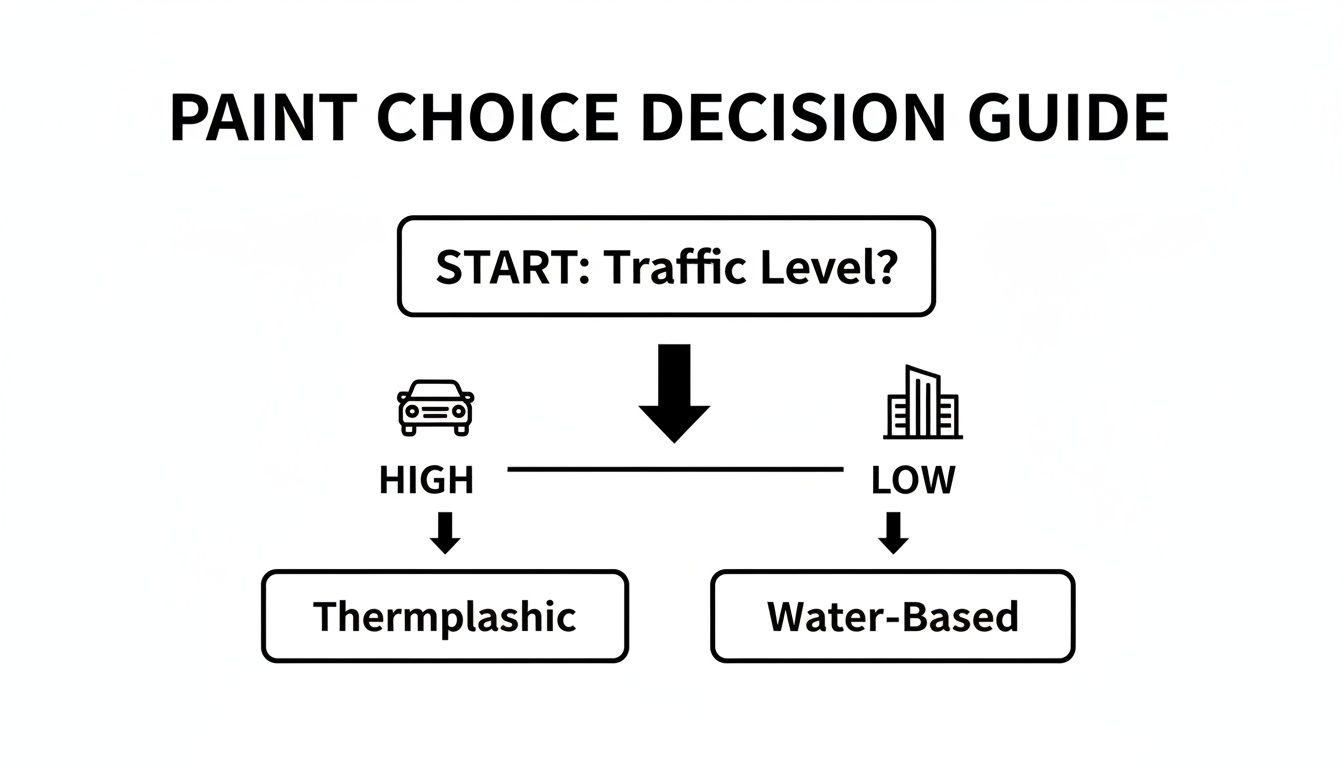
This decision guide makes it clear: for high-stress, high-traffic areas like a fire lane, you want a paint that lasts. That’s why durable options like thermoplastic are often the best choice.
The focus on safety and compliance isn't just local; it's a massive global industry. The market for parking deck coatings was valued at $2.35 billion in 2024 and is expected to climb to $3.914 billion by 2035. North America makes up a huge piece of that pie with a 39.2% market share, driven by strict safety codes just like the ones here in Houston. These numbers show just how critical proper maintenance and re-striping are for preventing accidents and ensuring emergency access.
Application and Surface Preparation: The Secret to Lines That Last
You can buy the most expensive, high-tech paint on the market, but it will fail—guaranteed—if you put it on a dirty, damaged surface. The real key to sharp, long-lasting parking lot lines isn't just what's in the can. It's the painstaking prep work that happens long before a single line gets sprayed.
Skipping these crucial steps is like building a house on a shaky foundation. It might look good for a week or two, but it’s only a matter of time before things start to crack, peel, and fall apart. Think of it this way: you wouldn't paint your living room without cleaning the walls and patching the holes first. The same logic applies to asphalt and concrete, where the stakes are much higher.
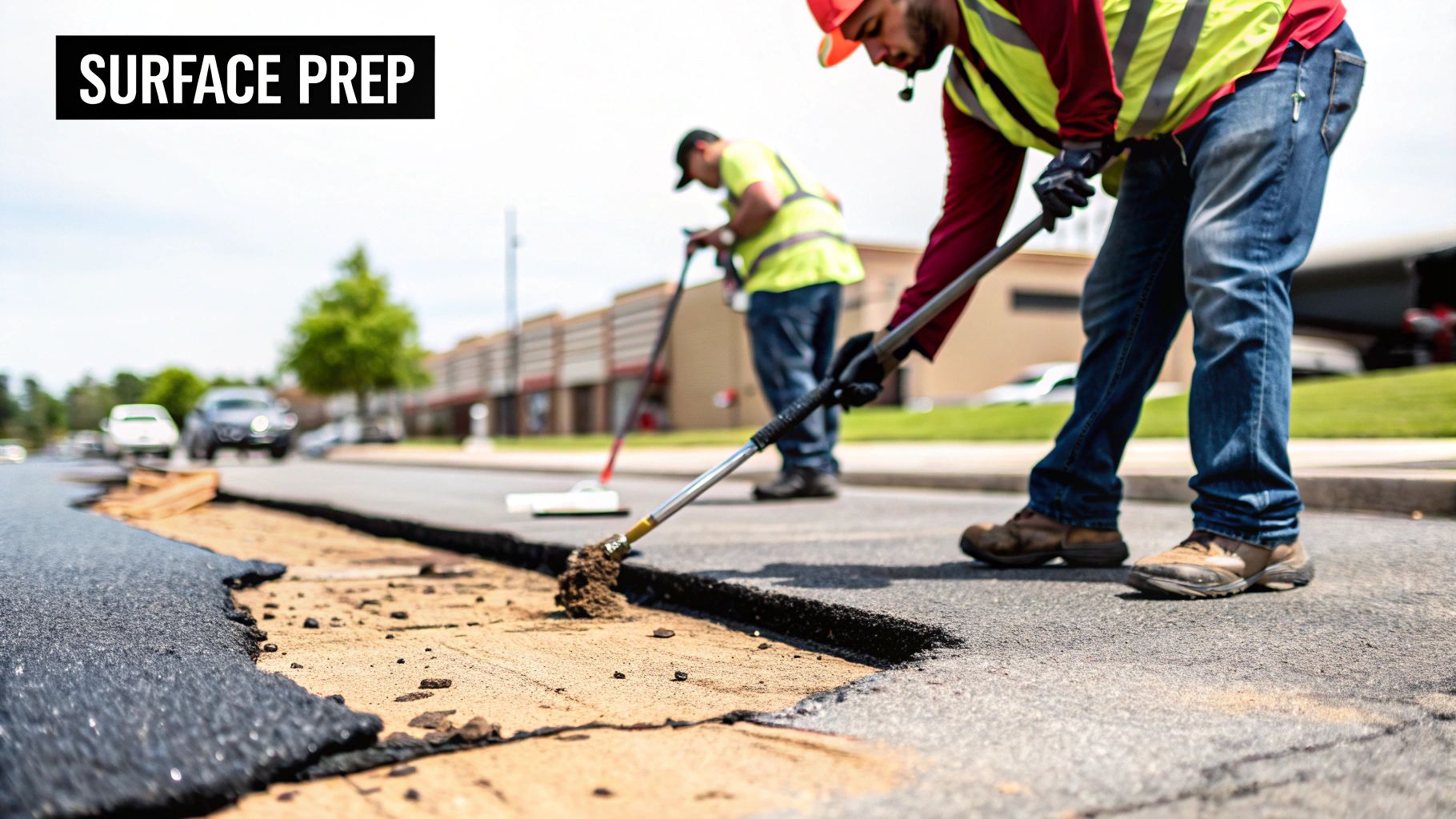
Laying the Groundwork for a Flawless Finish
Proper surface prep is non-negotiable. It’s the single biggest factor determining how well the paint sticks and how long it survives Texas weather and constant traffic. A clean, sound surface allows the paint to form a powerful mechanical bond. Without it, the best paint in the world will just sit on top, waiting to get peeled away by the first hot tire or heavy rain.
The whole process starts with a deep clean. Over the years, parking lots collect a stubborn film of dirt, oil, grease, and other fluids. This grime acts like a barrier, preventing the paint from ever truly gripping the pavement.
A professional crew tackles this with a systematic approach:
- Debris Removal: First, everything loose—sand, gravel, leaves, and trash—is blown and swept away.
- Power Washing: Next comes a high-pressure wash to blast out embedded dirt and stubborn grime, revealing the true surface underneath.
- Degreasing: For those tough oil and gasoline stains, specialized chemical degreasers are a must. They break down the petroleum residue and lift it right out of the pavement's pores.
This isn't just a quick rinse. It's an intensive cleaning designed to give the paint a pure, uncontaminated surface to bond with.
Repairing and Priming for Maximum Adhesion
Once the lot is spotless, it's time to fix any damage. Simply painting over cracks and potholes is a rookie mistake. Those underlying problems will show through the new paint in no time, leading to early failure and making your property look neglected.
A pristine surface is the canvas for a lasting paint job. Every minute spent on preparation saves hours of future repair work and protects the integrity of the entire project.
Here’s what the essential repair work looks like:
- Crack Sealing: We clean out minor cracks and fill them with a flexible, hot-applied rubberized sealant. This stops water from seeping into the foundation and causing bigger, more expensive problems down the road.
- Pothole Patching: Larger potholes are squared off, filled with fresh asphalt, and compacted to create a smooth, level repair that blends right in.
- Sealcoating: For older, faded asphalt, applying a fresh sealcoat is often the best move. It not only brings back that rich, black finish but also creates a perfect, uniform surface for new paint to adhere to.
Finally, you have to work with the weather, not against it. Paint should only go down when the surface temperature is above 50°F and rising, with zero rain in the forecast. Here in Houston's humid climate, we have to be especially careful about moisture. The pavement has to be completely dry for the paint to cure into a tough, durable film. An experienced crew knows how to read the conditions and schedule the work for a perfect result.
To learn more about what goes into a high-quality job, take a look at our construction quality control checklist.
How Houston's Weather Wreaks Havoc on Your Parking Lot Paint
Anyone who lives in Houston knows our weather is a force to be reckoned with. That same combination of blazing sun, thick humidity, and torrential rain doesn't just make for a tough summer—it actively works to destroy your parking lot markings. If you want your stripes to last, you have to understand what you're up against.
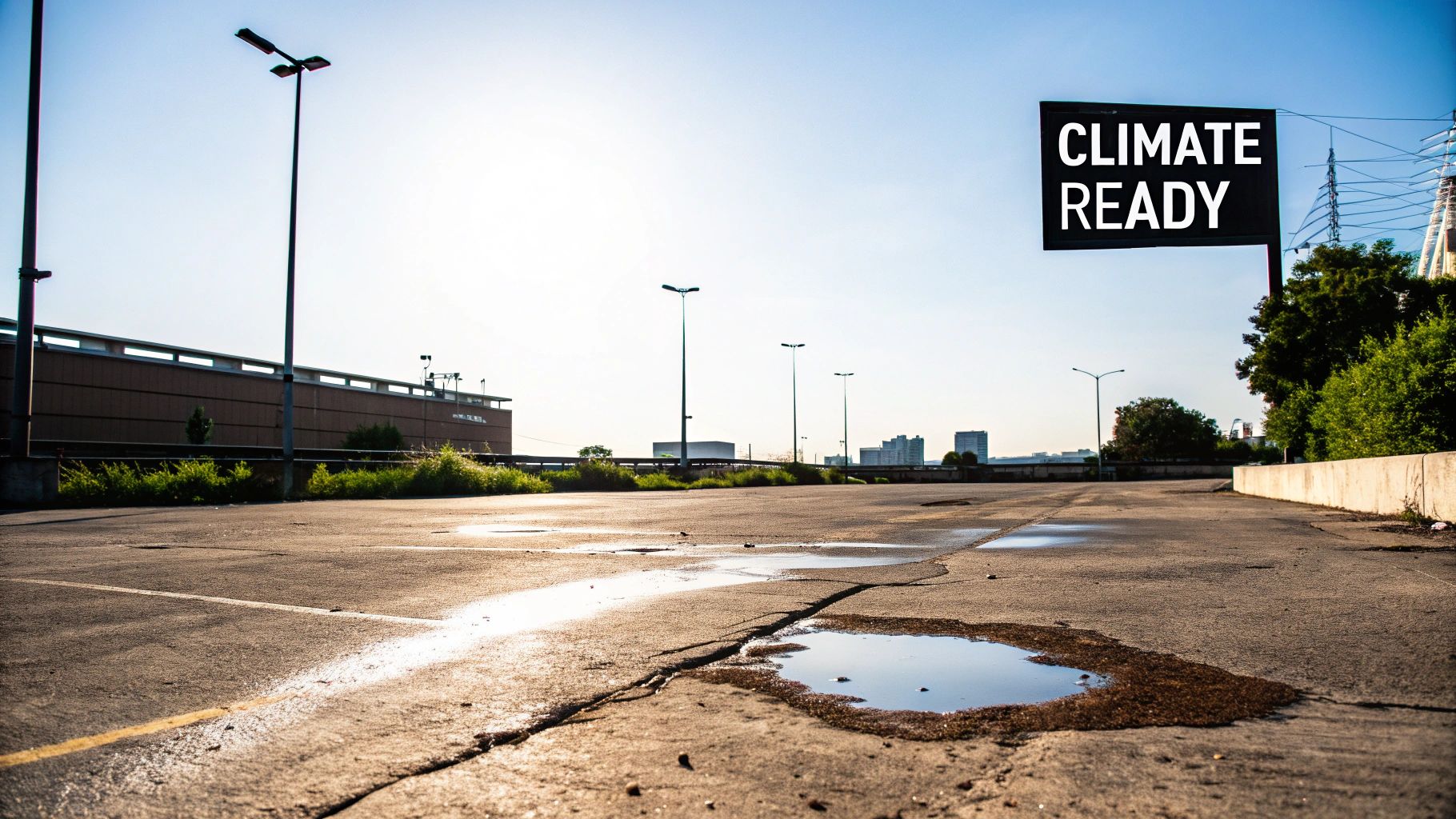
The Texas sun is easily the biggest culprit. The relentless UV radiation beats down on your lot day after day, bleaching vibrant colors and breaking down the paint itself. This process, called photodegradation, essentially cooks the binders that hold the paint together, leaving behind a chalky, brittle film that flakes away under traffic.
It’s more than just an eyesore. Faded, chipped lines create confusion for drivers, increase the risk of accidents, and can even lead to costly fines if your ADA or fire lane markings are no longer legible.
The One-Two Punch of Heat and Humidity
Houston’s infamous humidity only makes things worse. All that moisture in the air can dramatically slow down the paint's curing time, especially for common water-based formulas. When paint can't cure properly, it never achieves its full strength. It might feel dry to the touch, but underneath it remains soft and vulnerable.
The result is a frustratingly short lifespan. The first few cars that drive over these improperly cured lines can peel them right off the pavement, undoing the entire investment.
In a climate like ours, the temperature and moisture on the pavement aren't just minor details. They're the make-or-break factors that determine if a paint job will bond correctly and last, or fail within months. A true professional knows how to work with these conditions, not against them.
Then there’s the rain. Our sudden downpours leave standing water that seeps into the tiny pores of asphalt and concrete, weakening the paint's grip from below. Mix that water with oil and grime from cars, and you get a gritty, abrasive sludge that acts like liquid sandpaper every time a tire rolls over it.
Choosing the Right Paint for the Gulf Coast
Fighting back against our climate requires a smart strategy, starting with the right materials and a realistic maintenance plan.
- Look for UV-Resistant Formulas: Your best bet is a high-quality acrylic paint specifically formulated with UV inhibitors. These are designed to fight off the sun's fading effects and stay flexible in the heat, which prevents cracking.
- Upgrade for High-Stress Zones: For the most important markings—think fire lanes, loading zones, and busy entrances—it’s worth considering tougher materials. Chlorinated rubber paint holds up better against water, and for maximum durability, thermoplastic is in a class of its own.
- Be Proactive with Maintenance: The typical "re-stripe every two years" rule often doesn't cut it here. For a busy commercial property in Houston, you should be inspecting your lot at least once a year. This lets you catch problems early before they become safety hazards or compliance headaches.
Got Questions About Parking Lot Paint? We Have Answers.
When it comes to maintaining a parking lot, the details matter. We get a lot of questions about the paint itself—how long it lasts, when to apply it, and what it costs. Here are some straightforward answers to the questions we hear most often, based on our years of experience right here in Houston.
How Often Should We Re-Stripe Our Parking Lot in Houston?
For most commercial lots in our area, you should plan on re-striping every 18 to 24 months. It’s no secret that the Texas sun is brutal, and when you add our heavy rains to the mix, paint just doesn't last as long as it does in milder climates.
Now, that’s just a general guideline. If your lot sees constant action—think of a busy retail center, a logistics hub, or a large apartment complex—you'll likely need to do it annually. Keeping those lines bright and clear isn't just about looks; it's a critical part of keeping people safe and your property compliant.
The bottom line? Staying ahead of the wear and tear is always cheaper and safer than waiting until your lot becomes a liability.
What’s the Best Time of Year to Paint a Parking Lot?
The perfect window for painting is when the temperature—both in the air and on the asphalt itself—stays above 50°F. You also need a solid 24 hours without rain in the forecast. These conditions are essential for the paint to cure correctly and really grip the pavement.
Here in Houston, that makes spring and fall the prime seasons for striping. We can absolutely get projects done in the summer, but it takes careful planning. A professional crew knows how to work around the intense afternoon heat and pop-up thunderstorms to ensure the paint job doesn't fail.
A seasoned pro will never start a job without checking the forecast and taking the pavement's temperature. Applying paint in the wrong conditions is the number one reason for premature peeling and cracking.
What Should I Budget for Professional Parking Lot Striping?
The cost can swing quite a bit, as every project is unique. The final price tag really comes down to a few things: the overall size of your lot, how many lines and stencils you need, the type of paint you choose, and how much prep work is involved.
As a ballpark figure, property managers can expect to see prices from $0.25 to $0.75 per linear foot. A simple re-stripe on a lot that's already in good shape will be on the lower end of that spectrum. On the other hand, if we're laying out a brand-new design or dealing with a surface that needs a deep clean, crack filling, or old line removal, the cost will naturally be higher. Always ask for an itemized quote so you know exactly what you're paying for.
Can You Just Paint Over the Old Parking Lot Lines?
You technically can, but you almost never should without proper prep. If you want the new stripes to last and look sharp, the old ones need to be completely free of dirt, oil, and any flaking paint. A quick power wash is the bare minimum.
For the best possible result, especially if the old paint is a mess or you're changing the layout, we always recommend removing the old lines entirely. This is usually done with a grinder or ultra-high-pressure water blasting. It’s an extra step, but it’s the only way to prevent those faint "ghost lines" from showing through and to give the new paint a perfectly clean surface to bond to. It makes a world of difference in how long your investment lasts.
Ready to bring clarity and curb appeal back to your property? The team at Houston Parking Lot Striping knows what it takes to deliver a clean, durable, and compliant finish that stands up to the Texas weather. Contact us today for a free, no-obligation estimate for your project.