

Thermoplastic striping material: Why it delivers durable road markings
When you see those thick, vivid white and yellow lines on a major highway or in a busy commercial parking lot, you're almost certainly looking at thermoplastic striping material. This isn't your average paint. It’s a completely different kind of pavement marking, one that offers a level of durability that traditional paint just can't match. For property managers and business owners, understanding this material is key to making a smart, long-term investment in safety and curb appeal.
Why Thermoplastic Is the Smarter Pavement Marking Solution
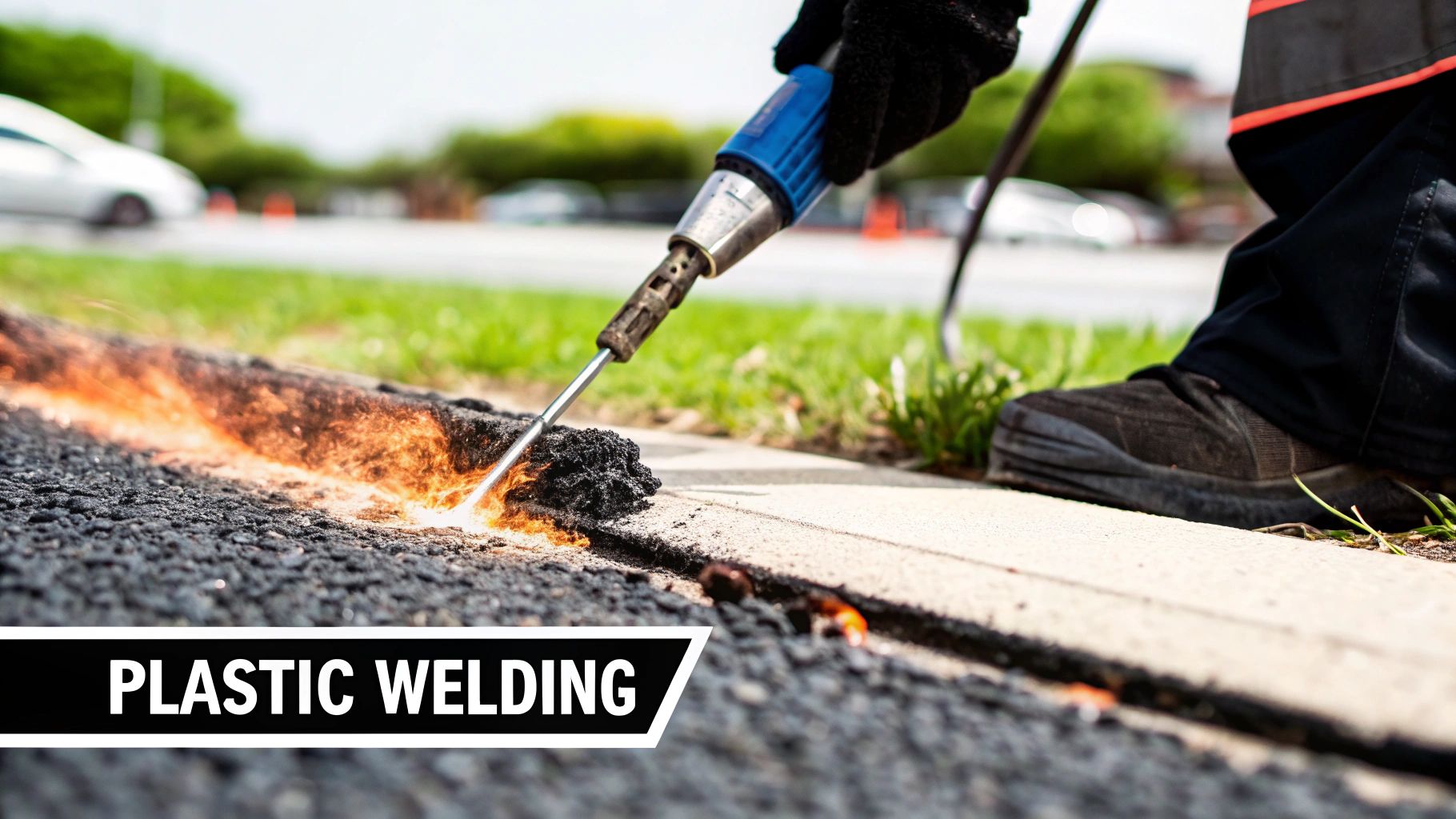
Think of the difference between painting a line on the ground and literally welding a plastic line to it. That's the core of what makes thermoplastic so effective and a superior choice for high-traffic areas.
Regular paint just sits on top of the pavement, a thin film exposed to sun, rain, and the constant abuse of tires. It’s no wonder it fades and flakes away, often within a single year. Thermoplastic, on the other hand, starts as a solid material—a blend of resins, pigments, and glass beads—that's heated to around 400°F. At this extreme temperature, it becomes a molten liquid that, when applied, sinks into the nooks and crannies of the asphalt. As it cools, it fuses with the pavement, creating an incredibly strong and durable physical bond.
What you're left with isn't a coat of paint—it's a thick, solid plastic marking that has essentially become one with the surface, ready to withstand years of wear and tear.
The Core Components of Thermoplastic Material
The secret to thermoplastic's outstanding performance is in its recipe. Every mix is a carefully balanced blend of three key ingredients, each with a critical job to do to ensure longevity and visibility.
- Polymer Resins: This is the glue that holds everything together. These high-quality resins provide the material's toughness and flexibility, allowing it to expand and contract with the pavement through changing temperatures without cracking under pressure.
- Pigments: High-quality, vibrant pigments are what give the markings their brilliant color—typically bright white or yellow—for maximum daytime visibility and compliance with road safety standards.
- Reflective Glass Beads: These are the tiny heroes of nighttime safety. Microscopic glass spheres are mixed into the material and also sprinkled on top during application. They act like tiny mirrors, catching a car's headlight beams and reflecting them directly back at the driver, making the lines pop in the dark.
This trifecta of components creates markings that are built to be seen and built to last, day or night, rain or shine.
For property managers and contractors, the choice of marking material has a direct impact on long-term budgets and property safety. Thermoplastic's resilience means fewer re-striping cycles, reduced labor costs, and less business disruption over time.
A Smart Investment for High-Traffic Properties
It’s this ruggedness that makes thermoplastic striping material the go-to choice for any property with serious traffic. From busy retail centers and industrial loading docks to municipal roads and airport runways, it’s designed to withstand constant wear, the grinding of power steering, and the full force of the elements.
For any commercial property, this is a huge win. It means enhanced safety, better curb appeal, and a lower total cost of ownership over the life of the pavement. By investing in a marking solution that endures, you're ensuring your property stays safe, compliant, and professional for years, not just months.
Understanding the Types of Thermoplastic Markings
When we talk about thermoplastic striping material, it’s not a one-size-fits-all deal. You've basically got two main players in the game, and knowing the difference is critical to getting the right result for your project. Each one is designed for different applications and installation methods.
The two big categories are hot-applied thermoplastic and preformed thermoplastic. While they both offer that rock-solid durability we're looking for, they have very different roles on the job site.
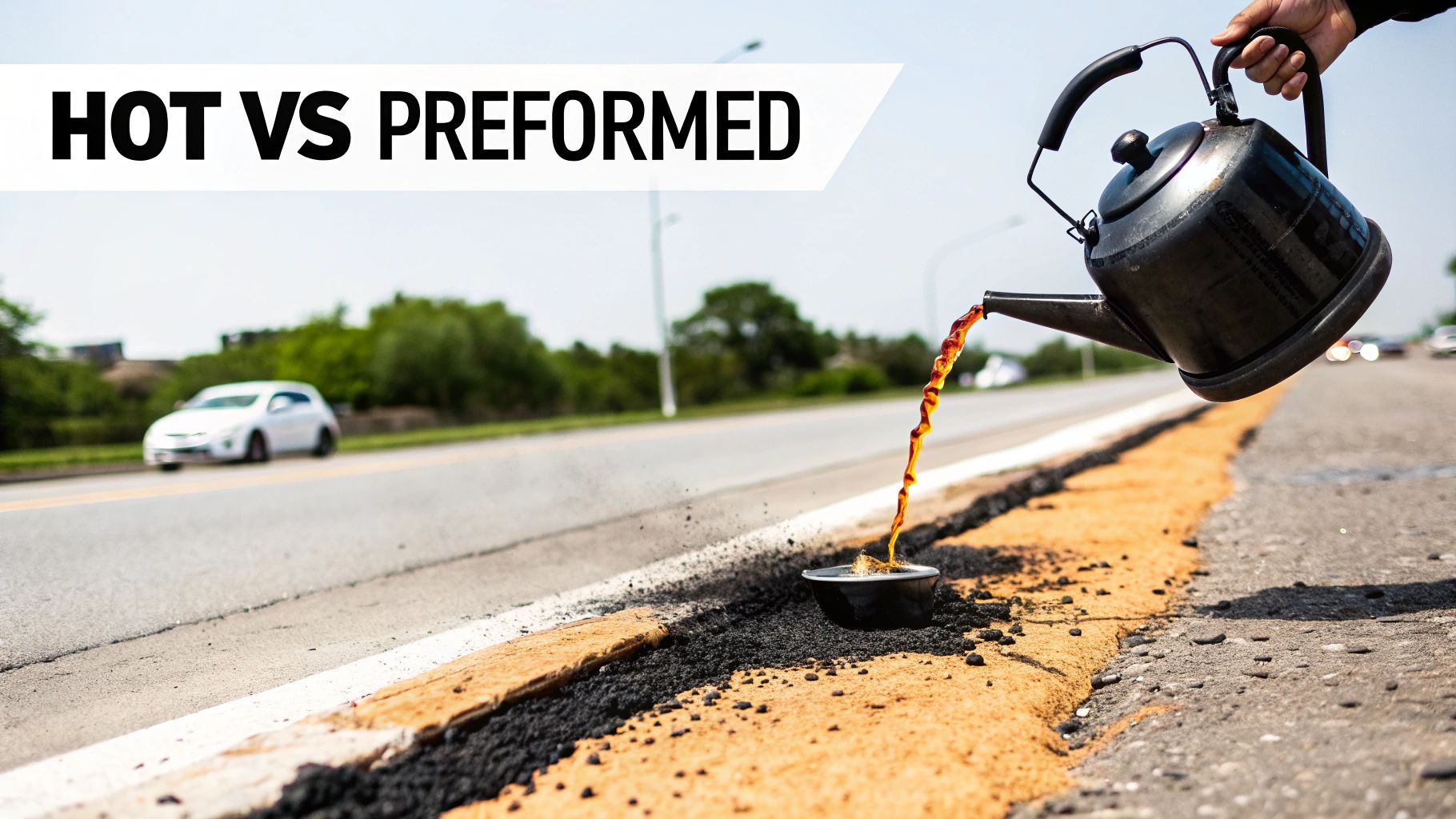
Hot-Applied Thermoplastic: The Workhorse for Long Lines
Think of hot-applied thermoplastic as the go-to for big, straightforward jobs. This material shows up on-site as a solid—usually in powder or block form. We melt it down in a specialized kettle, getting it up to a molten state of around 400°F.
Once it's liquid, we apply it directly to the pavement using a screed or extrusion machine. It cools and hardens in just a few minutes, forming a thick, tough line that bonds right to the surface. The secret to its longevity is the blend of hydrocarbon resins for durability and intermixed glass beads for nighttime visibility. As the top layer wears down over time, new beads are exposed, keeping the line reflective.
This method is all about efficiency and is perfect for laying down long, continuous lines quickly.
- Parking Lot Stalls: Ideal for striping hundreds of stalls in a new commercial lot.
- Roadway Edge Lines: The standard for creating miles of solid lines on highways and roads.
- Center Lines: Perfect for laying down dashed or solid center lines to manage traffic flow.
Simply put, if you have a lot of ground to cover with straight lines, hot-applied is almost always the most cost-effective choice.
Preformed Thermoplastic: Precision for Detailed Markings
On the flip side, when you need precision and detail, preformed thermoplastic is the star. This type of thermoplastic striping material comes ready to go in pre-cut shapes, symbols, and letters.
The installation is pretty straightforward. We lay the pre-cut pieces out on the pavement exactly where they need to go, then use a propane heat torch to melt them into the asphalt. This creates the same incredibly strong bond as the hot-applied version, but with total control over the shape.
The real magic of preformed thermoplastic is its ability to create crisp, intricate designs that would be a nightmare to attempt with molten liquid. It guarantees every symbol is uniform and compliant.
This makes it the only real choice for detailed work where accuracy is everything.
- ADA Symbols: Ensures handicap parking stalls are marked with perfectly formed, compliant symbols.
- Directional Arrows: Creates sharp, clear arrows for guiding drivers in parking lots and garages.
- Custom Logos: Lets you brand your pavement with a company logo that looks sharp and lasts.
- Lettering: The best way to create clean, legible markings like "STOP" or "NO PARKING."
To make the choice clearer, let's break down the key differences between these two materials.
Thermoplastic Material Comparison: Hot-Applied vs Preformed
| Characteristic | Hot-Applied Thermoplastic | Preformed Thermoplastic |
|---|---|---|
| Best For | Long, continuous lines (parking stalls, road lines) | Intricate shapes, symbols, letters, and logos |
| Application | Applied in molten liquid form from a kettle | Pre-cut pieces are laid out and heated with a torch |
| Efficiency | Very fast and cost-effective for large-scale projects | Slower application, ideal for detailed, smaller jobs |
| Precision | Good for straight lines, but not detailed designs | Excellent for crisp, precise, and complex graphics |
| Flexibility | Limited to lines and basic shapes | Can be cut into any custom design or shape imaginable |
By understanding these two distinct forms of thermoplastic, you can make a much more informed decision. Hot-applied gives you speed and efficiency for the long haul, while preformed delivers the precision you need for those critical symbols and custom graphics. It’s all about picking the right tool for the job to ensure every marking is perfect.
The Advantages of Thermoplastic: More Than Just a Line
When it comes to pavement markings, you're buying more than just lines on the ground. You're investing in safety, compliance, and the overall look of your property. While a fresh coat of paint looks good for a while, it’s often a short-term fix. For a truly professional and lasting solution, thermoplastic striping material is in a league of its own.
The advantages aren't just minor improvements; they represent a fundamental upgrade in performance. It all comes down to three things: incredible durability, excellent visibility, and a few clever, built-in safety features. Let's break down why this matters for any property manager or contractor aiming to get the most out of their budget.
Built for Extreme Durability
The number one reason people switch to thermoplastic is its sheer toughness. Paint is just a thin film that sits on top of the pavement, vulnerable to every tire that rolls over it. Thermoplastic is different. It’s a thick, molten material that fuses directly with the asphalt or concrete, creating a bond that’s built to last.
Just think about the daily abuse your parking lot markings face. Cars grinding their tires with power steering, delivery trucks scuffing up loading zones, and the constant friction from traffic are all working to wear them away. Thermoplastic is engineered to handle that constant punishment, often lasting up to five times longer than a standard paint job.
By forming a physical bond with the asphalt, thermoplastic doesn't just stick to the surface—it becomes part of it. This resilience is why it's the standard for highways and busy intersections, where failure is not an option.
This incredible longevity means lower costs over the life of the markings. Instead of budgeting for a full re-stripe every year, you can go several years without needing major work. That saves a ton of money, time, and disruption to your business.
Superior Visibility Day and Night
You can’t compromise on visibility. Clear markings are essential for a safe, well-functioning property, and this is where thermoplastic truly shines. The secret ingredient? Retroreflectivity.
As the hot thermoplastic is applied, tiny glass beads are mixed into the material and also sprinkled on top. These beads are like millions of microscopic mirrors. At night, when headlights hit the line, the beads catch the light and bounce it straight back to the driver’s eyes.
The effect is dramatic. The line appears to glow, making it incredibly easy to see in the dark or during bad weather like rain, when regular paint can all but disappear. This high visibility is a game-changer for:
- Preventing Accidents: Drivers can easily spot crosswalks and stop bars, giving them more time to react and protecting pedestrians.
- Improving Navigation: Bright, reflective directional arrows and stall lines guide drivers safely, reducing confusion and frustration.
- Ensuring Compliance: Highly visible ADA symbols and fire lane markings stay clear and easy to read, keeping your property up to code.
Enhanced Safety Through Physical Presence
There's one more safety feature that’s easy to overlook: the thickness of the line itself. Thermoplastic markings are typically applied at a thickness of 90 to 120 mils—that’s about the same as stacking two credit cards. This creates a slightly raised profile on the pavement.
It might not seem like much, but that raised edge provides both an audible hum and a slight vibration when a car drives over it. If a driver starts to drift out of their lane, this tactile and audible feedback can jolt them back to attention, helping prevent an accident. It’s a simple but effective safety feature that a thin layer of paint just can’t provide.
The industry is clearly taking notice. The global market for thermoplastic road markings is growing fast, projected to top $4 billion by 2033. This boom is fueled by new infrastructure projects and a greater focus on safety regulations worldwide. You can discover more insights about the thermoplastic market growth and its drivers. This trend makes one thing clear: for property owners and contractors alike, choosing a high-performance thermoplastic striping material isn’t just an upgrade—it's a smart investment in durability and safety that pays for itself.
Thermoplastic vs. Paint and Epoxy: Which is Right for Your Pavement?
When you’re looking at quotes for a striping project, it’s natural to gravitate toward the lowest number. But the real cost of pavement markings isn't what you pay on day one—it's the total cost over the life of your property. This is where you see the stark differences between thermoplastic striping material, old-school paint, and epoxy systems.
Water-based paint is always the cheapest option upfront, no question. The problem is that this initial savings quickly gets eaten up by future expenses. Paint is just a thin layer sitting on top of the asphalt; it gets scuffed, faded, and worn away by traffic and weather, forcing you to re-stripe every 12 to 18 months. That cycle of paying for labor, materials, and dealing with the disruption gets old, fast.
Epoxy markings are definitely a step up in toughness, but they have their own quirks. While epoxy is much more durable than paint, it can get brittle as it ages. This makes it prone to cracking and chipping, especially on pavement that flexes with temperature changes or gets hammered by heavy trucks.
The Durability Showdown: A Head-to-Head Battle
The single biggest difference comes down to lifespan. Thermoplastic isn’t a "coating" in the traditional sense. It's a thick, molten plastic that is literally fused to the pavement, creating a permanent bond built to take years of punishment.
- Water-Based Paint: You're lucky to get 12-18 months out of it in a busy commercial lot before it’s faded, worn, and needs to be redone.
- Epoxy Coatings: These can push the timeline to 2-3 years, but you might start seeing cracks or chips as the material becomes less flexible.
- Thermoplastic: This is the long-haul solution. It’s not uncommon to see thermoplastic lines last 5 to 7 years—that's three to five times longer than paint—while holding onto their color and visibility with almost no upkeep.
This incredible longevity is what makes thermoplastic such a smart investment. It shifts striping from a recurring maintenance chore to a one-and-done capital improvement. If you're weighing different coating options, our guide on choosing the right parking lot paint offers a deeper dive into the paint-specific choices.
The initial price for thermoplastic is higher, but it completely changes the maintenance game. Over a five-year window, one thermoplastic application can easily outlast three or more paint jobs, saving you a fortune in labor and materials while minimizing the headaches of shutting down your lot.
Comparing Key Performance Metrics
Let's lay it all out. When property managers and contractors compare their options, these are the factors that truly matter. This table cuts through the noise and shows the trade-offs between upfront cost and long-term performance.
| Feature | Water-Based Paint | Two-Part Epoxy | Thermoplastic Material |
|---|---|---|---|
| Typical Lifespan | 12-18 months | 2-3 years | 5-7+ years |
| Upfront Cost | Low | Medium | High |
| Long-Term Value | Low | Medium | Excellent |
| Durability | Poor (fades and chips) | Good (but can be brittle) | Excellent (fuses to pavement) |
| Visibility | Good initially, fades fast | Good, retains color well | Superior (retroreflective) |
| Drying/Cure Time | 30-60 minutes | Several hours | 5-15 minutes |
As you can see, the decision really comes down to balancing your immediate budget against future costs and the need for operational efficiency.
Downtime and Getting Back to Business
For any commercial property—whether it's a retail center, warehouse, or office park—downtime equals lost revenue. The speed at which you can reopen a freshly striped area to traffic is a huge deal.
This is another area where thermoplastic shines. Because thermoplastic striping material is applied as a hot liquid and hardens as it cools, it's ready for traffic in just 5 to 15 minutes. That rapid return-to-service is a game-changer, allowing businesses to get back to normal almost immediately.
Paint and epoxy, on the other hand, need hours to cure properly. That can mean blocking off entire sections of your lot, frustrating customers, and disrupting deliveries. By virtually eliminating downtime, thermoplastic proves itself as the smartest, least disruptive choice for any busy property.
How Thermoplastic Striping Is Professionally Installed
Getting a flawless, long-lasting thermoplastic application isn't magic—it's a science. Unlike slapping down a coat of paint, installing thermoplastic striping material demands specialized equipment and a real understanding of how the material actually fuses with the pavement. A top-notch installation is what unlocks its impressive five-to-seven-year lifespan.
The whole process starts with one non-negotiable rule: the surface must be impeccably clean and bone-dry. Any dirt, dust, grease, or moisture will get in the way of a solid bond, causing the striping to fail long before it should. That’s why professional crews always start with serious surface prep, often using power washers or high-powered blowers to get rid of every last bit of debris.
The Critical Preparation Phase
On asphalt, a clean, dry surface is usually all you need. Concrete, however, is a different animal altogether. It’s much denser and less porous, so hot thermoplastic can't melt into it and form a strong connection on its own.
To get around this, we have to apply a specialized primer or sealer first. Think of this primer as a double-sided tape for pavement; it creates a tacky surface that the molten thermoplastic can grip onto, forming a permanent bond. Skipping this step on concrete is a guaranteed recipe for peeling and chipping down the road.
This infographic lays out the typical lifecycle for different striping materials, showing why getting that initial installation right is so important for long-term value.
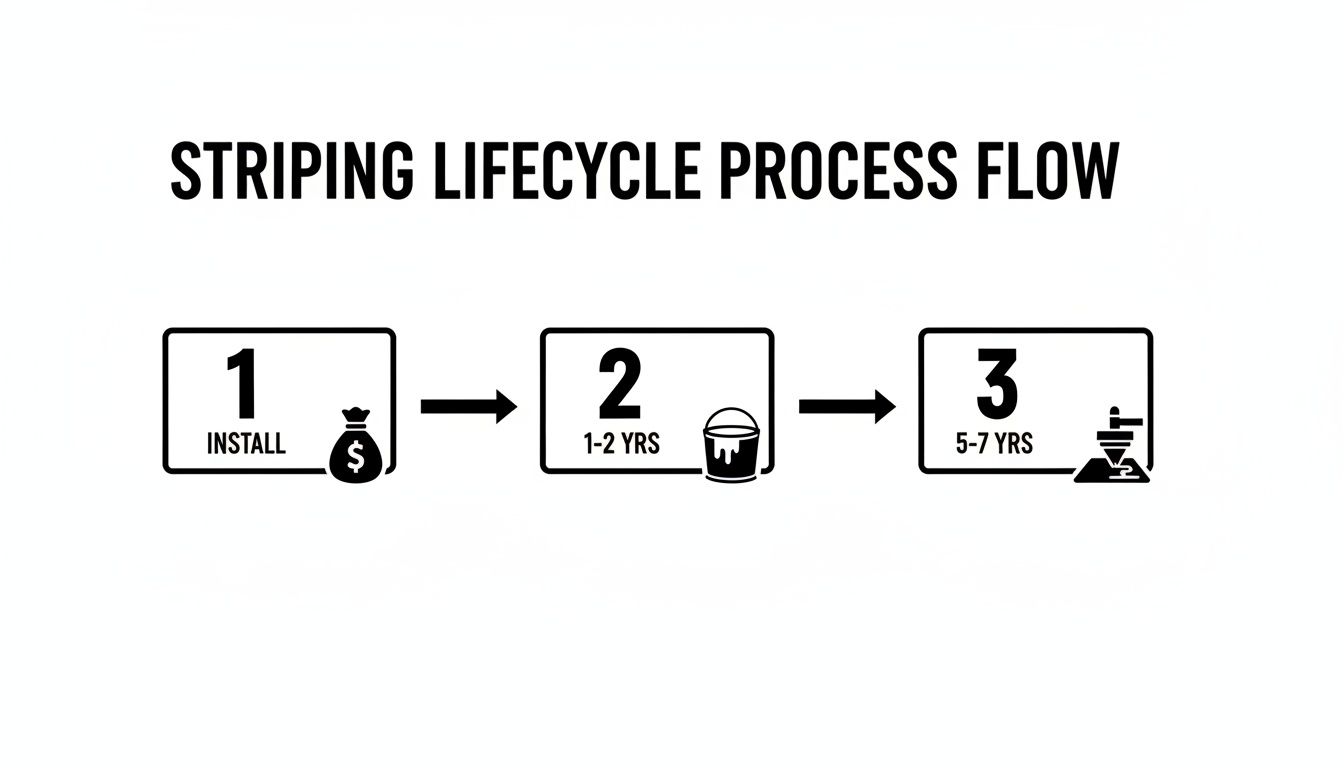
As you can see, paint needs a touch-up every one to two years. A professional thermoplastic job, on the other hand, can go five to seven years, which really cuts down on maintenance headaches and costs over time.
Heating and Application
With the surface prepped, the thermoplastic material goes into a specialized kettle where it's heated to around 400°F. This isn't a ballpark number—maintaining that exact temperature is crucial. If it's too cool, the material won't flow properly. Too hot, and you can scorch and ruin the compound.
The molten liquid is then applied with a screed or extrusion machine, which lays down the line at a consistent thickness, typically between 90 and 120 mils. Immediately after the line is put down, a crew member broadcasts a layer of glass beads over the top. These beads sink into the cooling thermoplastic, giving you that instant, bright retroreflectivity for nighttime visibility.
Weather is a massive factor in a successful installation. Any pro worth their salt will only apply thermoplastic when the pavement is above 50°F and warming up, with zero rain in the forecast. Trying to install it in cold or damp conditions is just asking for a weak bond.
The demand for durable markings like these is growing fast. The global road marking materials market is a multi-billion dollar industry, and thermoplastics account for roughly 36% of that. It’s a market that’s only getting bigger as property managers and public agencies look for ways to reduce long-term maintenance.
For a broader look at pavement marking, our guide on how to stripe a parking lot is a great starting point. By understanding what goes into a professional thermoplastic installation, you'll be much better equipped to hire the right contractor and make sure your investment is built to last.
Your Thermoplastic Questions, Answered
When you're deciding on the right material for your pavement markings, a lot of questions come up. We get it. As professionals who work with these materials every day, we've put together some straight-to-the-point answers about thermoplastic striping material to help you understand why it's such a popular high-performance choice.
How Long Does Thermoplastic Striping Take to Dry?
This is one of the best parts about working with thermoplastic: it dries incredibly fast. Since it’s a hot-melt compound applied at over 400°F, the material hardens as it cools, which happens very quickly.
Most of the time, thermoplastic markings are ready for traffic in just 5 to 15 minutes. This is a huge advantage for any active business, as it keeps disruptions and downtime to an absolute minimum. You won't be waiting hours for paint to dry.
Can Thermoplastic Be Applied to Concrete Surfaces?
Yes, it certainly can, but it requires one crucial extra step that isn't necessary on asphalt.
Concrete isn't as porous as asphalt, so we first have to apply a specialized epoxy primer. Think of this primer as a powerful adhesive that creates an unbreakable link between the concrete and the hot thermoplastic. Any reputable contractor will insist on this step; it's the only way to guarantee the markings will last.
Is Thermoplastic an Environmentally Friendly Option?
Compared to traditional solvent-based paints, thermoplastic is definitely a greener choice. It's a 100% solid material, which means it doesn't release any harmful Volatile Organic Compounds (VOCs) into the air when we apply it. The process is a physical melt, not a chemical one that relies on solvents.
Beyond that, its long lifespan is its biggest environmental benefit. Having to re-stripe far less often means less material, less fuel, and less labor are used over the years, significantly shrinking the project's overall environmental footprint.
What Is the Cost of Thermoplastic Compared to Paint?
Looking purely at the initial invoice, thermoplastic will be more expensive—usually two to three times the cost of a standard paint job. But that’s a shortsighted view. The real story is in the total cost of ownership over time.
Because thermoplastic lasts three to five times longer, you save all the money you would have spent re-painting every year or two. When you do the math, thermoplastic almost always comes out as the smarter long-term investment. If you want to dive deeper into the numbers, check out our guide on how much parking lot striping costs.
Ready to upgrade your property with markings that last? The experts at Houston Parking Lot Striping have the skill and equipment to deliver a perfect thermoplastic application built to withstand years of traffic and weather. Contact us today for a free, no-obligation estimate at https://houstonparkinglotstriping.com.