

A Complete Guide to Barriers for Parking Lots in Houston
When we talk about barriers for parking lots, we're discussing more than just accessories. Think of them as a fundamental investment in safety, legal compliance, and the protection of your property. These physical guides are what turn a potentially chaotic open space into a structured, secure environment for everyone.
Why Effective Parking Lot Barriers Are Non-Negotiable
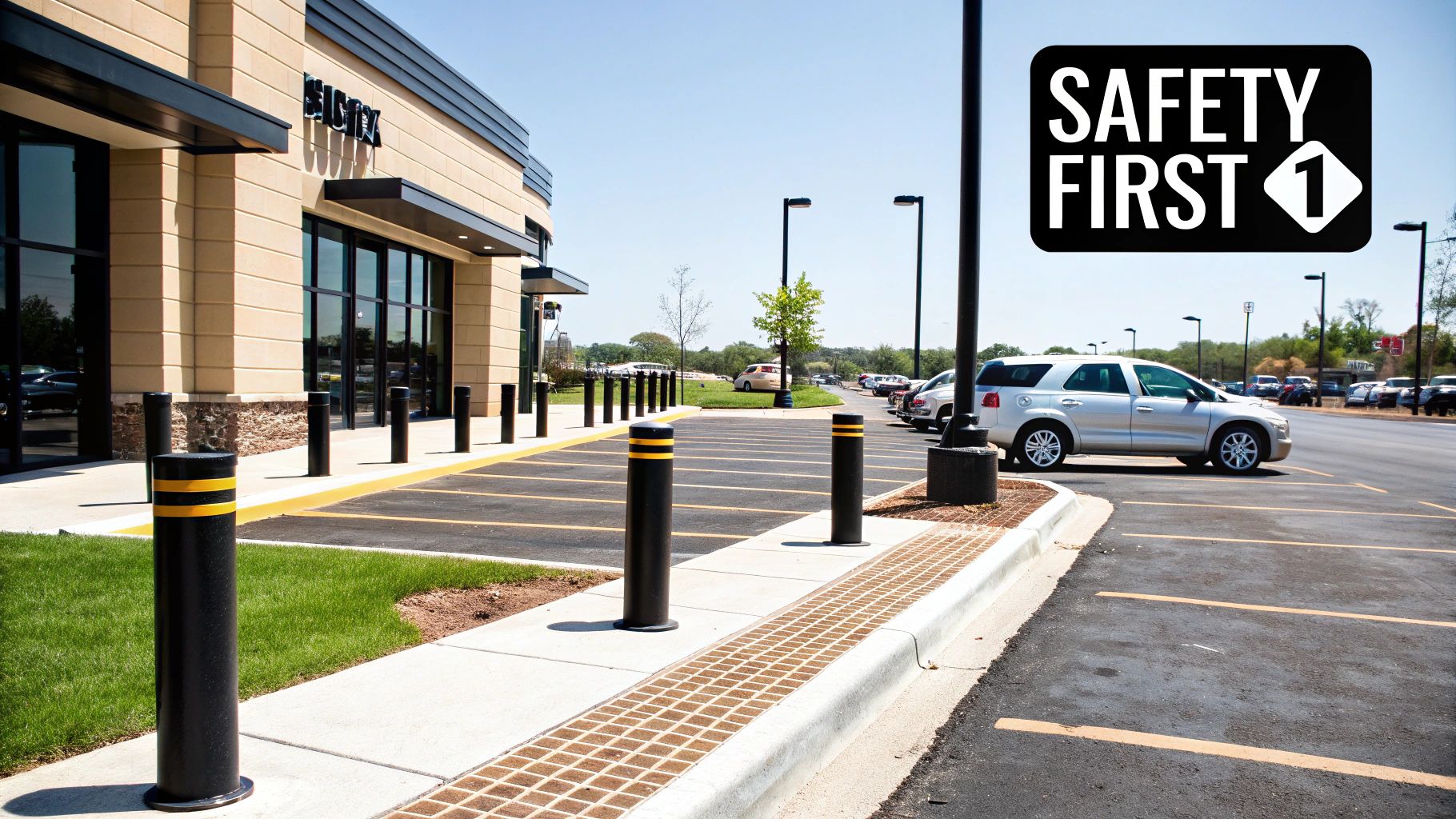
Picture a typical Houston shopping center on a busy Saturday afternoon. Without clear physical guides, it’s a free-for-all. Drivers cut across empty spaces, cars edge onto sidewalks, and pedestrians are left to navigate a dangerous mix of moving vehicles. Now, imagine that same lot with strategically placed barriers. The entire experience changes.
The word "barriers" in a modern parking facility means more than just automated gates. It’s a whole system of physical controls designed to organize, guide, and protect. These are the silent guardians that bring order to the chaos, ensuring your property is functional, safe, and legally sound.
The Core Functions of Parking Barriers
Good barriers do several critical jobs at once, protecting your property, your customers, and your bottom line. They aren't just obstacles; they are active, working parts of a well-run facility.
- Directing Traffic Flow: Simple things like curbs and planters create obvious pathways, guiding drivers through the lot and naturally reducing the chance of collisions.
- Protecting Valuable Assets: Bollards are the unsung heroes, standing guard in front of storefronts, utility boxes, and structural columns to prevent accidental impacts that lead to expensive repairs.
- Ensuring Pedestrian Safety: By creating a clear physical separation between where cars drive and people walk, barriers are essential for keeping your customers and employees safe.
- Maintaining Legal Compliance: The right barriers in the right places are key to meeting strict local codes, from ADA-accessible pathways to keeping fire lanes clear. For a deeper dive, check out our guide on compliant fire lane signage.
By defining clear boundaries and protecting vulnerable areas, barriers for parking lots act as a form of insurance, mitigating liability and preventing accidents before they happen.
Addressing Driver Frustration and Safety
This structured environment does more than just look good—it has a direct impact on your customers' experience. The 2023 Global Driver Survey found that a staggering 46% of Texas drivers report frequent or constant trouble finding parking. That frustration, made worse by a poorly designed lot, often leads to reckless driving and a bad first impression of your business. You can read more about the survey findings on driver behavior and their parking challenges.
A well-organized lot with clear, intuitive barriers cuts down on that stress. It creates a safer, more welcoming atmosphere that tells customers you’ve thought about their experience, making them more likely to come back.
The Different Kinds of Physical Parking Lot Barriers
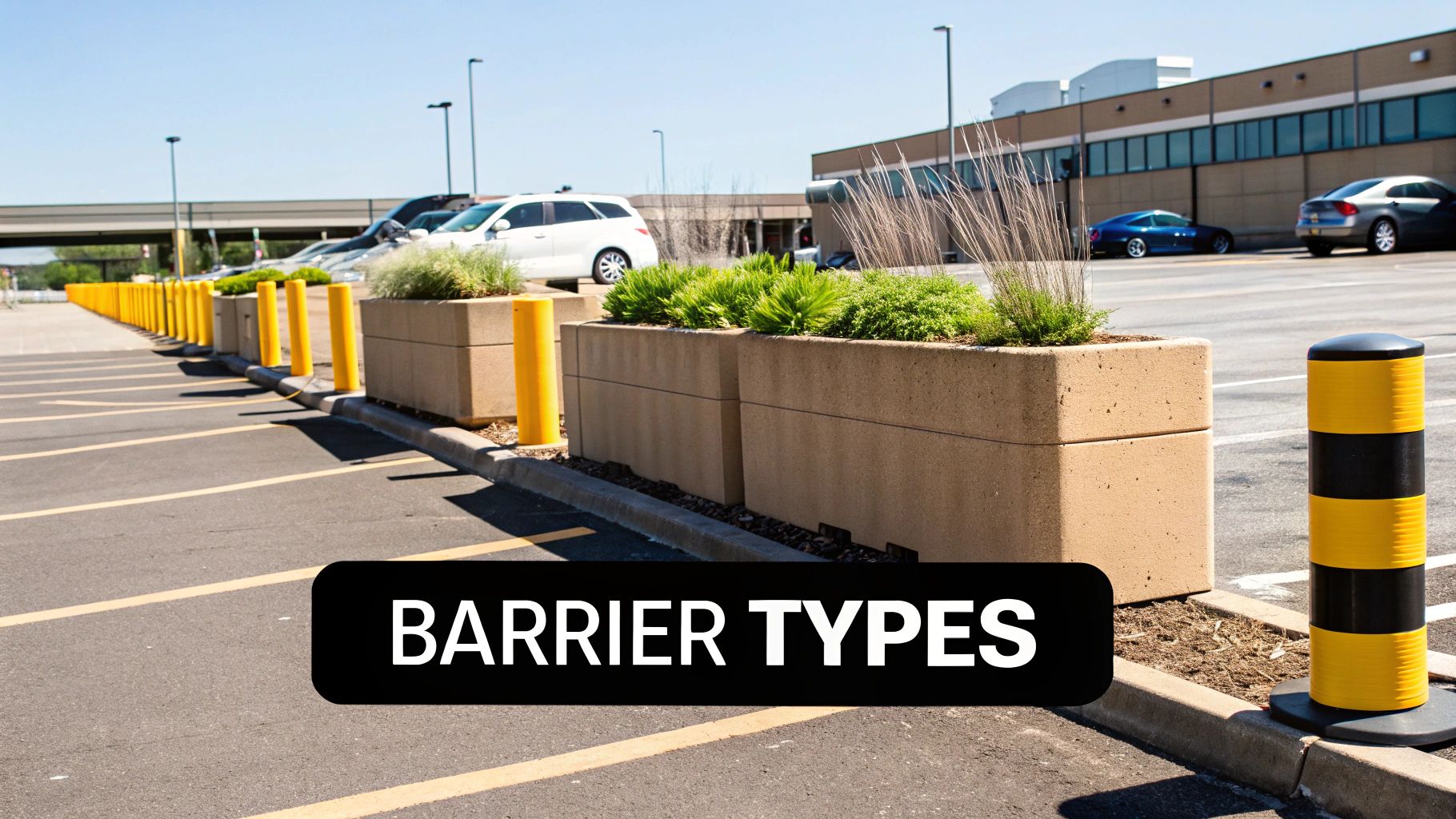
When you're outfitting a commercial property, it's easy to think of barriers for parking lots as interchangeable. But that’s a mistake. They aren't a one-size-fits-all solution; each type is a specialized tool designed for a specific job.
Think of it like a mechanic's toolbox—you wouldn't use a hammer to turn a bolt. In the same way, choosing the right barrier means matching its intended function to your property's real-world needs, whether that’s stopping a car in its tracks or just giving a driver a gentle nudge. Let's break down the most common options you'll see in Houston so you can understand which tool is right for which task.
Bollards: The Silent Sentinels
Bollards are the heavy-duty protectors of your property. Think of them as the silent sentinels standing guard at your storefront, protecting outdoor dining patios, and shielding vulnerable utility boxes. These are short, stout vertical posts engineered for one primary purpose: to create an impassable wall for vehicles.
Their job is to stop a car, period. This prevents accidental crashes from turning into devastating building damage or, worse, injuries. While most are made from steel and filled with concrete for raw stopping power, you can also find decorative versions that blend security with aesthetics. For any area where cars and people mix, bollards are less of an option and more of a necessity.
- Primary Function: High-impact protection for buildings and people.
- Common Materials: Steel, concrete, high-density plastic.
- Key Advantage: Unmatched ability to stop vehicles and prevent costly damage or serious injuries.
Wheel Stops: The Gentle Guides
Where bollards are about force, wheel stops—you probably know them as car stops or parking blocks—are all about finesse. These low-profile barriers sit at the front of a parking space and do exactly what their name implies: they gently stop a car's wheels.
Their real purpose is to keep vehicles from pulling too far forward. This prevents cars from creeping onto sidewalks, crushing landscaping, or bumping into the front of your building.
Wheel stops are a tactile cue for drivers, ensuring every vehicle parks at a uniform depth. This simple bit of organization is what keeps walkways clear and protects your property from constant, low-impact bumps and scrapes.
Usually made from recycled rubber, plastic, or concrete, wheel stops are an incredibly cost-effective way to create order and predictability in your parking lot. They won't stop a speeding car, but they're perfect for guiding low-speed parking maneuvers.
Concrete Barriers: The Unmovable Dividers
When you need to draw a hard line that no one can cross, concrete barriers (often called Jersey barriers) are the answer. These are the heavyweights of traffic control. Their interlocking design and sheer mass make them the perfect tool for separating traffic lanes, cordoning off construction areas, or establishing a formidable property perimeter.
The key benefit here is weight. Once they're in place, they aren't going anywhere without heavy machinery. This makes them a fantastic solution for semi-permanent security and clear, unambiguous traffic direction. They may not win any beauty contests, but for pure, unmovable function, nothing beats them.
Curbs and Planters: The Functional Landscapers
Here's where function meets form. Curbs and planters manage to do double duty, acting as both practical barriers and aesthetic upgrades. A simple poured-concrete or extruded-asphalt curb clearly defines the edge of a traffic lane or parking island, guiding cars while also controlling rainwater runoff.
Large, heavy concrete planters take that idea to the next level. You can place them strategically to act like decorative bollards, directing traffic flow and protecting pedestrian zones while adding a welcome touch of greenery. This makes them a favorite for retail centers, office campuses, and apartment communities where curb appeal is just as important as safety.
- Primary Function: Guiding traffic flow and defining spaces.
- Common Materials: Concrete, asphalt, precast stone.
- Key Advantage: Integrates safety functions with landscape design for a more attractive property.
Guardrails: The Roadway Protectors
We’re all used to seeing guardrails on highways, but they serve the same critical function in large-scale commercial lots. If your property has multiple levels, steep drop-offs, or internal roadways bordering a ditch or retention pond, guardrails are essential.
Made from strong, corrugated steel, they are specifically engineered to absorb and redirect the momentum of an out-of-control vehicle. They’re not just a fence; they’re a safety system designed to prevent a car from leaving the roadway or plunging from an elevated area like a parking garage. They are a non-negotiable safety feature anywhere a change in elevation or an adjacent hazard poses a serious risk.
To make it even simpler, here’s a quick-reference guide that breaks down the core purpose of each barrier type.
Parking Lot Barrier Comparison Guide
| Barrier Type | Primary Function | Common Materials | Key Benefit |
|---|---|---|---|
| Bollards | High-impact asset & pedestrian protection | Steel, Concrete, Plastic | Unmatched vehicle-stopping power for critical safety. |
| Wheel Stops | Low-speed parking guidance | Recycled Rubber, Plastic, Concrete | Cost-effective way to ensure uniform parking depth. |
| Concrete Barriers | Semi-permanent traffic division & perimeter control | Precast Concrete | Sheer weight provides an unmovable, secure boundary. |
| Curbs & Planters | Low-impact traffic guidance & space definition | Concrete, Asphalt, Stone | Blends safety functions with landscape and aesthetics. |
| Guardrails | Vehicle redirection along edges & drop-offs | Corrugated Steel | Engineered to absorb impact and prevent vehicles from leaving roadways. |
Each of these barriers plays a distinct role in creating a safe, organized, and efficient parking environment. Knowing the difference is the first step toward making the right investment for your property.
Choosing the Right Barriers for Your Houston Property
Knowing what a bollard or a wheel stop is is one thing. But picking the right one for a specific spot on your property—one that will stand up to Houston’s climate and do its job day in and day out—is where the real expertise comes in. It’s about looking past the price tag to understand what really drives long-term performance and value.
I like to compare it to choosing tires for a truck. You wouldn't put slick racing tires on a heavy-duty rig that's constantly running through muddy job sites, right? The same logic applies here. The barrier you choose has to be perfectly matched to its function, location, and the kind of abuse it will take from traffic and our wild Texas weather.
Assess Your Property's Load and Impact Needs
The first and most important question to ask yourself is simple: what am I trying to stop? Your answer to that question directly dictates the load rating you need, which is just a technical way of saying how much of a hit it can take. The risks at a small retail boutique are worlds away from those at a massive industrial warehouse.
- Low-Impact Zones: In areas where you just need to guide slow-moving cars—like marking the end of a parking stall—a simple recycled rubber wheel stop is often all you need. Its job isn't to stop a car cold, but to give the driver a gentle nudge.
- High-Impact Zones: Now, if you're protecting a storefront, a gas meter, or a pedestrian walkway, you need something engineered to absorb a serious impact. This is non-negotiable territory for steel pipe bollards, often filled with concrete and anchored deep into the ground. They are designed to be the point of failure, sacrificing themselves to protect the far more valuable assets behind them.
Choosing a barrier is fundamentally an exercise in risk assessment. Under-specifying a barrier to save a few bucks upfront can lead to catastrophic failure and serious liability down the road.
Material Durability in the Houston Climate
Houston's climate is notoriously hard on building materials. That potent mix of blistering summer heat, thick humidity, and torrential rain creates a perfect storm for corrosion and decay. Choosing the right material isn't just a suggestion; it's critical for getting a good return on your investment.
Concrete barriers and wheel stops are workhorses, standing up well to moisture, but they can crack over time if they aren't made to high standards. Steel bollards offer incredible strength, but they absolutely must have a protective finish—either galvanized or powder-coated—to stop rust in its tracks. In our humid air, rust can compromise a bollard's integrity faster than you'd think. Even recycled rubber or plastic options, which handle moisture well, can get brittle or fade under constant bombardment from our intense UV rays.
Visibility and Drainage Considerations
A barrier you can’t see is a hazard. Visibility is key, especially in dimly lit corners of a parking lot or during one of our classic Houston downpours. A bright coat of safety yellow paint and a few strips of high-intensity reflective tape can make all the difference, helping drivers spot bollards and wheel stops before it's too late.
Drainage is another one of those uniquely Houston problems. A poorly placed barrier, especially a long, continuous concrete curb, can act like a dam, causing rainwater to pool. That standing water is a slip-and-fall risk and will chew away at your pavement over time. You have to make sure your barrier plan allows water to flow to drains, which might mean leaving strategic gaps or using barriers designed with built-in channels.
Matching the Barrier to the Substrate
Finally, think about what you're bolting it down to. The installation surface, or substrate, determines the best way to anchor the barrier and can even influence which type of barrier you should choose in the first place.
- Concrete Surfaces: Concrete is the ideal foundation. It provides a solid, stable base for surface-mounting with heavy-duty anchor bolts. It's also perfect for core-drilling, where we cut a deep hole to embed a bollard for maximum, unyielding impact resistance.
- Asphalt Surfaces: Asphalt is much softer and more flexible. While you can mount lighter-duty items on it, you can't install a high-impact bollard directly into asphalt and expect it to hold. For those, we have to pour a dedicated concrete footing first to give it the solid anchor it needs to do its job.
Getting this right is crucial for a successful installation. If you want to dive deeper, you can learn more about how these surfaces differ in our guide comparing asphalt versus concrete parking lots. Any true professional will always assess the substrate before making a recommendation to ensure your barriers are secure for the long haul.
Strategic Placement for Safety and Compliance
Choosing the right type of barrier is only half the battle. The real secret to a parking lot that's both safe and easy to navigate lies in where you put those barriers. Think of them and your pavement markings as a team—together, they create the grammar of your parking lot, providing the structure that makes sense to drivers and pedestrians alike.
After all, just sticking a bollard in the ground doesn't automatically make things safer. It's the placement that turns a simple post into an effective safety tool. When you get the location of your barriers for parking lots right, they protect property, guide traffic, and keep you compliant. Get it wrong, and they become just another obstacle.
This map really drives home how durability, impact resistance, and visibility all play off each other.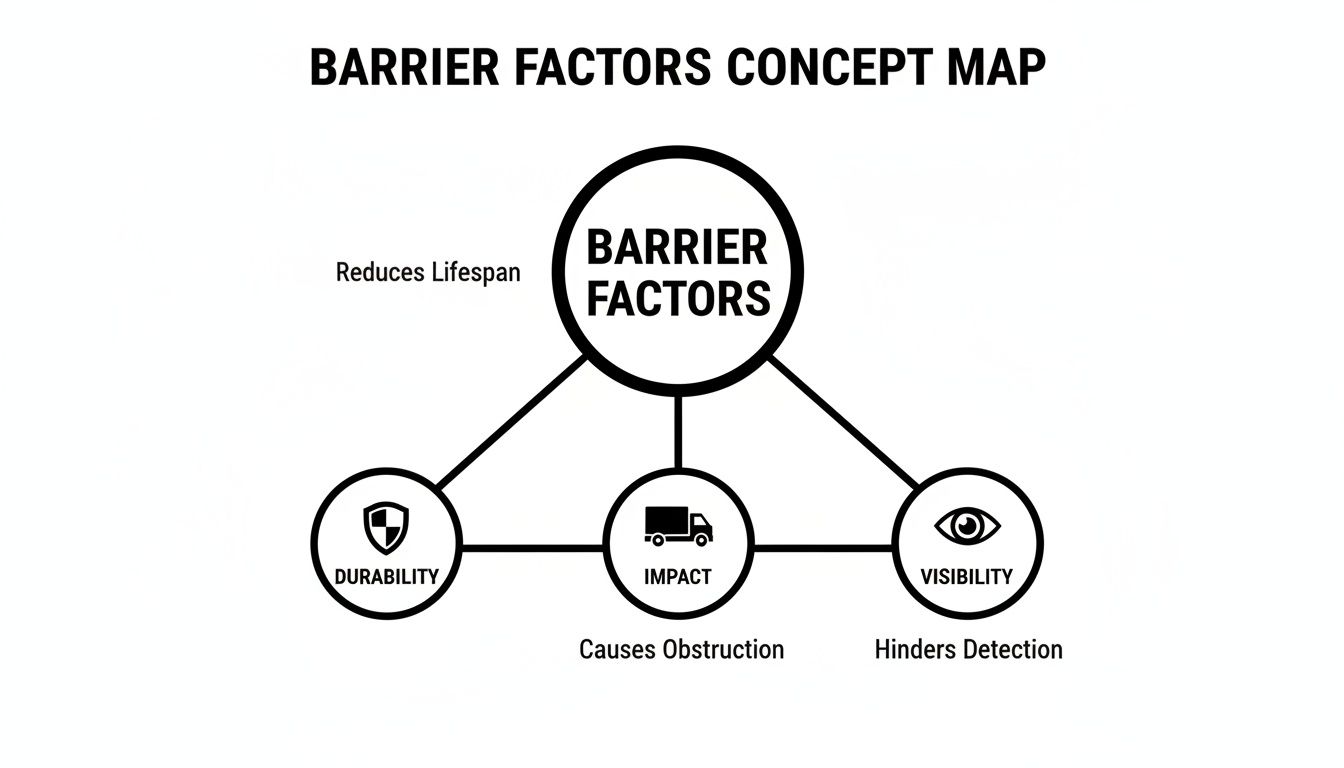
As you can see, these aren't isolated features; they work together to create a solution that actually performs when you need it most.
Aligning Barriers with Pavement Markings
The best parking lots have barriers and markings that are in perfect sync. They tell the same story, reinforcing the rules of the road on your property. A poorly placed wheel stop can make an expertly striped stall useless, just as a bollard installed too close to a crosswalk can create a brand new hazard.
- Wheel Stops: These need to be set so a typical car's front end overhangs the block without jutting into a walkway. A common mistake is putting them too far back, which effectively shortens the space and encourages sloppy parking.
- Bollards: When protecting a storefront or walkway, you need to space bollards far enough apart for comfortable pedestrian and wheelchair access—usually 3 to 5 feet—but close enough to stop a vehicle from getting through.
- Concrete Barriers: Use these to draw hard lines that can't be ignored. They're ideal for defining construction zones or separating traffic lanes where simple painted lines might not be enough of a deterrent.
A well-planned layout considers both the physical barrier and the visual cues of the striping. This synergy creates an intuitive environment where drivers and pedestrians naturally understand where they are supposed to go.
Ensuring Compliance with ADA and Fire Codes
Beyond just good sense, barrier placement is strictly governed by legal codes, especially the Americans with Disabilities Act (ADA) and local fire lane regulations. Misplacing a barrier isn't just a logistical hiccup; it can lead to hefty fines and serious liability.
This is particularly crucial for accessible parking. A 2024 survey found that a staggering 69% of people with disabilities struggle to find accessible parking. Even more concerning, 52% have had to cancel essential trips because of it. Barriers that block access aisles or curb ramps make these vital spaces unusable. You can read more in the Accessible Parking Coalition's survey results.
Key Placement Rules for Compliance
To stay out of trouble and ensure your property is safe for everyone—including first responders—you need to stick to these non-negotiable guidelines:
- Maintain Clear Fire Lanes: Absolutely nothing can obstruct a designated fire lane. Not a planter, not a bollard, not even a "temporary" concrete block. These areas must be completely clear for emergency vehicle access, period.
- Protect ADA Access Aisles: Those striped aisles next to accessible parking stalls aren't optional buffers. They must be kept free of any obstruction, including wheel stops that could become a tripping hazard for someone using a mobility device.
- Preserve Accessible Routes: Barriers cannot block the designated path from an accessible parking space to the building entrance. This route must be at least 36 inches wide and completely clear of obstacles.
Ultimately, strategic placement is about building a system where every element has a purpose. It takes a solid understanding of traffic flow, human behavior, and the specific codes that govern commercial properties here in the Houston area. Getting it right ensures your investment in barriers truly pays off in enhanced safety and compliance.
Getting it Done Right: Installation, Maintenance, and Long-Term Value
Choosing the right barriers for your parking lot is the first step, but the job is far from over. A barrier is only as good as its installation, and its lifespan depends entirely on proper upkeep. Without a professional installation, even the most heavy-duty bollard is just for show.
Let’s break down what goes into a secure installation and how to make sure your investment protects your property for years to come.
Think of it like the foundation of a house. You wouldn't trust an amateur to pour the concrete that holds everything up, right? The same logic applies here. The long-term reliability of your safety barriers hinges on getting the installation right from day one.
The Two Core Installation Methods
When it's time to anchor barriers, professional installers typically rely on one of two methods. The right choice depends on the ground surface and how much impact the barrier needs to withstand.
Surface-Mounted Installation: This is the go-to for existing concrete surfaces. We secure the barrier's base plate directly onto the concrete with heavy-duty anchor bolts. It's a faster, less disruptive process that works perfectly for lower-impact applications like rubber wheel stops or decorative bollards.
Core-Drilled Installation: For true stopping power, this is the industry standard. Using a specialized drill, we cut a deep, clean hole into the substrate. The steel pipe bollard is then set into the hole and anchored with fresh concrete, creating a rock-solid installation that can take a serious hit.
A professional installer knows that anchoring a high-impact bollard directly into asphalt is a recipe for failure. For asphalt lots, a dedicated concrete footing must be poured first to provide the unyielding stability needed to stop a vehicle.
A Practical Maintenance Checklist for Property Managers
Your barriers aren't a "set it and forget it" asset. Regular check-ups are critical, especially in Houston’s climate where the intense sun, heat, and humidity work against you. A simple routine inspection can catch small problems before they turn into big liabilities.
Here’s a straightforward checklist to follow:
- Inspect for Physical Damage: Check barriers immediately after any known vehicle impact. Look for dents, deep scrapes, or any sign that the base has shifted or loosened. A damaged barrier won't offer the same protection in a second collision.
- Check for Corrosion and Cracking: Houston's humidity is tough on materials. For steel bollards, check for chips in the paint or powder coating where rust can creep in. On concrete barriers, look for new cracks or crumbling that could compromise their strength.
- Ensure High Visibility: A barrier only works if drivers see it. Keep them clean from dirt and grime. Most importantly, check that any reflective tape is still bright and fully adhered—reapply it as soon as it starts peeling or fading.
Framing the Investment: It's About Long-Term Value
It’s tempting to just look at the upfront cost, with a basic steel bollard often starting in the $75 to $300 range before installation. But that’s a shortsighted view. The real calculation is about long-term value and return on investment (ROI).
The true cost isn't the price of the bollard. It’s the cost of a vehicle crashing into your storefront, the liability from a pedestrian injury, or the recurring expense of repairing damaged sidewalks and landscaping. When you see it that way, professional installation and simple maintenance are small investments that prevent enormous financial and safety risks down the road.
Integrating Barriers with a Complete Pavement Management Plan
Thinking of parking lot barriers as a one-off project is a common mistake, and it can be a costly one. The safest, most durable, and fully compliant parking lots are built when these physical guides are treated as a critical piece of a much larger puzzle: your overall pavement management strategy. It’s all about seeing the system—barriers, markings, and pavement condition—as interconnected parts that have to work together.
This integrated approach sidesteps the headaches and rework that pop up when you tackle these jobs separately. For instance, planning your barrier placement before you re-stripe the lot ensures your physical guides and painted lines are in perfect sync. You avoid the classic blunder of a new wheel stop blocking a freshly painted ADA access aisle or a bollard making a prime parking stall unusable.
A Holistic Approach to Pavement Safety
When you coordinate these services, the result is seamless. Having the same experienced team handle your line striping, ADA markings, and barrier installation guarantees consistency in both quality and compliance. This eliminates the communication breakdowns that often happen between different vendors, making sure every element is placed correctly the first time.
Let's talk safety for a moment. Research into urban walkability found that parking lots scored a dismal 23% on objective safety metrics—people just don't feel as safe there as they do on roads or sidewalks. By integrating physical barriers like bollards and planters with clearly marked crosswalks, you create defined, protected pathways that directly address those fears. You can dive deeper into how physical design impacts pedestrian safety by reading the full research on walkability.
The Value of a Single Expert Partner
Working with a single, trusted contractor for all your pavement marking and safety needs brings some major advantages. It simplifies project management, gives you a single point of contact for accountability, and ensures a consistent standard of quality across your entire property. From the sealcoat that extends your pavement’s life to the bollards protecting your storefront, a coordinated plan is simply more efficient and budget-friendly in the long run.
A complete pavement plan treats your parking lot like the critical asset it is. By integrating barrier installation with essential maintenance like striping and repairs, you create a safer, more professional environment that protects your investment and reduces long-term liability.
At Houston Parking Lot Striping, we bring over 15 years of pavement marking expertise to every job, including the expert installation of wheel stops and bollards. This comprehensive approach means your lot isn't just freshly painted—it's truly safe, compliant, and well-organized. To learn more about taking care of the asphalt itself, check out our guide on professional parking lot repair.
Contact us today for a free estimate, and let's build a complete safety plan for your Houston property.
Your Parking Lot Barrier Questions, Answered
Even the best-laid plans can bring up questions. When it comes to choosing the right barriers for parking lots, a little expert insight goes a long way. Here are the answers to some of the most common questions we hear from Houston property managers and contractors.
What's the Difference Between a Bollard and a Wheel Stop?
This is a classic, and the answer comes down to purpose: vertical protection versus horizontal guidance.
A bollard is a strong vertical post. Its main job is to act like a bodyguard for your building, storefront, or pedestrian areas, stopping a vehicle in its tracks before it can cause damage or injury.
A wheel stop, on the other hand, is a low-profile horizontal block you see at the front of a parking space. It’s not meant to stop a speeding car; it’s a gentle reminder for a driver to stop before their vehicle hangs over a curb or bumps into a wall. Think of it as a parking guide.
How Do I Know if My Property Really Needs Barriers?
Frankly, almost every commercial property can benefit from some type of barrier. The real question is which kind and where.
You almost certainly need them if:
- Parking spots are right up against your glass storefront or building entrance (you'll want bollards here).
- Vehicles can easily overhang sidewalks where people walk (wheel stops are essential).
- Drivers seem confused about where to go, creating chaotic traffic flow (curbs or planters can create clear pathways).
- You have vulnerable utilities, like gas meters, transformers, or fire hydrants, exposed to traffic.
A quick walk around your property can reveal these risks. A professional assessment will pinpoint the high-priority zones where installing barriers can immediately boost safety and cut down your liability.
Can I Just Install These Myself to Save a Few Bucks?
While the DIY spirit is admirable for some projects, this isn't one of them. Professional installation isn't just a suggestion; it's critical for any barrier that’s supposed to provide real safety.
An improperly installed bollard, for example, is just a piece of metal waiting to fail. It won't stand up to impact, creating a false sense of security and a huge liability risk.
Professionals handle the critical details: digging the correct footing depth, using the right anchors for asphalt versus concrete, and ensuring every placement meets strict ADA and fire code regulations. The cost of a barrier failing—in property damage, potential injuries, or fines—is exponentially higher than the savings from a DIY job.
Proper installation turns a simple product into a reliable safety system. It's an investment in protecting your property and the people on it, giving you genuine peace of mind.
At Houston Parking Lot Striping, we do more than just paint lines; we engineer safe, efficient, and compliant parking environments. Contact us for a free estimate on professional barrier installation and to discuss a complete pavement management plan for your property.