

What Are Bollards Used For? A Guide to Safety and Protection
At its most basic, a bollard is a short, sturdy post. But to dismiss it as just that is to miss the point entirely. Think of bollards as the unsung heroes of a commercial property—the silent guardians standing watch over storefronts, guiding cars through busy lots, and carving out safe spaces for people to walk.
What Are Bollards Actually Used For?
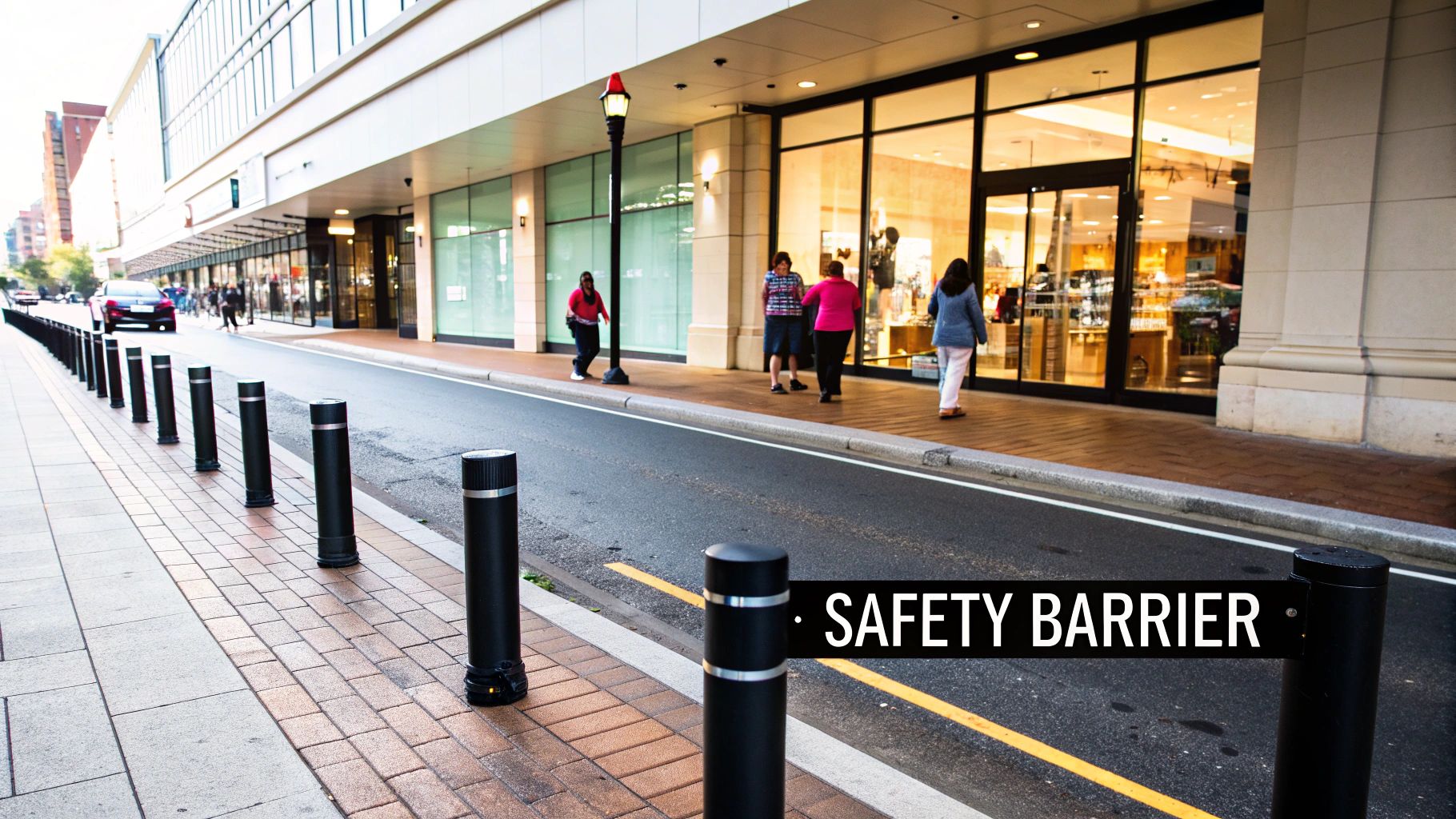
We see them everywhere, from the local grocery store to downtown Houston office buildings, but what job are they doing? In short, bollards create a clear physical and visual line in the sand between vehicles and areas where they don’t belong. Their purpose is to boost safety, tighten up security, and bring order to the controlled chaos of a busy commercial property.
These simple posts are engineered to stop costly accidents before they happen, prevent smash-and-grab robberies, and generally make a property feel more organized and secure. For any property manager or contractor, understanding this makes one thing clear: bollards aren't an expense. They're a fundamental investment in safety and operational integrity.
The Primary Uses of Bollards
While bollards are versatile, their applications generally fall into a few key categories. Each one is designed to solve a specific problem or mitigate a particular risk you'd find on a commercial site.
Protecting Buildings And Assets
This is arguably their most critical job. Bollards act as a shield for the things that are most vulnerable to vehicle impact—storefronts, utility boxes, ATMs, and outdoor equipment. A single runaway car can cause tens of thousands of dollars in damage, and a well-placed bollard is often the only thing standing in the way.
Controlling Vehicle Traffic
In a bustling parking lot, clear direction is everything. Bollards are fantastic for guiding drivers along specific routes, marking no-go zones like fire lanes, and preventing people from cutting across landscaping or pedestrian areas. This simple guidance cuts down on confusion and helps prevent fender benders.
Ensuring Pedestrian Safety
Creating a safe separation between people and cars is non-negotiable. Bollards form a protective barrier around sidewalks, outdoor dining patios, and building entrances, giving pedestrians peace of mind. In a high-traffic retail center, this physical separation is essential.
Enhancing Security And Controlling Access
Beyond accidental impacts, bollards are a powerful deterrent against intentional threats. They are a property's first line of defense against ram-raiding, a tactic where thieves use a vehicle to smash through an entrance. A properly installed security bollard can stop a vehicle dead in its tracks.
To make these functions easier to understand, here's a quick breakdown of where and why you see bollards in action.
Primary Uses of Bollards At a Glance
| Primary Use | Key Function | Common Locations |
|---|---|---|
| Asset Protection | Shielding vulnerable structures from vehicle impact | Storefronts, gas pumps, utility meters, ATMs |
| Traffic Control | Guiding vehicle flow and restricting access | Parking lot entrances, drive-thrus, fire lanes |
| Pedestrian Safety | Separating walkways from vehicle traffic areas | Sidewalks, crosswalks, outdoor seating areas |
| Security | Preventing unauthorized vehicle access and ram-raids | Building perimeters, government buildings, stadiums |
This table shows just how multifaceted these simple posts are. From directing a minivan in a parking lot to stopping a deliberate attack, their role is both broad and vital for a well-managed property.
Why Bollards Have Become A Necessity
The need for strong physical barriers has never been greater. Statistics paint a sobering picture: in the U.S. alone, vehicle-into-building crashes cause over 400 injuries and 500 deaths each year. The targets are often commercial properties, with 23% hitting retail stores and 19% crashing into restaurants. These aren't just numbers; they represent real risks that property owners in places like Houston face every day. You can find more data on this from security experts at Tymetal.com.
By installing bollards, a property manager does more than just protect the building—they show a clear commitment to public safety. This proactive stance can also help lower insurance premiums and reduce liability in the event of an incident. In the end, a thoughtful bollard installation is a core part of any smart property management plan. It’s one of the most effective ways you can increase property value with strategic improvements.
How Bollards Protect Commercial Properties
You can define a bollard all day long, but its real value shows up in the field. Out there, they're the unsung heroes of commercial property safety. These aren't just passive posts sitting on a sidewalk; they are an active, around-the-clock part of your property's safety and security plan, preventing accidents, deterring crime, and protecting your bottom line.
Think about the front entrance of a busy Houston shopping center. You’ve got cars pulling up, dropping people off, and trying to navigate a tight space. All it takes is one mistake—a foot slipping from the brake to the gas pedal—for a car to jump the curb. Suddenly, you have a vehicle on the sidewalk, endangering pedestrians and possibly heading straight through a glass storefront. That's exactly where bollards earn their keep.
A line of strategically placed bollards creates a simple, unyielding physical barrier. They stand guard, making sure cars stay where they belong and people have a safe space to walk. It's not a suggestion; it's a physical reality that gives everyone—customers, employees, and tenants—a crucial sense of security.
Shielding Vulnerable Assets from Impact
Walk around any commercial property, and you'll see critical, expensive equipment sitting just feet from moving vehicles. We're talking about the things that keep the lights on and the business running: utility boxes, fire hydrants, massive HVAC units, and ATMs. A simple parking miscalculation can turn into a major headache, causing expensive damage and operational downtime.
This is where bollards act as a kind of armor. By placing a few sturdy posts around a transformer or gas meter, you create a protective cage that can take a hit from a car or truck. It's a straightforward fix that prevents a fender-bender from becoming a catastrophe that shuts your business down for days.
Fortifying Perimeters Against Unauthorized Access
Bollards do more than just stop accidents; they’re also a frontline defense against deliberate threats. For any storefront, one of the biggest security worries is a "ram-raid," where criminals use a vehicle as a battering ram to smash through an entrance and grab merchandise.
A well-planned line of security bollards is one of the most effective ways to stop a ram-raid cold. These are engineered to halt a moving vehicle, making it physically impossible to breach the building. An easily shattered glass storefront becomes a much harder target.
A perimeter fortified with bollards sends a powerful message to would-be criminals: this property is protected, so move along. It's both a physical obstacle and a strong visual deterrent. For businesses with high-value inventory or those in higher-crime areas, this level of protection is essential.
The Growing Importance of Bollard Security
You don't have to look far to see that bollards are becoming a critical piece of modern infrastructure. The global market for automated barriers and bollards is expected to jump from $2.43 billion in 2025 to $4.28 billion by 2034. North America is a huge part of that, making up a significant 36% share in 2024.
This trend is all about the growing need to secure areas with heavy foot traffic and protect against new threats. You see it in cities like Amsterdam, where they use bollards everywhere to manage traffic on tight streets and keep cyclists and pedestrians safe in tourist-heavy zones. You can find more details on the growth of the bollards market on PrecedenceResearch.com.
Choosing the Right Bollard for Your Needs
Picking the right bollard isn't as simple as pointing to one in a catalog. It's a decision that has to be grounded in what you’re trying to accomplish on your property. You wouldn't use a simple parking block to guard a bank entrance, and in the same way, the wrong bollard can be an expensive mistake that doesn't actually solve your problem. The whole game is matching the bollard's function, material, and type to the real-world demands of your site.
It all boils down to one fundamental question: what, or who, needs protecting? This decision tree is a great way to visualize how that single question guides you to the right solution.
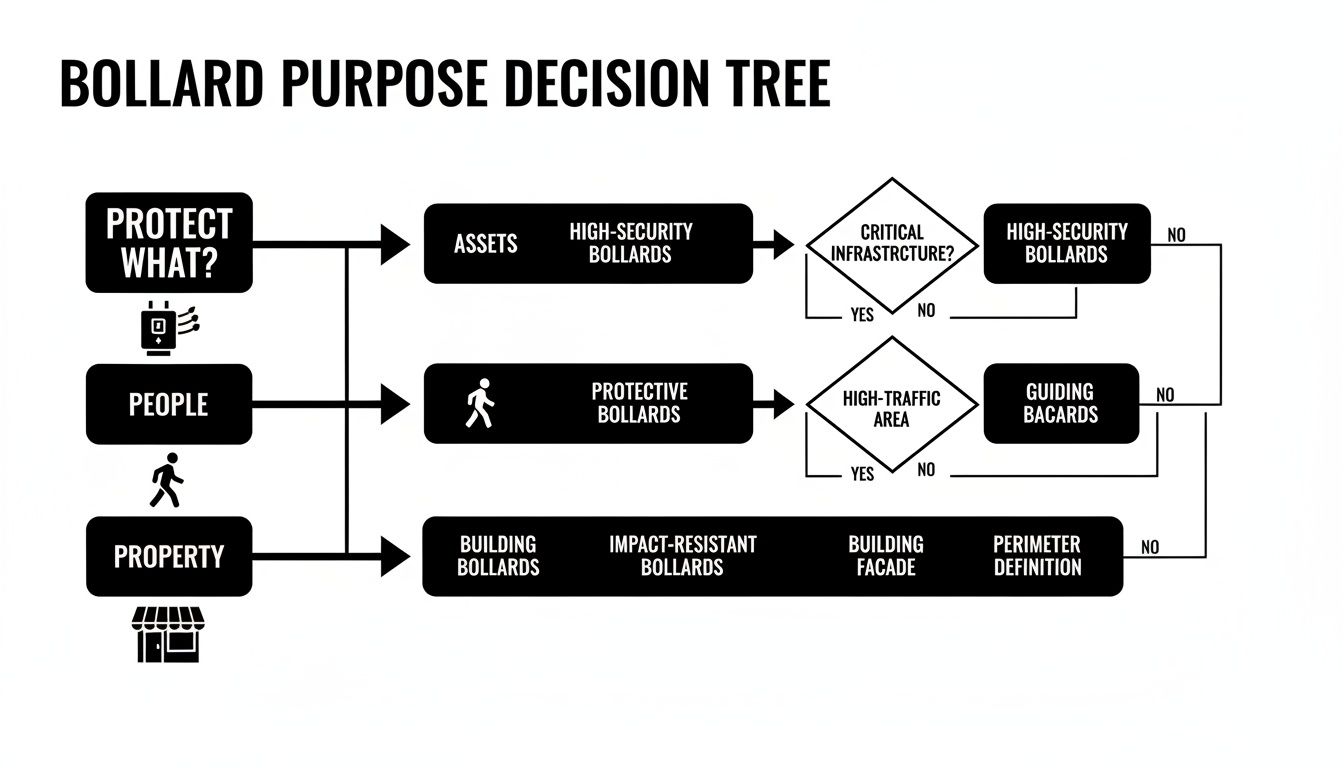
As you can see, your primary goal—whether it's protecting assets, people, or the building itself—is the first and most important step in narrowing down your options.
Differentiating Bollard Types by Functionality
Let’s break down the main categories. Getting a handle on these is the first step toward making a smart choice. Each type is engineered for a different balance of security, flexibility, and access, making them suited for very different jobs around a commercial property.
Fixed Bollards: Think of these as the permanent, silent guardians of your property. They are installed deep into the ground with concrete footings, providing 24/7 protection that doesn't clock out. Fixed bollards are the go-to solution for areas that need constant security without exception—think storefronts, vulnerable utility boxes, and pedestrian-only walkways.
Removable Bollards: Here’s where you get a smart blend of security and flexibility. Removable bollards can be unlocked from their ground sleeves and lifted out, allowing temporary vehicle access when needed. They're perfect for places like public plazas that host farmer's markets, or for securing fire lanes that need to be clear for emergency services but blocked the rest of the time.
Retractable Bollards: Also known as telescopic bollards, these are the most dynamic option for controlling access. With the turn of a key or the push of a button, they can retreat into the ground to allow a vehicle to pass and rise back up to secure the perimeter. You’ll see these at high-security facilities, government buildings, and private drives where access needs to be strictly managed on a case-by-case basis.
Decorative Bollards: Who says security can't look good? Decorative bollards prove that function and form can coexist beautifully. They combine architectural aesthetics with reliable protection, often made from materials like polished stainless steel or finished to perfectly match a building’s design. They protect your property while genuinely enhancing its curb appeal.
To help you decide, this table breaks down how each type of bollard serves a different purpose on a commercial property.
Comparing Bollard Types For Your Property Needs
| Bollard Type | Primary Function | Best For | Common Materials |
|---|---|---|---|
| Fixed | Permanent asset & pedestrian protection | Storefronts, utility meters, building corners, dedicated walkways | Steel, Concrete, Stainless Steel |
| Removable | Securing areas that need occasional vehicle access | Fire lanes, event spaces, delivery zones, public plazas | Steel, Aluminum, Stainless Steel |
| Retractable | Dynamic, on-demand access control | High-security entrances, private driveways, government buildings | Heavy-duty Steel, Stainless Steel |
| Decorative | Combining architectural appeal with light-duty protection | Building entrances, landscape definition, historical districts | Cast Iron, Aluminum, Stainless Steel, Polymer |
Ultimately, the best choice aligns with how you use your space day-to-day. A fixed bollard is great for "set it and forget it" security, while a retractable one offers an active management solution.
Selecting the Right Material for the Job
The material a bollard is made from is everything. It directly dictates its strength, how it will hold up over time, and what it looks like. Picking the right material ensures it can handle not just Houston’s weather, but a potential vehicle impact, too.
The concept of hostile vehicle mitigation (HVM) has become a major focus in public safety planning. With data showing thousands of injuries annually from vehicle-into-building crashes, facility managers now see high-strength bollards as an essential safety tool. You can find detailed analysis on the growing market for HVM solutions and their impact on safety on Fact.MR.
Here are the most common materials you’ll encounter and what they bring to the table:
Steel Bollards: Steel is the undisputed workhorse of the bollard world. It offers incredible strength and impact resistance, and it’s often filled with concrete to create an almost immovable object. Steel bollards are the industry standard for high-security areas, from preventing smash-and-grab robberies at retail stores to protecting federal buildings. For critical applications, always look for crash-rated steel bollards, which have been physically tested and certified to stop a specific vehicle weight at a specific speed.
Concrete Bollards: Known for their sheer mass and brute-force durability, concrete bollards provide a formidable physical barrier. They can be pre-cast into all sorts of shapes and sizes, making them a versatile choice for creating a strong perimeter around parks, stadiums, and sprawling commercial properties.
Stainless Steel Bollards: If you need robust protection without sacrificing a clean, modern look, stainless steel is an outstanding choice. Its inherent resistance to corrosion makes it a perfect fit for Houston's humidity, as it won't rust or degrade. These are a popular pick outside corporate headquarters, upscale shopping centers, and modern buildings where aesthetics are just as important as security.
Strategic Bollard Installation and Placement
Choosing the right bollard is only half the battle. Where and how you install it is what truly determines its effectiveness. Strategic placement is part science, part art, turning a series of simple posts into a robust, unified safety system.
Think of it like setting up a defensive line in football. If the players are scattered randomly, they won't stop anything. The goal is to create a formidable barrier that anticipates threats while still allowing your team—or in this case, pedestrians and approved vehicles—to move freely.
Poorly planned installations can create more problems than they solve. They can block fire truck access, create bottlenecks for people with disabilities, or worse, fail to stop a vehicle from a vulnerable angle. This is why professional planning isn't just a good idea; it's essential for getting the security and compliance you need.
Key Placement Considerations
To build an effective defense, you have to know the field. For a commercial property, that means analyzing vehicle traffic patterns, common pedestrian pathways, and your most critical vulnerabilities.
A fundamental decision is how the bollards will be anchored. Surface-mounted bollards are bolted directly onto an existing concrete slab, which makes for a quick and less disruptive installation. They are a great fit for guiding traffic inside a parking garage or in areas where you can't dig deep.
On the other hand, in-ground bollards are set deep into concrete footings. This method offers far superior impact resistance because it transfers the massive force of a collision directly into the ground. For high-security needs, like protecting a storefront from a ram-raid, this is the only way to go.
The installation method you choose has to match the risk you're trying to prevent. A surface-mounted bollard can direct a slow-moving car, but only a deeply embedded, in-ground bollard has the raw stopping power needed to thwart a determined vehicle attack.
Balancing Security with Accessibility
A truly successful bollard layout protects your property without getting in the way of people. This is where navigating local codes and accessibility standards becomes absolutely critical.
You have to get these non-negotiable details right:
- ADA Compliance: Bollards need enough space between them for wheelchairs and other mobility devices to pass through comfortably. The standard is typically a clear width of at least 36 inches, but it's always smart to double-check specific Houston-area regulations.
- Emergency Vehicle Access: Fire lanes and emergency access routes must remain completely clear. This is the perfect application for removable or retractable bollards, which provide solid security but can be quickly taken down by first responders when seconds count.
- Subsurface Conditions: Before you ever break ground, you must know what's buried underneath. Hidden utility lines, water pipes, and poor soil conditions will dictate where and how deep you can install your bollards. Hitting a gas line can turn a simple safety project into a very expensive emergency.
Thinking through bollard placement from the beginning is a key part of any good property design. If you're in the planning stages of a new commercial lot, you can see how these pieces fit into the larger puzzle in our guide to parking lot layout design. Smart planning ensures safety, compliance, and functionality work together from day one.
Comparing Bollards with Other Safety Barriers
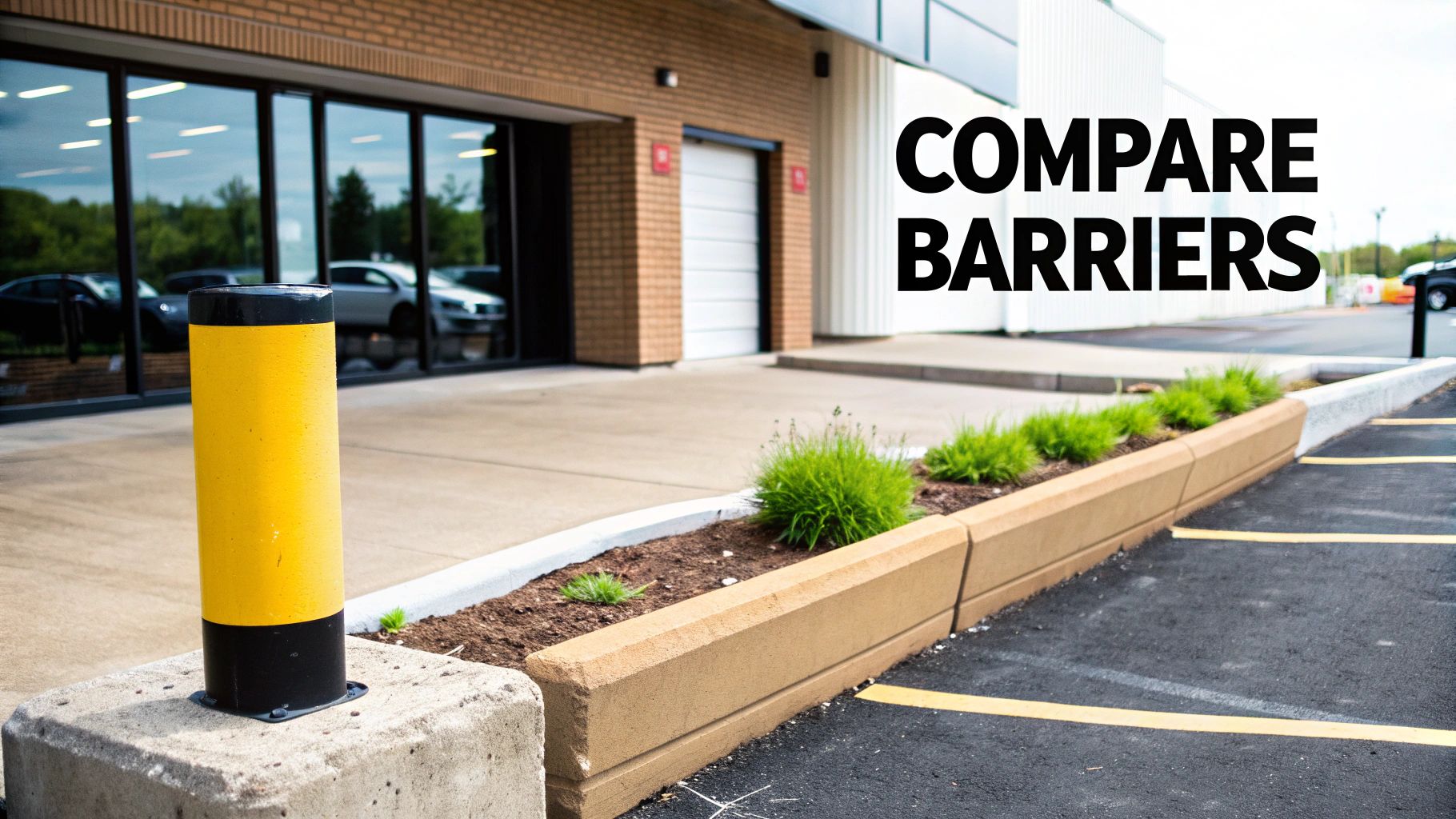
While bollards are fantastic for stopping vehicles in their tracks, they're just one tool in a much larger property safety toolbox. To make the right call for your site, you need to understand where bollards shine and how they compare to other common barriers. Each solution has a specific job, and picking the right one is crucial for creating a space that’s both safe and easy to navigate.
Think of it like this: you wouldn't use a hammer to turn a screw. In the same way, the unique risks at your Houston property will determine whether you need the brute-force stopping power of a bollard or the gentle guidance of a wheel stop.
Bollards vs. Parking Blocks
Parking blocks—you might know them as wheel stops or car stops—are everywhere in commercial lots. Their job is simple and specific: they keep a car from rolling too far forward into a parking space. This prevents vehicles from bumping into walls, jumping curbs, or creeping into pedestrian walkways.
But that's where their utility ends. A parking block is only meant for low-speed guidance. It offers zero protection against a vehicle moving with any real speed or intent. A car can easily drive right over one, meaning it will do nothing to stop an accidental acceleration or a deliberate ramming. This difference is the most important thing to grasp when deciding between the two.
Bollards are designed for high-impact resistance to stop a moving vehicle, protecting storefronts and people. Parking blocks simply help position a parked car and offer no real security against a vehicle in motion.
Bollards vs. Concrete Planters
Large concrete planters are a popular choice when property owners want a more decorative barrier. They can look great, adding a touch of green while creating a physical obstacle. For defining spaces like an outdoor cafe patio or marking a pedestrian-only zone, they can certainly be effective.
The problem is their inconsistent impact resistance. A heavy, well-made planter might deflect a slow-moving car, but most aren't engineered or anchored to stop a direct, high-speed hit. When struck, they can shatter into dangerous projectiles or slide out of the way, completely failing to stop the threat.
- Bollards: Engineered and installed for predictable, reliable stopping power.
- Planters: Offer visual separation and some low-speed resistance, but you can't count on them in a real impact scenario.
Bollards vs. Guardrails
You see guardrails everywhere along highways and around the edges of large industrial properties. They are specifically designed to deflect vehicles that hit them at an angle, keeping them from running off the road or into a dangerous area. They excel at managing traffic flow along a continuous edge, like the side of a building or a drop-off.
The key difference lies in how they handle a direct, head-on impact. A guardrail is built to absorb and redirect that energy along its entire length. A bollard, especially a crash-rated one, is designed to absorb and stop that force dead at a single point. If you need to protect a specific target—like a storefront entrance, a gas meter, or an ATM—from a perpendicular approach, a bollard is the clear winner.
To get a better feel for how these systems fit together, take a look at our complete guide to the different barriers for parking lots.
Your Top Bollard Questions Answered
To wrap things up, let's tackle some of the most common questions property managers and contractors ask. We'll give you the straightforward, practical answers you need to get your safety planning on the right track.
Can a Bollard Really Stop a Car?
Absolutely, but it's all about choosing the right tool for the job. A standard steel bollard is more than capable of stopping a low-speed vehicle during an accidental bump, like a driver mistaking the gas for the brake.
But for true security against a determined threat, you need to step up to crash-rated bollards. These aren't just strong—they're scientifically tested and certified to stop a specific vehicle weight (say, a 15,000-pound truck) traveling at a specific speed (like 30 mph). The secret is in matching the bollard's rating and its installation depth to the potential risk you're facing.
What's the Price Tag on Bollard Installation?
Bollard costs run the gamut, depending entirely on what you need them to do. It helps to think of it on a scale from simple visual guides to high-impact security barriers.
- Basic Steel Bollards: If you just need visual traffic guides or protection from low-speed bumps, you can expect a starting cost of around $200 to $1,000 per bollard, before installation.
- Retractable or Removable Bollards: For flexible access control, these models have more moving parts and typically fall in the $1,000 to $3,000 range.
- Crash-Rated Bollards: When you need to protect high-value assets like banks or government buildings, these engineered systems can run from $1,500 to well over $10,000 per unit.
Installation costs are a separate factor and depend heavily on whether you’re just surface-mounting them or digging deep concrete footings.
What's the Difference Between a Bollard and a Wheel Stop?
This is a really important distinction, and one that trips up a lot of property managers. A wheel stop (that small concrete or rubber block at the front of a parking space) has one job and one job only: to tell a driver when to stop pulling forward. It offers zero real protection from a vehicle that's actually moving.
A bollard, on the other hand, is a vertical post engineered from the ground up to take a direct hit from a moving vehicle. They might both be found in a parking lot, but their functions are worlds apart. One is for gentle parking guidance; the other is for life and property safety.
Here's the bottom line: Wheel stops position parked cars. Bollards protect people and property from moving cars. Mistaking one for the other creates a dangerous false sense of security.
Are There Rules for Where I Can Put Bollards?
Yes, and they’re not something you can ignore. The placement of bollards is governed by some key regulations, mostly centered on accessibility and emergency access.
The Americans with Disabilities Act (ADA) has strict rules about spacing to ensure people using wheelchairs can get through. You generally need to maintain a clear path of at least 36 inches between posts.
On top of that, you have to follow local fire codes. You can't just put bollards anywhere they might block a fire lane or an emergency access route. This is precisely why removable or retractable bollards are so useful—first responders can clear the path when every second counts. Your best bet is always to work with a professional installer who knows the specific codes here in the Houston area.
Protecting your commercial property requires expertise and precision. The team at Houston Parking Lot Striping has over 15 years of experience installing bollards that meet safety, security, and compliance needs across the Greater Houston area. From planning the right layout to professional installation, we ensure your assets and people are properly protected.
Ready to secure your property? Get a free, no-obligation estimate for your bollard installation at https://houstonparkinglotstriping.com.