How much does parking lot striping cost? A Practical Guide to Pricing
When you're putting together a budget for property maintenance, one of the first questions that always comes up is, how much does parking lot striping cost? The short answer is that most straightforward restriping jobs land somewhere between $500 and $1,000, with a common average hovering around $750.
But that's just a starting point. The final price tag really hinges on what your specific lot needs.
Your Guide To Parking Lot Striping Costs
Getting a handle on parking lot striping costs is a must for any property manager, general contractor, or business owner. A freshly striped lot isn't just about looking good; it's about keeping people safe, making the most of your parking space, and staying compliant with local laws. This essential maintenance task enhances curb appeal and ensures a safe, organized environment for both drivers and pedestrians.
Think of your parking lot as the first handshake you offer a customer. Crisp, clear lines make a great first impression, signaling that you're professional and you care about the details. This immediate visual impact communicates a commitment to safety and quality before visitors even step out of their vehicles.
On the flip side, faded, confusing, or cracked markings can cause fender-benders, waste valuable space, and even open you up to liability issues. That's why investing in this service is so important for your property’s curb appeal and overall function. This guide will walk you through the typical expenses so you can frame a realistic budget and know what to look for in a professional quote.
A Quick Look At The Numbers
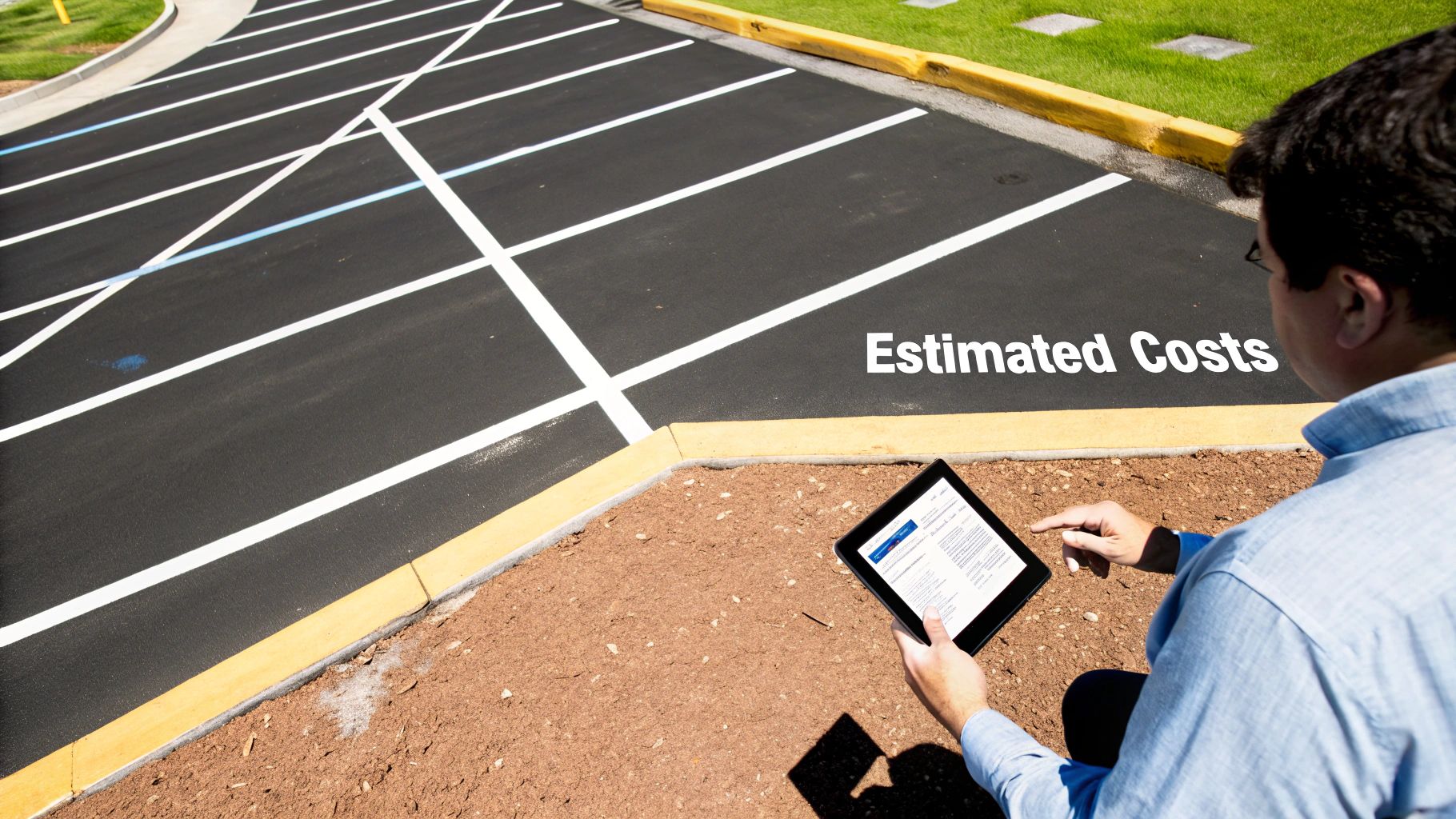
Let's get down to some real-world figures. For a standard lot with about 100 stalls (which usually covers 25,000 to 40,000 square feet), you can expect the cost to be in the $800 to $1,000 range. This typically covers a basic restripe of existing lines.
If you have a smaller lot with maybe 30-50 spaces, the price is often closer to $425. Just keep in mind that with smaller jobs, the minimum mobilization fee ($250 to $350) makes up a bigger chunk of the total cost. You can learn more about how parking lot maintenance costs break down for different project sizes.
To give you a clearer snapshot, we've put together a table with common services and their average costs. This is a great reference to have handy when you start planning your project and reaching out for quotes.
Parking Lot Striping Costs At A Glance
| Service Or Unit | Average Cost Range |
|---|---|
| Standard Parking Stall (4-inch line) | $4 – $10 per stall |
| Per Linear Foot (4-inch line) | $0.25 – $0.75 per foot |
| ADA Handicap Stencil | $25 – $50 per stencil |
| Directional Arrows | $15 – $30 per arrow |
| Stop Bars | $20 – $40 per bar |
| Fire Lane Stenciling | $20 – $50 per stencil |
| Curb Painting | $0.75 – $2.00 per linear foot |
| Line Removal | $1.00 – $3.00 per linear foot |
| Mobilization/Setup Fee (Minimum Charge) | $250 – $500 |
This table gives you a solid baseline for what to expect, but remember that every project is unique.
Why Prices Vary
It's really important to see these numbers as averages. Your final project cost will be influenced by several factors, which we'll dive into throughout this guide.
The condition of your pavement, the type of paint you choose, and the complexity of the layout all play a huge role in the final quote. A simple re-stripe on a smooth, clean surface will always be more affordable than a brand-new layout on cracked, damaged asphalt.
At the end of the day, knowing these ballpark figures helps you set a realistic budget. As we go on, we’ll break down how contractors structure their quotes and which variables will move the needle on your price, giving you the confidence to make a smart decision for your Houston property.
Making Sense of Your Striping Quote
When a parking lot striping quote lands on your desk, it can feel a bit like trying to read a different language. You'll see terms like "linear feet" and "per stall," and it’s easy to get bogged down in the jargon. But once you understand the common ways contractors price their work, you can compare bids like a pro and get a real handle on how much parking lot striping will cost for your property.
Most professionals in the Houston area use one of three main pricing models. Each has its place depending on the job, and knowing the difference helps you see exactly what you're paying for. This isn't just about the bottom line; it's about making sure you get the best value and the right approach for your specific lot.
Pricing Per Linear Foot
Think of this model as paying for exactly what you get, down to the inch. You’re charged for the total length of every line painted on the pavement. This method is the most precise and is the go-to for lots with unique layouts, custom markings, or a lot of different elements beyond simple parking spaces.
It's the perfect fit for projects that involve more than just stalls, like:
- Long, continuous fire lane boundaries
- Custom-painted cross-hatching in "No Parking" zones
- Painting the curbs along medians or walkways
Looking at the cost breakdown, a standard stall line usually runs about $0.25 per linear foot, making the line itself just $4-$5. Bigger jobs like painting fire lane cross-hatching can be $0.20 to $0.40 per foot, and curbs are often $0.75 to $1.00. Other common markings, like a stop bar, might cost $20-$30, while directional arrows are typically in the $10-$20 range.
Pricing Per Stall
This is the most common and straightforward way to price a standard job. Just like it sounds, the contractor charges a flat rate for every parking space they stripe. This is the ideal model for typical parking lots—think retail centers, office parks, and apartment complexes—where the job is mostly about painting uniform stalls.
The beauty of this model is its simplicity. You can quickly get a solid cost estimate by just multiplying your number of stalls by the contractor's rate. However, you need to be clear on what that rate includes. Does it cover just the two white lines, or are stop bars and other markings part of the deal?
Pro Tip: Always ask your contractor what’s included in their "per stall" price. You need to know if it's just the stall lines or if things like stenciling, numbering, or ADA handicap parking space requirements are priced separately.
Pricing By The Hour
Finally, you might see an hourly rate. This isn't as common for a straightforward re-stripe, but it's essential for jobs where the scope is hard to nail down from the start. We typically use this for complex new layouts from blueprints, intricate repair work, or heavy-duty line removal that requires specialized grinding equipment.
An hourly rate gives the contractor the flexibility to deal with unforeseen challenges on the job. While it makes precise budgeting a little tougher for the property owner, it ensures the job gets done right. If you get an hourly quote, it’s smart to ask for a "not-to-exceed" number to keep the budget in check.
What Really Drives Your Final Striping Cost?
When you get a few different quotes for a striping job, you might wonder why the numbers vary. It’s because every parking lot has its own story and its own set of needs. The final price tag isn't just about paint and labor; it's a reflection of the specific details of your property. Let's break down the key factors so you can see exactly what goes into a professional quote.
The most obvious factor is, of course, the size of your lot. A massive lot with hundreds of stalls is going to cost more overall than a small storefront with just a dozen spots. But here's where it gets interesting: bigger projects often benefit from economies of scale. The cost per stall or per linear foot usually drops on larger jobs because the crew's setup and travel time are spread out over more work.
Pavement Condition and Prep Work
The current state of your asphalt is a huge variable. Think of it like painting a room in your house—you wouldn't just slap a new coat of paint over cracked, peeling walls, right? The same logic applies here. A smooth, clean, recently sealed surface is the perfect canvas. The paint goes down easy and sticks like it should.
But if your lot has seen better days, with cracks, potholes, or layers of grime, there's some prep work to be done first. This isn't just about making things look pretty; it’s about making the new lines last.
This prep work can include:
- Power Washing: Blasting away the dirt, oil, and gunk that prevents fresh paint from bonding to the asphalt.
- Crack Sealing: Filling in cracks to create a smooth, solid surface for the paint to lay on.
- Pothole Repair: Patching up any damaged areas for safety and a truly professional finish.
Adding these steps will increase the initial cost, but skipping them is like throwing money away. Without proper prep, your new lines will start to flake and fade in no time.
The Paint You Choose Matters
Not all paint is created equal. The type of material you select has a direct impact on both the upfront cost and how long your stripes will look crisp and clear.
- Water-Based Acrylic Paint: This is the go-to for most re-striping projects. It's a reliable, budget-friendly choice that generally holds up for 1-2 years, depending on how much traffic your lot gets.
- Thermoplastic Paint: This is the heavy-duty option. It's a plastic material that's heated and bonded to the asphalt. It can easily last 3 to 5 times longer than standard paint, but it does come with a higher price tag.
Thermoplastic paint might seem like a bigger investment at first, but its durability often provides a better long-term return. For high-traffic areas, spending more now can save you from having to re-stripe every other year.
Layout Complexity and Removing Old Lines
The complexity of the job itself plays a huge role. The most straightforward and affordable job is a simple re-stripe—we just trace over your existing faded lines. It's quick and efficient.
Things get more involved with a new layout. This is common for brand-new construction or for businesses that want to completely reconfigure their lot to improve traffic flow or add more stalls. It requires precise measurements, chalking out the entire design, and starting from a blank slate. If you're thinking about a fresh start, our guide on effective parking lot layout design is a great resource.
And what if you need to get rid of the old layout first? That’s where line removal comes in. Using powerful grinders or water blasters to erase the old markings is a labor-intensive step that adds to the cost. But it's absolutely necessary if you want a clean, professional look without confusing "ghost lines." Any custom work, like numbered stalls, reserved parking stencils, or company logos, will also factor into the final price.
Putting The Numbers Into Perspective
It's one thing to talk about individual cost factors, but it’s another to see how they all come together on a real-world quote. To give you a better feel for how much parking lot striping costs, let's walk through three common scenarios we see all the time here in Houston. These examples show how the unique needs of different properties, from a small retail strip to a huge industrial lot, result in very different final numbers.
This quick visual breaks down how the size of the job, the condition of your pavement, and the type of paint you choose all build on a base price.
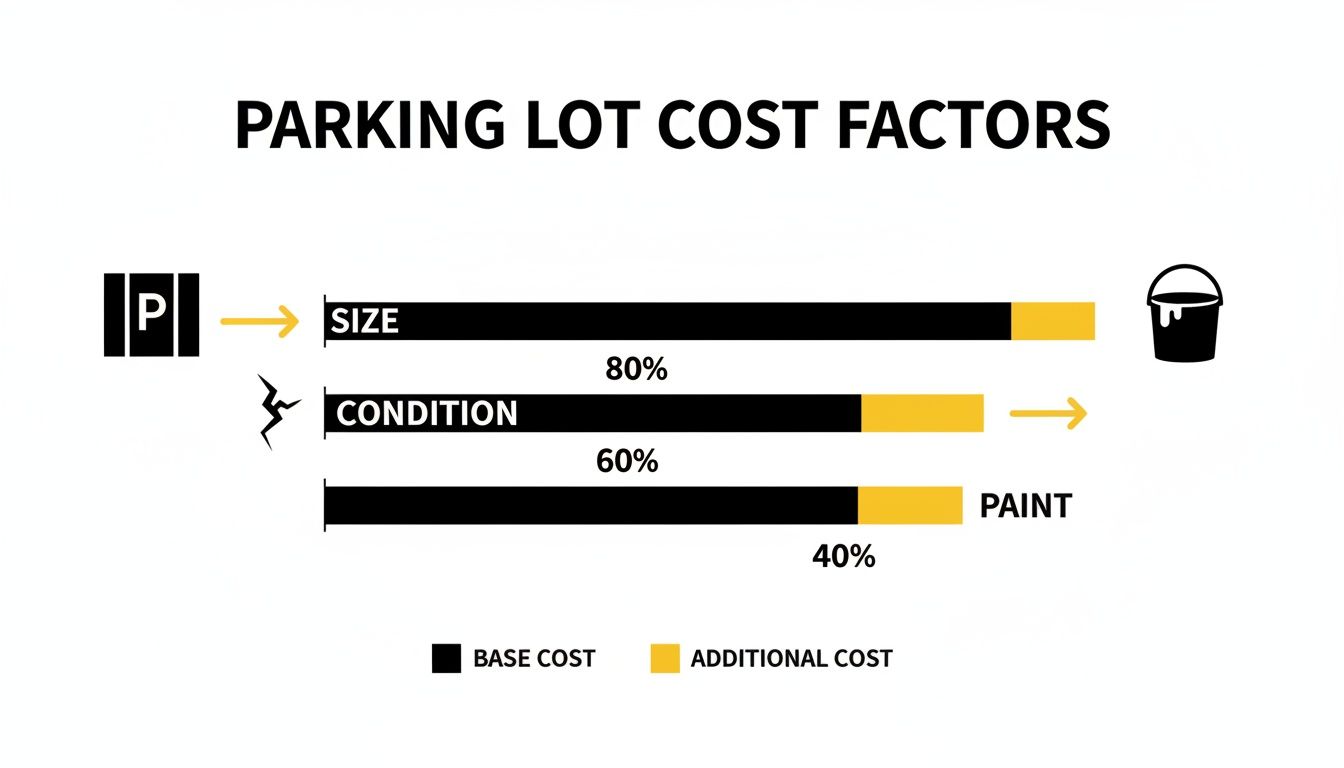
As you can see, the scale of the project sets the foundation, but the prep work and materials are what really shape the final cost.
Scenario 1: Small Retail Plaza Re-Stripe
Let's start with a classic job: a small retail plaza with a 40-stall parking lot. The lines are faded, but the asphalt itself is in decent shape. All it needs is a straightforward re-stripe using a standard water-based acrylic paint. The only specialty work required is marking two ADA-compliant handicap stalls.
Here’s how a quote for that might break down:
- Mobilization Fee: A standard $250 charge to get the crew and equipment out to the site.
- Per-Stall Rate: For a simple re-stripe, a rate of $7 per stall is typical. That brings the 40 stalls to $280.
- ADA Markings: Painting two handicap stencils at $35 each adds another $70.
For this job, the total estimated cost lands right around $600. This really shows how the mobilization fee is a significant chunk of the budget on smaller projects, which is why it’s always a good idea to bundle services if you can.
Scenario 2: Mid-Sized Office Complex
Next up, a mid-sized office building with a 150-stall lot. Because this project is larger, the contractor can usually offer a better per-stall rate. The job involves re-striping all the stalls, freshening up two fire lanes, and adding five new directional arrows to help manage the flow of traffic.
The quote could look something like this:
- Mobilization Fee: This stays consistent at around $250.
- Per-Stall Rate: Here’s where economies of scale help. The rate drops to $5 per stall, for a subtotal of $750.
- Fire Lanes: Refreshing two fire lanes costs approximately $150.
- Directional Arrows: The five new arrows at $20 each add $100.
For a property like this, the total project cost would be about $1,250. It’s a perfect example of how adding essential safety features like fire lanes and clear directional markings contributes to the final investment.
Scenario 3: New Industrial Facility Layout
Finally, let's look at a brand-new industrial facility that needs a complete layout for 200 stalls, plus specialized safety zones. Since this is a new layout on fresh asphalt, it's a much more involved process that requires precise measurements and chalking directly from the blueprints.
- New Layout Rate: The detailed setup involved pushes the rate to $12 per stall, totaling $2,400.
- Safety Markings: This facility needs pedestrian crosswalks ($400) and designated "No Parking" zones ($300).
- Stencils & Arrows: A high volume of directional arrows and custom stencils could easily add another $500.
The total for a complex, new-build project like this could quickly pass $3,600. Recent industry data backs this up, showing that while small lots average around $425, larger 150-stall projects often land closer to $3,880 once you factor in labor, materials, and setup. For a deeper dive into these numbers, you can explore a great analysis of striping cost variables on Angi.com.
Getting A Clear And Accurate Quote
Getting a solid price for your parking lot project doesn't start when you pick up the phone—it starts with a little prep work on your end. The more details you have ready, the more accurate the quote will be. It's a lot like going to the doctor; the better you can describe the symptoms, the faster they can give you a precise diagnosis and treatment plan.
By gathering the right information beforehand, you cut down on the frustrating back-and-forth and help your contractor build a quote that won't have any nasty surprises hiding in the fine print.

Information To Have Ready
Before you reach out for an estimate, try to have these key details handy. It will make the conversation much more efficient and productive for everyone.
- Total Stall Count: What's the exact number of parking spaces that need lines?
- Lot Dimensions: Do you have the approximate square footage? Even a simple diagram of the layout helps immensely.
- Surface Condition: Take a quick walk around. Note any major cracks, potholes, or heavy oil stains that will need to be addressed before painting.
- Scope of Work: Are you just looking for a simple re-stripe over existing lines, or is this a brand-new layout from scratch?
- Specialty Markings: Make a list of everything else you need, like ADA handicap stencils, fire lanes, directional arrows, or any custom lettering.
This is the foundational information every good contractor needs. When you provide these details upfront, they can immediately start putting together a much more realistic initial price for your project.
Critical Questions To Ask Your Contractor
Giving your contractor the right information is only half the battle. You also need to ask the right questions. This is your chance to really understand who you're hiring and gauge the quality and professionalism they bring to the table. A reputable company will have no problem answering these.
A professional's willingness to answer detailed questions about their process, materials, and insurance is a direct reflection of their commitment to quality. Transparency is the hallmark of a trustworthy partner.
Here are five non-negotiable questions you should ask every striping contractor you're considering:
- Are you fully insured? Always, always ask for proof of general liability and workers' compensation insurance. This protects your property and your business from any liability while the crew is on-site.
- What type of paint do you recommend for our lot? A true expert will explain the pros and cons of different paints—like water-based versus thermoplastic—and recommend the best fit for your specific traffic volume and Houston's unique climate.
- How do you handle surface preparation? The longevity of the paint job depends entirely on the prep work. Ask them to walk you through their process for cleaning the surface before a single line is painted.
- How do you ensure ADA compliance? Your contractor needs to be an expert on current ADA standards. They should confidently discuss stall dimensions, access aisle requirements, and correct signage placement.
- What is your process for minimizing business disruption? Find out how they plan to schedule the work. Can they stripe in phases or work during your off-hours to keep your doors open and customers happy?
Asking these questions shows you're an informed client and helps you establish a clear standard for comparing different bids. It ensures you're evaluating contractors on the quality of their work, not just the bottom-line price. For those managing larger commercial projects, developing a detailed checklist is a must. You can find some excellent tips in our article on creating a construction quality control checklist to make sure no detail gets overlooked.
Your Top Questions About Striping Costs, Answered
Once you have a quote in hand, you’re bound to have some practical questions. It's only natural. Thinking through the logistics, how long the new lines will last, and exactly what’s included in the price is just smart property management. Let's dive into some of the most common questions we hear from Houston property managers.
Getting these details ironed out beforehand means no surprises down the road. It ensures the entire project runs smoothly and aligns with your business operations and long-term maintenance plans.
How Often Should A Parking Lot Be Re-Striped?
This is easily one of the most frequent questions we get, and the honest answer is: it depends. The lifespan of your parking lot's paint really boils down to two things: how much traffic you get and the type of paint we put down.
For most commercial properties using standard water-based acrylic paint, you should plan on a re-stripe every 1 to 2 years. Between the constant wear from tires and the relentless Houston sun, fading is just a fact of life.
A well-maintained parking lot is a reflection of your business. Faded, unclear lines can suggest poor upkeep, while crisp, bright markings create a positive and professional first impression for every visitor.
If your lot is a high-traffic hub—think a bustling retail center or a 24/7 industrial facility—you'll likely lean closer to an annual re-stripe to keep things looking sharp and safe. On the flip side, properties with less vehicle turnover might comfortably push that timeframe to the two-year mark.
This is where it can pay to think about more durable materials. While they cost more upfront, options like thermoplastic paint can last 3 to 5 times longer than standard paint. This can mean significant savings in the long run by stretching out the time between maintenance cycles.
Can You Stripe Our Lot In Phases To Keep Our Business Running?
Absolutely. We wouldn't be professionals if we couldn't. We know that for most businesses, completely shutting down the parking lot simply isn't an option.
That’s why we specialize in phased striping. It’s a standard part of our process where we methodically work on one section of your lot at a time, keeping the rest open for your customers and employees. It's all about minimizing disruption.
Here’s how we typically handle phased work:
- Strategic Planning: First, we'll sit down with you to map out a schedule. We’ll identify which sections can be closed off and when, carefully working around your peak business hours.
- Clear Communication: On the day of the job, we use cones, barriers, and temporary signs to clearly direct traffic away from the work zone. No confusion, no mistakes.
- Efficient Execution: Our crew is experienced in working quickly and systematically. We complete each section and let the paint cure properly before moving on to the next, getting your spaces back in service as fast as possible.
This methodical approach ensures your business keeps humming along while we give your lot a fresh look. We’re happy to schedule the work during your slowest periods, overnight, or over a weekend to make it even easier on you.
Is Surface Cleaning Included In The Striping Price?
That's an excellent question, and it gets to a crucial detail that’s often overlooked. Generally, a standard striping quote will include basic prep, like using a power blower to clear away loose leaves, dust, and light debris.
However, if your lot needs a deeper clean, that's almost always a separate line item. Think about it—if you have significant oil spots, caked-on mud, or years of built-up grime, just blowing it off won't cut it. Fresh paint needs a perfectly clean, dry surface to adhere to.
For a durable, professional finish, power washing is a must. It blasts away all the tough contaminants that would cause new paint to peel and fail prematurely. While it does add to the initial cost, it’s a necessary investment to protect the longevity of your new stripes. Always ask your contractor to clarify if power washing is included or if it will be an additional—but highly recommended—charge.
Ready to get a clear, no-surprise quote for your property? The team at Houston Parking Lot Striping has the experience to deliver a precise, durable, and professional finish that keeps your business looking its best. Contact us today for a free, detailed estimate.