

Asphalt vs Concrete: A Clear Guide to Parking Lot Options (asphalt vs concrete)
When you're weighing asphalt against concrete, it really boils down to one question: Are you playing the short game or the long game? Asphalt gets you a lower upfront cost and a faster turnaround, while concrete delivers unmatched durability and a much longer lifespan. For a commercial property in Houston, your decision hangs on whether immediate budget concerns outweigh long-term value.
Foundational Choices for Houston Paving
Choosing the right pavement for a commercial parking lot in the Greater Houston area is a significant capital investment. The material underfoot will dictate your budget, maintenance routines, and even your property's curb appeal for the next several decades. Both asphalt and concrete are made from a mix of sand and stone, but their binders are worlds apart—petroleum-based bitumen for asphalt and Portland cement for concrete—and that's what creates their distinct performance profiles.
This isn't just a simple choice between black and gray. It's about understanding how each surface stands up to Houston's specific challenges, from punishing summer heat to torrential downpours. For general contractors and property managers, this decision sets the tone for the project's timeline and the property's operational costs for years to come.
Key Differentiators at a Glance
Before we get into the weeds of cost-per-square-foot and performance metrics, let's look at the high-level differences. These are the core trade-offs that usually steer the initial conversation on any commercial paving project.
At its heart, the choice is between flexibility and rigidity. Asphalt is a flexible pavement; it can give a little with temperature swings and minor shifts in the ground beneath it. Concrete is rigid, spreading heavy loads over a wide area with incredible efficiency, but it's less forgiving if the sub-base isn't perfectly stable.
This table cuts straight to the chase, outlining the essential give-and-take between the two paving giants.
Asphalt vs. Concrete: A Quick Comparison
| Feature | Asphalt (Flexible Pavement) | Concrete (Rigid Pavement) |
|---|---|---|
| Initial Cost | Lower. You're typically looking at 40-50% less on the initial invoice. | Higher. This requires a much larger upfront capital investment. |
| Installation Speed | Fast. It cures quickly and can handle traffic in just 1-2 days. | Slow. You need to give it at least 7 days to cure before vehicles can use it. |
| Lifespan | Shorter, averaging 20-25 years if you keep up with maintenance. | Longer, easily lasting 30-40+ years under normal wear and tear. |
| Heat Performance | The dark surface soaks up heat and can get soft in extreme Texas temperatures. | Its lighter color reflects sunlight, keeping the surface noticeably cooler. |
| Maintenance Needs | More demanding. Plan on sealcoating every 3-5 years to protect it. | Lower maintenance, mainly involving sealing the joints every few years. |
| Repair Complexity | Simpler and cheaper. Patching and resurfacing is straightforward. | More involved and costly. Repairs often mean cutting out and replacing entire slabs. |
This quick snapshot really sets the stage. While asphalt looks like the winner for budget and speed, concrete's incredible longevity and minimal upkeep make a powerful argument for long-term value. The right answer for your Houston property will come from a careful look at your expected traffic, daily operations, and financial goals—all of which we'll break down next.
Financial Breakdown: Upfront Costs and Lifecycle Value
When you're looking at asphalt versus concrete, the first invoice you see is only chapter one of the financial story. While the upfront cost is a huge factor for most commercial projects, a smart financial analysis looks at the total cost of ownership over the entire life of the pavement. The real decision comes down to balancing that immediate cash outlay against what you'll spend down the road.
Asphalt almost always wins the race on initial installation cost. For a typical commercial lot here in Houston, property managers can expect to pay 40-50% less to install an asphalt surface compared to a concrete one. That's a huge saving, and it comes from a process that's less labor-intensive and gets done faster—minimizing business disruption and getting your property back in action.
But those initial savings are just the beginning. The complete financial picture really comes into focus once you factor in maintenance, repairs, and how long each material is realistically expected to last.
Analyzing the Initial Investment
That lower price tag for asphalt is undeniably attractive, especially when the budget is tight or you'd rather keep capital free for other investments. A standard commercial installation might put asphalt between $3-$8 per square foot, whereas concrete often lands in the $6-$15 per square foot range.
What does that mean in real terms? For a 50,000-square-foot parking lot, choosing asphalt could save you anywhere from $150,000 to $350,000 right out of the gate. This makes it a very compelling choice for retail centers, apartment complexes, or any business where a quick return on investment and lower initial spend are top priorities.
If you're in the planning stages, you can get a clearer picture with our detailed guide to help you calculate asphalt paving costs for your specific project.
This chart gives you a quick visual breakdown of how cost, installation speed, and durability really stack up.
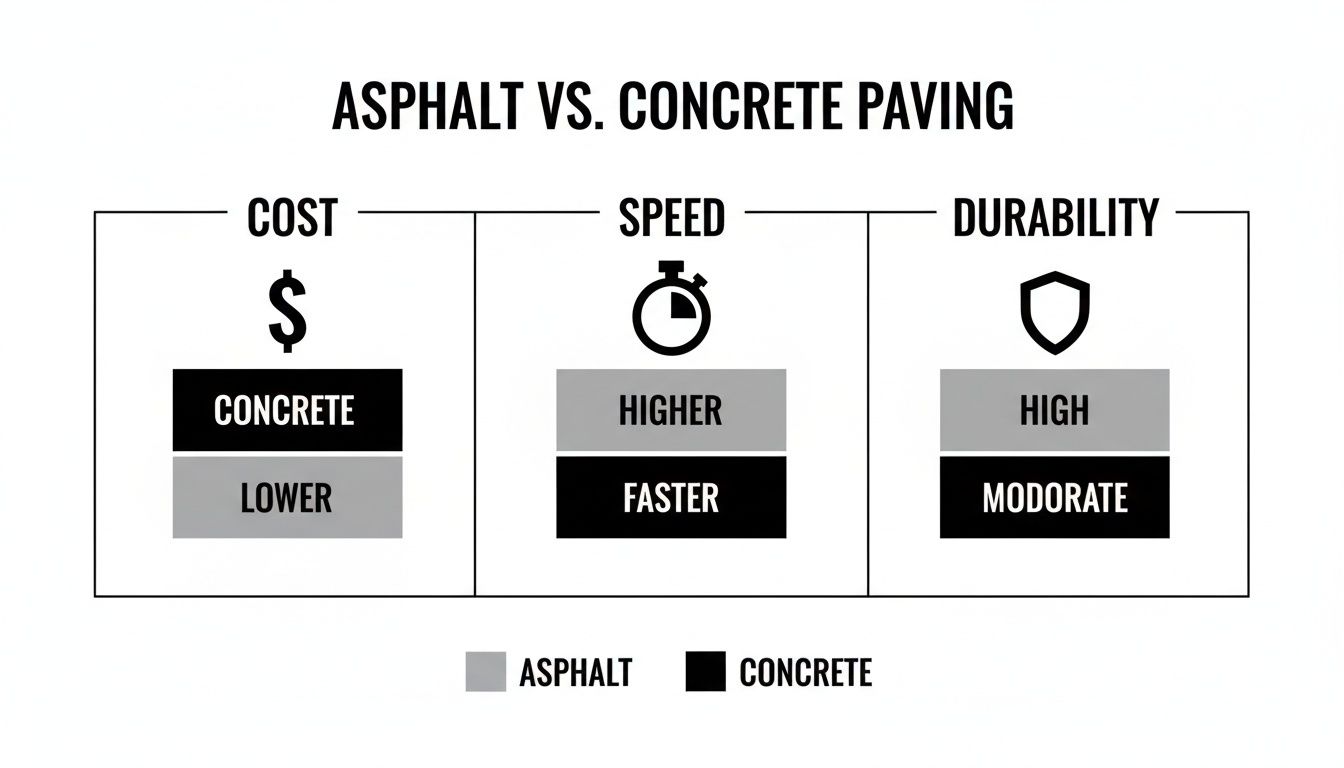
As you can see, asphalt has a clear advantage in upfront cost and how fast it can be installed, while concrete's strength is in its long-term durability.
Shifting Focus to Lifecycle Value
While asphalt is cheaper to put down, concrete often proves its worth over the long haul. This is where the concept of lifecycle value comes in—it’s the total of every dollar you'll spend from installation day to the day it's replaced. And this is where the financial dynamic between asphalt and concrete starts to shift.
To help you see the long-term financial picture, we've broken down the costs over a typical lifespan.
Cost and Lifecycle Comparison for Houston Commercial Lots
| Financial Factor | Asphalt (Bitumen) | Concrete (Portland Cement) |
|---|---|---|
| Upfront Installation Cost | $3 – $8 per square foot. Significantly lower initial capital outlay. | $6 – $15 per square foot. A much higher initial investment. |
| Typical Lifespan | 20-25 years, with proactive maintenance. | 30-40+ years, depending on use and maintenance. |
| Key Maintenance Costs | Requires sealcoating every 3-5 years and regular crack filling. | Minimal; mainly requires periodic joint sealing and occasional cleaning. |
| Long-Term Financial Outlook | Lower initial cost but requires a consistent, recurring maintenance budget. | Higher initial cost but offers a more predictable and lower maintenance spend. |
This table highlights the fundamental trade-off: a smaller initial investment with asphalt versus a larger one with concrete that pays off with lower, more predictable maintenance needs over a much longer service life.
Concrete's impressive durability means it can last 30-40 years—or even longer—with very little intervention. Usually, you're just looking at periodic joint sealing. Asphalt, on the other hand, has a solid lifespan of 20-25 years but demands more hands-on care. This includes routine crack filling and, most importantly, sealcoating every 3-5 years to protect it from Houston’s intense sun and heavy rains.
The 30-Year Cost Projection
When you stretch the timeline out to 30 years, the financial gap starts to narrow quite a bit. The exact numbers will always depend on traffic loads and how diligent you are with maintenance, but the total cost of ownership often ends up being surprisingly similar.
- Asphalt Long-Term Costs: You have the initial installation, plus multiple rounds of sealcoating, crack repairs, and probably a major resurfacing or overlay around the 15 or 20-year mark.
- Concrete Long-Term Costs: This is mostly the high initial installation cost, plus minor expenses for occasional joint sealing and cleaning over the years.
For a high-traffic industrial facility or a loading dock that's constantly getting hammered by heavy trucks, concrete's higher upfront price is easily justified by its superior strength and fewer repair headaches. Over its lifetime, it becomes the more cost-effective choice.
But for a church or an office park with lighter, more sporadic traffic, the ongoing costs of maintaining asphalt might stay low enough to keep its financial edge for its entire service life. Taking this long-term perspective is the key to making a sound investment in your property.
Performance in the Demanding Houston Climate
Houston's climate isn't just tough—it's a punishing force. We're talking about a relentless combination of intense summer heat, suffocating humidity, and sudden, torrential downpours. This environment doesn't just test paving materials; it actively works to tear them apart. When you're weighing asphalt vs concrete, you have to think about how each one stands up to these specific local pressures.
This isn't just about what looks best or costs less on day one. It's about choosing a surface that's truly engineered to survive decades of Gulf Coast weather. Both materials have their moments to shine—and their distinct vulnerabilities—when facing Houston's climate, making this a critical strategic decision.
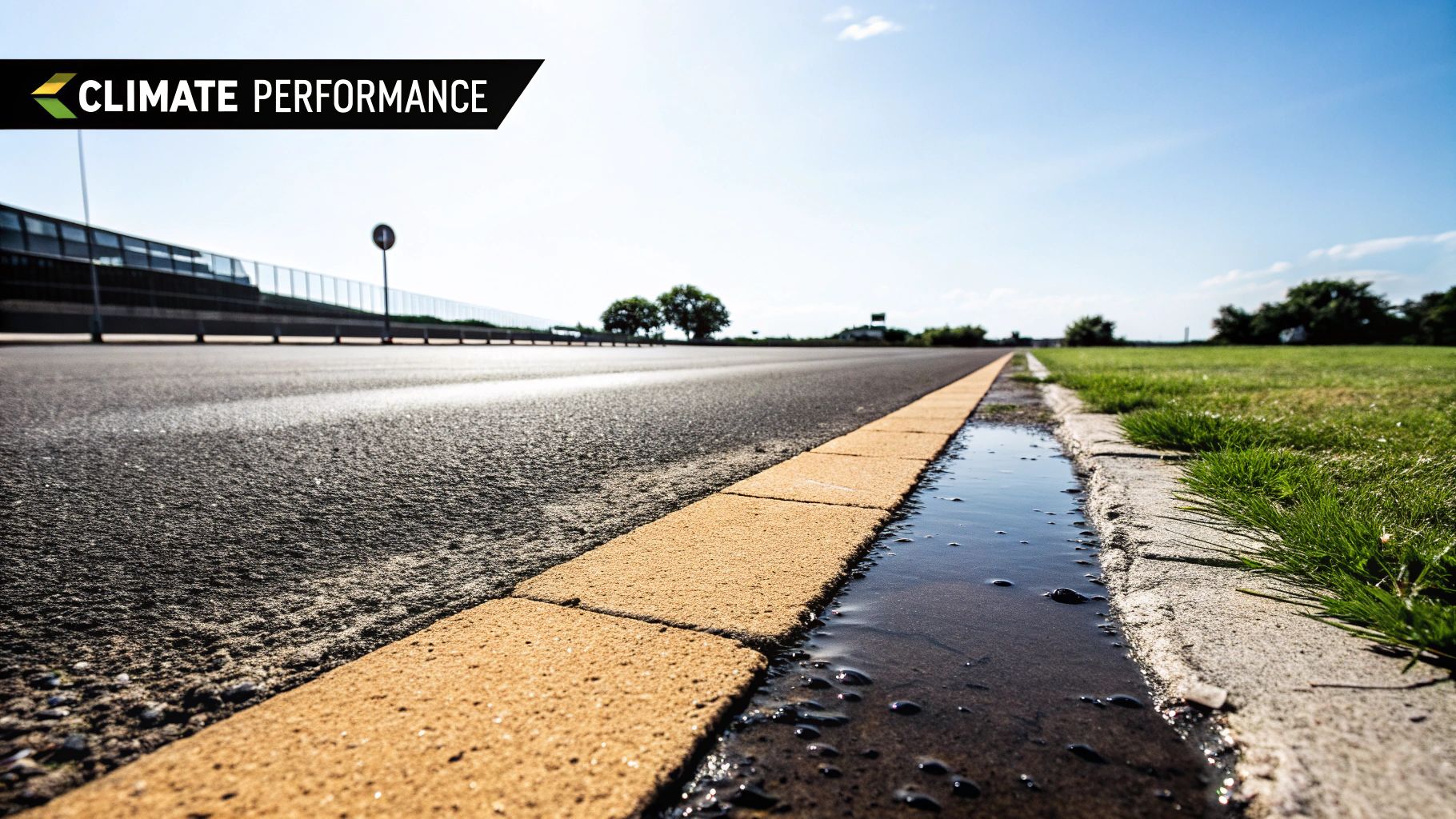
Surviving the Intense Houston Heat
Summer in Houston means pavement can get hot enough to cook on, soaring well above the air temperature. It’s a brutal environment for any surface, and this is where you see a major performance gap between asphalt and concrete.
Asphalt’s dark, petroleum-based nature means it soaks up a massive amount of solar radiation. On a typical 95°F day, it’s not uncommon for an asphalt lot to hit 150°F or even higher. This extreme heat softens the bitumen that binds it all together, making the pavement vulnerable to rutting and deforming under the weight of heavy vehicles—think of a delivery truck idling at your loading dock.
Concrete, on the other hand, tells a completely different story. Its lighter gray color reflects a good portion of that solar radiation, a property known as high albedo. This keeps the surface significantly cooler. A cooler lot doesn't just help with the urban heat island effect; it means the pavement maintains its rigid strength, making it the clear winner for areas that see constant, heavy traffic during our hottest months.
The bottom line on heat performance is simple: asphalt absorbs heat and can get pliable, while concrete reflects heat and stays rigid. For high-traffic commercial lots in Houston, concrete’s stability in the heat is a huge long-term advantage.
Managing Flexibility and Expansion
While concrete wins the heat battle, those temperature swings introduce another challenge. Houston's weather can shift dramatically, causing materials to expand and contract. This is where asphalt’s natural flexibility becomes its greatest strength.
As a flexible pavement, asphalt can expand in the heat and shrink in the cool with a much lower risk of cracking. It essentially moves with the ground and adapts to the thermal stress.
Concrete, being a rigid pavement, has almost no give. To handle the incredible internal stress from thermal expansion, it depends entirely on a well-planned grid of control joints. These joints are just pre-planned weak points that let the slabs expand and contract without destroying themselves. If those joints aren't designed, cut, and maintained perfectly, the stress will find its own way out, leading to ugly, random cracks that are a headache to fix.
Handling Torrential Rain and Drainage
It's no secret that Houston gets a lot of rain. How your parking lot handles all that water is critical to its lifespan. The main goal is to keep water from getting under the surface and turning the sub-base—the foundation of your entire lot—into mush.
Asphalt's Vulnerability: Asphalt is naturally a bit porous, and over time, the sun bakes it out, creating tiny cracks. If you don't seal it, water will find its way into those cracks, weakening the sub-base and leading to potholes and that classic "alligator" cracking. A proactive sealcoating schedule every 3-5 years is non-negotiable to keep it waterproof.
Concrete's Resilience: A properly finished concrete slab is much less permeable than asphalt. Here, the weak points are the control joints. As long as those joints are kept sealed with a quality, flexible sealant, water is effectively channeled off the surface, protecting the sub-base from getting saturated.
In the end, both materials demand diligent maintenance to deal with Houston's rain, but their failure points are different. With asphalt, the entire surface is a potential entry point for water; with concrete, the battle is won or lost at the joints.
Long-Term Maintenance and Repair Strategies
Once your new parking lot is down, the conversation isn't over. It just shifts from the upfront price tag to the long-term value you’ll get out of it. When it comes to asphalt and concrete, the game plan for maintenance and repairs couldn't be more different, and getting it right is the key to protecting your investment. The choices you make here will determine your property's lifespan, safety, and curb appeal for years, even decades.
Good upkeep isn't about scrambling to fix problems as they pop up; it’s about staying ahead of the game and preserving the surface you paid for. This is where the fundamental differences between flexible asphalt and rigid concrete really show. Each material has its own playbook for standing up to Houston's punishing climate and the daily grind of traffic.
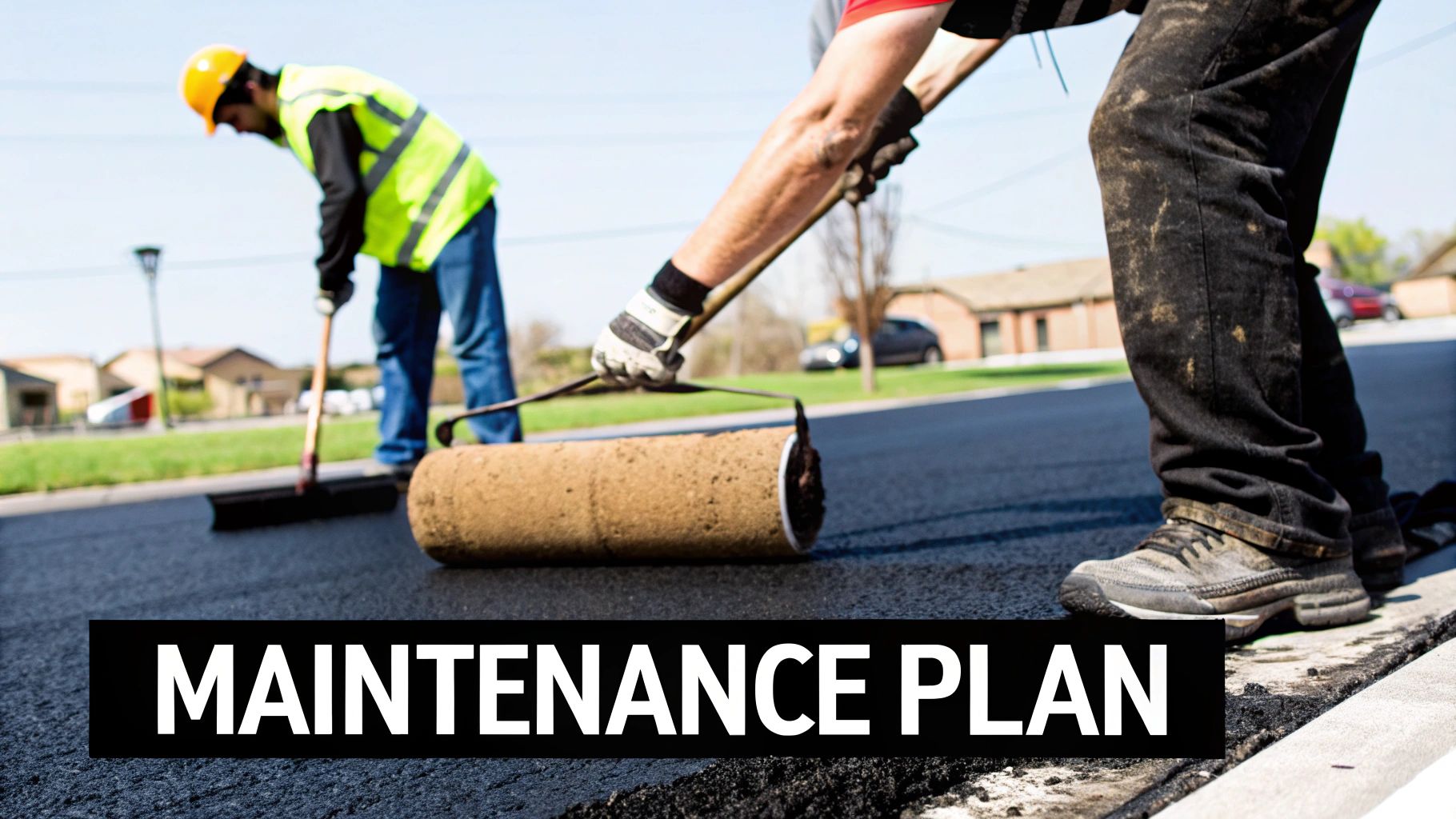
Proactive Asphalt Maintenance: A Cycle of Protection
Keeping an asphalt lot in top shape is a cyclical, hands-on process. It’s all about shielding its petroleum-based binder from the elements. If you let it go, the sun and rain will break down the surface and send it to an early grave.
The absolute cornerstone of asphalt care is sealcoating. This protective top layer needs to be reapplied every 3-5 years. Think of it as sunscreen for your pavement—it blocks the UV rays that make asphalt brittle and oxidized while also keeping water from soaking into its pores. For a more detailed look, our guide on how to properly seal coat asphalt is a great resource.
Just as critical is routine crack filling. Small cracks are going to happen as the pavement ages. Sealing them up right away is crucial. It stops water from getting down into the sub-base, which is what turns a tiny crack into a pothole or a web of "alligator" cracks.
Concrete Maintenance: Guarding the Joints
Concrete maintenance is a different beast—less frequent, but it demands a sharp eye for detail. All its strength comes from that rigid structure, but its Achilles' heel is the joints. Those lines you see are control joints, put there intentionally to give the concrete a place to expand and contract without cracking.
Your main job is joint sealing. The flexible sealant in those joints is the only thing stopping water from getting under the slabs and washing away the foundation. You should have them inspected every year and resealed whenever they start to fail.
Beyond the joints, you’ll want to watch for surface issues. Spalling, which looks like the top layer is flaking or chipping off, can happen over time. Catching and repairing these small spots keeps them from becoming big, expensive problems.
Here’s the core philosophy: with asphalt, you’re constantly protecting the entire surface from breaking down. With concrete, you’re protecting its structural integrity by defending its weakest points—the joints.
Comparing Repair Processes: Speed vs. Complexity
When damage inevitably happens, the way you fix it is a huge factor in the asphalt vs. concrete debate. The approaches couldn't be more different in terms of cost, time, and how much they disrupt your business.
Asphalt repairs are almost always faster and easier on the wallet.
- Patching: For potholes or small failed sections, we can simply cut out the bad spot, fill it with new hot-mix asphalt, and compact it. Often, you can have cars driving on it the very same day.
- Resurfacing (Overlay): When the surface has widespread damage but the base is still solid, we can lay a whole new layer of asphalt right on top. It gives you a brand-new-looking lot for a fraction of the cost of a full replacement.
Concrete repairs, on the other hand, are more involved and disruptive.
- Slab Replacement: You can’t really "patch" concrete seamlessly. If a section is damaged, the entire slab has to be cut out, demolished, and hauled away before a new one can be poured.
- Extended Curing Time: The real killer is the downtime. After a new slab is poured, it needs days to cure and gain strength before it can handle traffic. That means a chunk of your parking lot is out of commission for a while.
This difference is a big deal for day-to-day operations. For a busy shopping center, being able to fix a pothole overnight is a massive win compared to roping off a section of the lot for a week while a concrete repair cures. When you choose your material, you're not just planning for routine upkeep—you're planning for the inevitable repairs, too.
Pavement Markings and Business Operations
Your parking lot surface does more than just support vehicles. It’s a critical part of your daily operations, influencing everything from customer safety to business accessibility. When you're weighing asphalt vs concrete, you have to look at how each material affects pavement markings and the installation timeline. These aren't just minor details—they have a direct impact on your property's immediate function and professional image.
Making the right choice here can save you a lot of headaches down the road. The wrong one could mean repeated disruptions and unexpected costs that hit your bottom line.
Pavement Marking Visibility and Durability
Clear, durable parking lot stripes, ADA markings, and fire lane indicators are absolute must-haves for compliance and safety. The surface you choose plays a huge part in how well those markings hold up.
Fresh asphalt is the perfect backdrop for striping. Its dark, uniform black surface creates a stark contrast with standard white and yellow traffic paint. This makes every line and symbol—from parking stalls to handicap stencils—pop, ensuring you meet ADA visibility requirements with ease.
Concrete, on the other hand, presents a few challenges. Its lighter gray color naturally provides less contrast, so markings don't stand out as sharply. More importantly, concrete’s surface texture and chemistry can sometimes fight against paint adhesion. You often need specialized paint formulas or extra surface prep like grinding or acid etching just to get the markings to stick properly and last. To learn more about this, our guide on choosing the right parking lot paint for your surface breaks it all down.
The bottom line is this: asphalt's dark surface naturally boosts paint visibility, which simplifies both the initial striping and future restriping. With concrete, you'll likely need extra work or specific products to get the same level of contrast and durability.
Installation Timelines and Business Disruption
Here’s where the operational differences between asphalt and concrete really show. The time it takes to get your lot back up and running can have a serious financial impact, whether you run a retail center, an office park, or an industrial facility.
If speed is your main concern, asphalt is the hands-down winner. Once the final roller compacts the hot mix, it cools down and cures pretty fast. In typical Houston weather, you can have an asphalt lot striped and ready for traffic in just 24 to 48 hours. For any business that can’t afford a long shutdown, that quick turnaround is a game-changer.
Concrete, however, demands patience. After it's poured, it goes through a long chemical curing process to reach its full strength. It might be solid enough to walk on in a day, but you’ll need to wait at least 7 days before letting passenger cars on it. If you’re expecting heavy trucks, you should really wait for the full 28-day cure.
That lengthy curing time means serious logistical planning. You’ll have to figure out alternative parking, redirect deliveries, and manage customer access for a week or more. That kind of disruption is a real cost that needs to be factored into your decision. So, when you're thinking about asphalt vs concrete, it’s just as much about logistics as it is about the material itself.
Choosing the Right Pavement for Your Houston Property
After weighing the costs, climate resilience, and long-term maintenance, the final call on asphalt versus concrete boils down to one thing: your specific business needs. This isn't about which material is "better" in a vacuum. It’s about making a strategic choice that aligns with your property’s daily operations, traffic flow, and financial plan.
Let’s move past a simple pro/con list and look at practical, real-world scenarios. This final analysis pulls everything together to give you clear, actionable advice, helping you make a confident investment for your property.
Scenario-Based Recommendations
The best paving solution is directly linked to how your property functions every single day. A surface that’s perfect for a quiet office park would be a disaster for a busy distribution hub. Let’s look at some common Houston business types to see where you fit in.
Asphalt Is the Smart Choice When Speed and Upfront Cost Are Key:
- Retail Centers and Shopping Malls: For these businesses, downtime is lost revenue. Asphalt’s fast 24-48 hour cure time is a massive advantage, getting parking lots open and customers back in quickly. The lower initial cost also frees up capital that can be used for landscaping, lighting, or other customer-facing improvements.
- Apartment Complexes and HOAs: Paving projects can be a major headache for residents. Asphalt allows for a phased approach with minimal disruption, and its more manageable upfront cost fits neatly into annual budgets without requiring special assessments.
- Office Parks with Standard Car Traffic: For properties that primarily see passenger vehicles, asphalt hits the sweet spot of performance and value. It’s durable enough for daily commuters, and when repairs are needed, they’re fast and won’t disrupt the workday for your tenants.
Concrete Is the Clear Winner for Unmatched Strength and Longevity:
- Industrial Facilities and Warehouses: Think loading docks, truck aprons, and equipment yards. These areas face constant abuse from heavy-axle loads. Concrete is the only material that can stand up to this punishment without the rutting and warping that would quickly destroy an asphalt surface.
- Gas Stations and Fast-Food Drive-Thrus: These high-turnover spots are magnets for oil, fuel, and chemical spills that eat away at asphalt. Concrete’s natural resistance to these substances makes it far more durable and easier to keep clean in these tough, targeted zones.
- Properties Built for Long-Term Value: If you're a property owner with a "buy and hold" strategy, concrete’s 30-40+ year lifespan is incredibly appealing. While the initial investment is higher, the minimal maintenance over the decades often leads to a lower total cost of ownership.
When it comes down to it, the deciding factor is almost always the type of traffic you have. If your property deals with heavy trucks on a daily basis, you need the structural integrity of concrete—no question. For almost every other standard commercial use, asphalt's blend of cost, speed, and solid performance makes it an excellent choice.
Ultimately, the asphalt vs concrete question is answered by matching the material’s strengths to your business priorities. By taking a hard look at how your property operates, you can choose the pavement that delivers the best performance and return on investment for your Houston commercial space.
Common Questions About Paving in Houston
When you're looking at a major investment like a new parking lot, you're going to have questions. It's only natural. The classic asphalt vs. concrete debate gets particularly interesting in Greater Houston, where our specific climate and business needs really influence the right answer. Let's tackle some of the most frequent questions we hear from property managers and contractors.
Which Surface Is Better for Heavy Truck Traffic in Houston?
For areas with constant heavy truck traffic—think loading docks, industrial driveways, or distribution centers—concrete is the undisputed winner. Its rigid slab-like structure is designed to spread immense weight across a wide area, which prevents the deep ruts and warping that asphalt is prone to under heavy, slow-moving trucks.
Houston’s intense heat only magnifies the issue. On a blistering summer day, asphalt softens, making it even more vulnerable to damage from the sheer pressure of a fully loaded semi. Concrete, on the other hand, stands firm and maintains its structural integrity in these high-stress zones.
Does Pavement Color Matter in the Houston Heat?
Absolutely. Pavement color isn't just an aesthetic choice here; it directly impacts surface temperature and the micro-climate around your property. This is a huge consideration when weighing asphalt vs. concrete for our region.
- Concrete: Being much lighter in color, it reflects a significant amount of sunlight. This property, known as high albedo, keeps the surface noticeably cooler. That means less heat radiating onto your building and a stronger pavement on the hottest days.
- Asphalt: Its deep black color acts like a magnet for solar radiation. It’s not uncommon for asphalt temperatures to climb above 150°F, which softens the surface and rapidly ages the liquid binder holding it all together.
A cooler parking lot isn't just a minor perk. It makes the entire property more comfortable for customers and staff and can even help reduce the ambient temperature immediately surrounding your building.
Is One Material More Environmentally Friendly?
This is a nuanced question, as both materials have their own environmental story. The "greener" option really depends on what you value most for your project.
Asphalt is actually one of America’s most recycled products. Old pavement is regularly ground up and incorporated into new asphalt mixes, which cuts down on landfill waste and the demand for new raw materials.
On the flip side, concrete's biggest environmental win is its incredible lifespan, often lasting 30-40+ years. This durability means less frequent tear-outs and replacements, saving a tremendous amount of resources over the long haul. Modern concrete mixes also incorporate recycled industrial byproducts like fly ash. Ultimately, your choice comes down to prioritizing high recyclability versus an exceptionally long service life.
Whether you're wrestling with the asphalt vs. concrete decision or just need crisp, durable markings on your current lot, having an expert on your side is critical. Houston Parking Lot Striping delivers professional, code-compliant pavement marking to ensure your property is safe, functional, and looking its best. Contact us today for a free estimate.