Finding Parking Lot Striping Near Me A Complete Guide
When you type "parking lot striping near me" into a search bar, you're not just looking for someone to paint lines. You’re looking for a partner who can boost your property's safety, efficiency, and overall curb appeal. Think of it this way: a freshly striped lot is the very first handshake your business gives a visitor, and it speaks volumes about your commitment to quality.
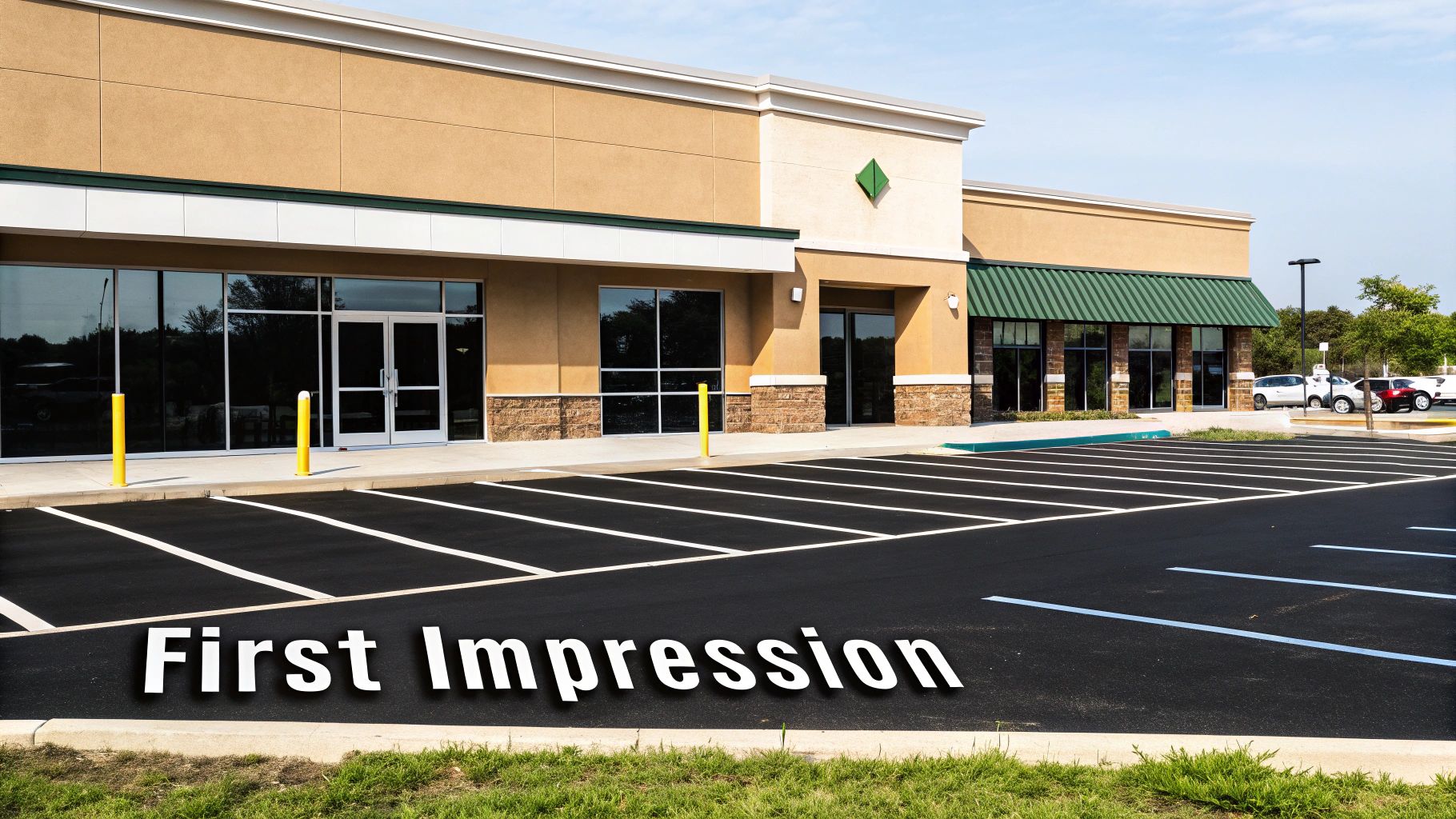
Your Parking Lot Is Your Business's First Impression
Long before a customer ever steps through your front door, they have to navigate your parking lot. What does that first experience say about your business? Are the lines confusing, cracked, and barely visible? Or are they bright, clear, and easy to follow?
That initial moment sets the tone for their entire visit. A chaotic, poorly maintained lot can subtly suggest that the business itself is just as disorganized. On the other hand, a clean, well-marked lot instantly conveys professionalism and care, building trust before they've even parked.
More Than Just Aesthetics
While sharp, clean lines certainly look good, professional striping is really about function and safety. It’s a carefully designed system that brings order to the potential chaos of a busy parking area. Every single line, arrow, and symbol has a job to do, all working together to guide drivers and protect pedestrians.
A professional layout achieves several crucial goals:
- Maximizes Parking Capacity: A smart, efficient layout ensures you’re using every square foot effectively, fitting the maximum number of cars without feeling cramped.
- Improves Traffic Flow: Clear directional arrows and defined driving lanes keep vehicles moving smoothly, which is a lifesaver during busy periods. No more confusion or fender-benders.
- Enhances Pedestrian Safety: Properly marked crosswalks and walkways give people a safe, designated path to follow, keeping them visible and away from moving traffic.
- Ensures Legal Compliance: This is a big one. Correct striping is mandatory for meeting ADA and fire code regulations, helping you avoid hefty fines and legal headaches.
A Critical Asset for Property Managers
If you’re a property manager or a general contractor, you already know that a well-maintained parking lot is non-negotiable. The global market for parking lot paving services is projected to hit an incredible $18.9 billion in 2025, which just goes to show how vital this work is. A huge slice of that market comes from commercial properties like shopping centers and office buildings, where faded lines aren't just an eyesore—they're a serious liability. You can discover more about this growing market and its impact on commercial properties.
A well-maintained parking lot is not an expense; it's a critical investment in safety, compliance, and customer experience. It directly influences how your property is perceived and how efficiently it operates.
At the end of the day, professional striping turns a simple slab of pavement into a powerful asset. By prioritizing clear, compliant, and professional markings, you create an environment that welcomes visitors, keeps them safe, and reflects the high standards of your business. It's one of the simplest yet most effective upgrades you can make.
Understanding the Different Types of Pavement Markings
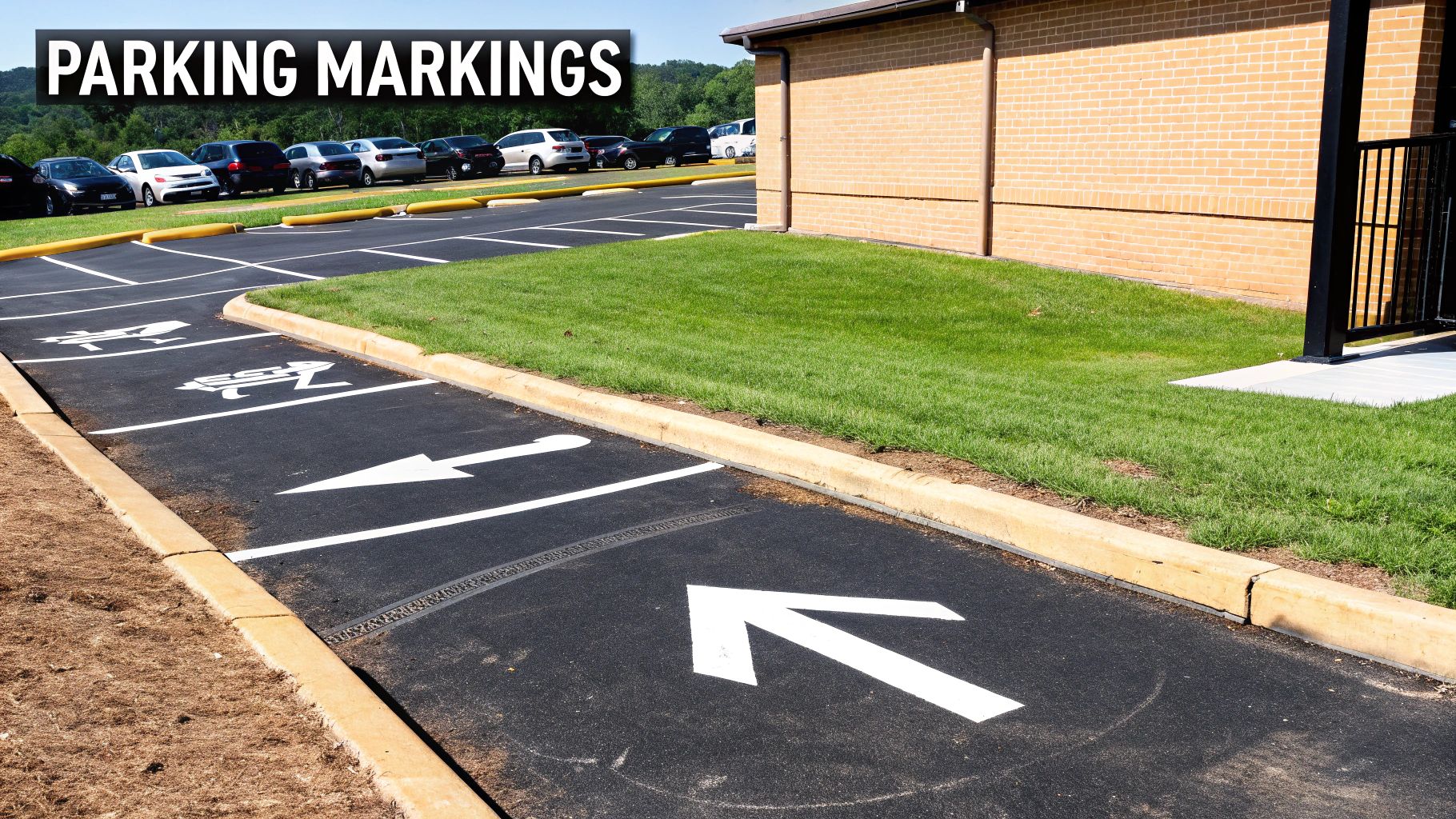
Think of your parking lot as a silent traffic cop. Every line, arrow, and symbol is part of a visual language that tells drivers exactly where to go, how to park, and what to avoid. Getting this language right is the first step to creating a lot that’s safe, efficient, and up to code.
When you start looking for "parking lot striping near me," you’ll quickly see that projects fall into two main categories: new layouts and re-striping. A new layout is just what it sounds like—we're starting from a blank slate on a freshly paved surface, measuring and painting every single line for the very first time. On the other hand, a re-stripe is all about maintenance. It’s a refresh, where a contractor traces over your old, faded lines to bring them back to life.
Defining the Space with Parking Stalls
The bread and butter of any parking lot are the stalls themselves. These simple lines are what determine your property's capacity and have a huge impact on how easily people can get in and out.
You really have two main choices when it comes to stall design:
- Straight Parking (90-Degree): This is the go-to for maximizing space. If your goal is to fit as many cars as possible, 90-degree stalls are the most efficient layout. The trade-off is that they can be a bit tighter for drivers to maneuver.
- Angled Parking (45 or 60-Degree): Drivers love angled parking. It’s far easier to pull into and back out of, which naturally creates a smoother, one-way flow of traffic. It does take up a little more room per car, but the reduction in fender-benders makes it a popular choice for busy retail centers.
Guiding Movement with Directional Markings
Beyond the parking stalls, a whole host of other markings work together to manage the flow of traffic and keep everyone safe. We use heavy-duty stencils to create these symbols so they’re crisp, clear, and universally understood.
Good pavement markings aren't just for looks—they're a critical part of your property's function. They eliminate confusion, prevent accidents, and create a positive experience for every visitor from the moment they pull in.
Some of the most common markings we apply include:
- Directional Arrows: These are the unsung heroes of a well-designed lot. They guide drivers through lanes and prevent chaos at intersections.
- Stop Bars: That thick white line is a non-negotiable command. It tells drivers precisely where to stop, which is crucial for preventing collisions where traffic crosses.
- Loading Zones: Usually marked in yellow, these zones keep vital access points clear for delivery trucks and service vehicles.
- Reserved Parking: From "Visitor" and "Employee of the Month" to specific apartment numbers, custom stencils keep your lot organized and ensure the right people have a place to park.
Non-Negotiable Safety and Compliance Markings
Finally, some markings aren't a suggestion—they're the law. Fire lanes are at the top of that list. We mark them with bright red paint on the curbs and bold stenciling on the asphalt to ensure emergency vehicles have unobstructed access at all times.
In the same vein, ADA-compliant handicap stalls are absolutely mandatory. They come with very specific rules about stall dimensions, access aisles, and signage. Knowing the difference between all these markings is key when you talk to a contractor. Choosing the right kind of parking lot paint is also a big piece of the puzzle, as you need something that will hold up to Houston's sun and rain. When you understand these basics, you're in a much better position to make smart decisions for your property.
How to Navigate ADA and Fire Lane Compliance
As a property manager or business owner, trying to decipher the web of regulations for your parking lot can feel like a full-time job. Two areas you absolutely can't afford to get wrong are the Americans with Disabilities Act (ADA) and local fire codes. These aren't just suggestions or "best practices"—they are iron-clad legal requirements that protect every single person who sets foot on your property.
Getting these rules right isn't just about avoiding trouble; it's about mitigating serious liability. An improperly marked lot is more than just an inconvenience; it's a safety hazard that opens your business to hefty fines and legal battles. Think of it as one of the most critical investments you can make in your property's safety and longevity.
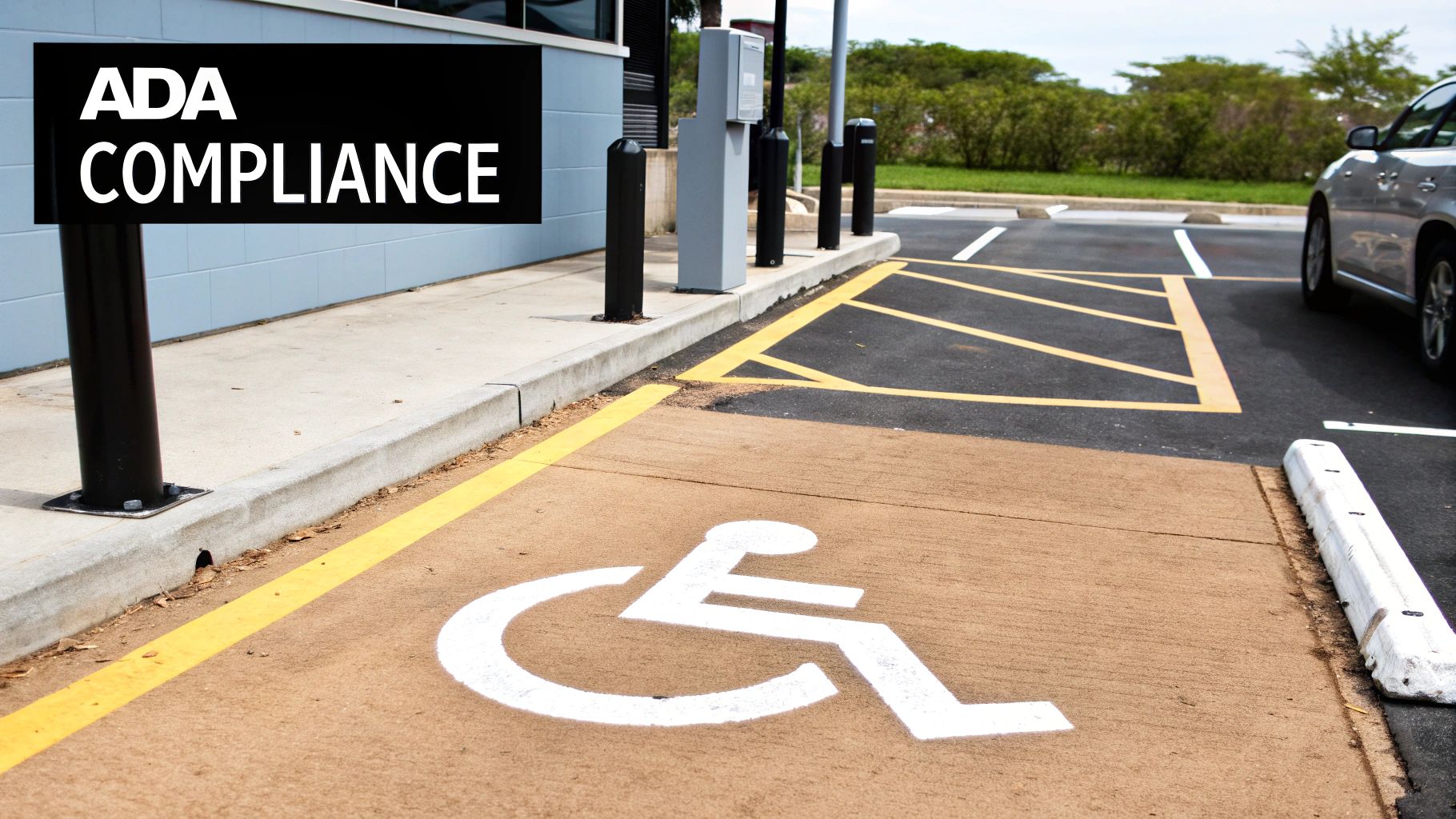
Unpacking ADA Parking Requirements
The Americans with Disabilities Act exists to guarantee safe and equal access for everyone, and your parking lot is the very first impression. The regulations are incredibly specific, detailing everything from the number of accessible stalls to their precise dimensions and the signs you have to post.
Here's a quick look at the essentials of ADA compliance:
- Calculating Stall Count: The total number of parking spaces you have dictates the minimum number of accessible stalls required. It's a sliding scale, so the more spots you have, the more accessible ones you'll need.
- Stall Dimensions: A standard accessible stall must be at least 8 feet wide. But it doesn't stop there. Each one needs an adjacent access aisle—that's the striped area—to give people enough room to deploy a wheelchair ramp and get in and out of their vehicle safely.
- Van-Accessible Spaces: For every six accessible spots (or fraction of six), at least one has to be van-accessible. These need a wider access aisle, a full 8 feet, to handle side-mounted lifts.
- Signage and Markings: Every accessible space needs a sign with the International Symbol of Access, mounted at a specific height. The ground markings themselves are also key, usually painted blue with blue striping for the access aisle.
Cutting corners on these standards can lead to severe penalties. For a much deeper dive, check out our detailed guide on ADA handicap parking space requirements.
Don't underestimate the financial risk of non-compliance. Fines for ADA violations can quickly climb into the tens of thousands of dollars per incident. Fire code violations are just as serious and can even lead to your business being shut down until you fix the problem.
To help simplify the stall count, here's a quick reference based on the federal guidelines.
Quick Guide to ADA Parking Requirements
This table provides a snapshot of the minimum number of accessible spaces required by the ADA, based on the total parking capacity of your lot.
| Total Parking Spaces in Lot | Minimum Required Accessible Spaces | Required Van-Accessible Spaces |
|---|---|---|
| 1 to 25 | 1 | 1 |
| 26 to 50 | 2 | 1 |
| 51 to 75 | 3 | 1 |
| 76 to 100 | 4 | 1 |
| 101 to 150 | 5 | 1 |
| 151 to 200 | 6 | 1 |
| 201 to 300 | 7 | 2 |
| 301 to 400 | 8 | 2 |
| 401 to 500 | 9 | 2 |
| 501 to 1,000 | 2% of total | 1 in every 6 accessible spaces |
| 1,001 and over | 20, plus 1 for each 100 over 1,000 | 1 in every 6 accessible spaces |
Remember, this is a starting point. Local Houston ordinances might have additional requirements, which is why working with a local expert is so important.
Ensuring Clear Fire Lane Access
Just as vital as ADA compliance is making sure emergency vehicles can get to your building without a single obstacle. Fire lanes are non-negotiable pathways for fire trucks and ambulances, and they have to be clear 24/7. A blocked fire lane can turn a small, manageable emergency into a full-blown catastrophe.
The local Fire Marshal in Houston enforces very specific rules for these zones. Key requirements include:
- Mandated Width: Fire lanes have to be wide enough for the biggest emergency vehicles, which usually means a width between 20 and 24 feet.
- Curb Color Codes: You’ll almost always see fire lane curbs painted a specific color, typically a bright, unmissable red or yellow, to signal that parking is strictly forbidden.
- Pavement Stenciling: Big, bold stencils that read "NO PARKING FIRE LANE" must be painted on the asphalt at set intervals all the way down the lane.
The growing demand for compliance is one reason the line striping machines market is projected to hit $3.06 billion by 2033. For property owners, this means better technology is available to create durable, crisp markings that can withstand the Texas sun and storms. With potential fines exceeding $10,000 per violation, professional striping isn't a cost—it's an essential investment.
These regulations are complex and can change. The safest and smartest move is to partner with a contractor who lives and breathes this stuff. A professional specializing in parking lot striping in the Houston area will know the ins and outs of both ADA and local fire codes, guaranteeing your property is safe, accessible, and completely up to code.
What to Expect From a Professional Striping Service
Hiring any contractor can feel like a bit of a gamble. You’re looking for someone who’s not just skilled but also transparent and reliable. So, what really happens when you hire a professional for parking lot striping? It's not as simple as just showing up with a can of paint. A true pro follows a time-tested process from the first call to the final walkthrough, ensuring you get exactly what you paid for with no headaches.
Let's pull back the curtain and walk through the steps a reputable company takes. This isn't just about painting lines; it's a structured approach designed to deliver precision, ensure compliance, and cause as little disruption to your business as possible.
Step 1: Initial Consultation and a Free Estimate
It all starts with a conversation. When you first reach out, our main goal is to get a handle on your project. Are we working with a blank slate of new asphalt that needs a complete layout from scratch? Or are we just bringing some faded, tired lines back to life with a re-stripe?
We'll talk through the key details—the size of your lot, any special markings you need like loading zones or "Employee of the Month" spots, and when you need it done. Based on that chat, we'll put together a detailed, no-obligation estimate. We believe in clarity, so our quotes break down all the costs, making sure there are no surprises down the road.
Step 2: A Thorough On-Site Assessment
Before a drop of paint hits the pavement, we have to see the property for ourselves. A project manager will come out to walk the lot, take precise measurements, and get a feel for the condition of the asphalt. Think of this as the diagnostic phase, where we spot any potential issues before they become real problems.
This visit is crucial for a few reasons:
- Planning the Layout: We confirm the best way to arrange the stalls to maximize your space and keep traffic flowing smoothly.
- Checking for Compliance: We'll make sure everything is lined up with current ADA and local fire code requirements. The last thing you want is a compliance issue.
- Evaluating the Surface: We inspect the asphalt for things like cracks, oil spots, or grime that could prevent the paint from sticking properly.
This detailed assessment becomes the blueprint for the entire job, allowing us to lock in the plan and get you on the schedule.
Step 3: Getting the Surface Ready
You can't build a strong house on a weak foundation, and you definitely can't paint lasting lines on a dirty, unprepared surface. Honestly, this is the most critical step for a professional-looking, long-lasting job. If a contractor skips proper prep, even the best paint in the world will start peeling and fading in months, not years.
A clean surface isn't just a suggestion—it's essential for paint adhesion. Cutting corners here is the number one reason striping jobs fail early, turning a two-year investment into a six-month headache.
So, what does prep involve? First, our crew uses powerful blowers to clear away all the loose dirt, leaves, and debris. For the tougher stuff like stubborn grime, oil stains, or mildew, we bring in high-powered pressure washers to deep-clean the asphalt. The goal is a pristine surface that’s ready to bond with the new paint.
Step 4: Precision Striping and Stenciling
With a perfectly prepped surface, the real magic happens. Our crew arrives with professional-grade equipment, including airless line striping machines that lay down crisp, uniform lines every single time. They’ll carefully map out the entire lot with chalk lines, double-checking every measurement to ensure the layout is perfect before any permanent marks are made.
Using high-quality, durable traffic paint, they bring the plan to life. This means painting all the parking stalls, directional arrows, stop bars, and fire lanes with exacting precision. They’ll also use stencils to apply any required ADA-compliant handicap symbols, "RESERVED" spots, or other custom markings your lot needs.
Step 5: Curing and the Final Walkthrough
The last step is simply letting the paint do its thing. Our crew will block off the newly striped areas with cones and caution tape to keep cars from smudging the wet paint. Depending on the weather and the type of paint used, it usually takes just a few hours before your lot is ready for traffic again.
Once everything is dry, we conduct a final quality assurance check. The project manager will walk the entire lot, inspecting every line and stencil to make sure the job meets regulatory standards and, more importantly, your standards. This final inspection is our promise to you that the job was done right.
How Much Does Parking Lot Striping Actually Cost?
When it's time to get your parking lot striped, one of the first questions is always about the budget. It’s important to understand that you're not just buying paint—you're investing in safety, compliance, and the first impression your property makes.
Let's be clear: there's no "one-size-fits-all" price. The final quote you get will depend on a few key things, like the size of your lot, the complexity of the design, and the current state of the pavement. A simple re-stripe on a clean, smooth surface will always be more budget-friendly than a brand-new layout on damaged asphalt that needs a lot of prep work.
The process a professional follows is pretty straightforward, but it’s what ensures you get a fair price and a job well done.
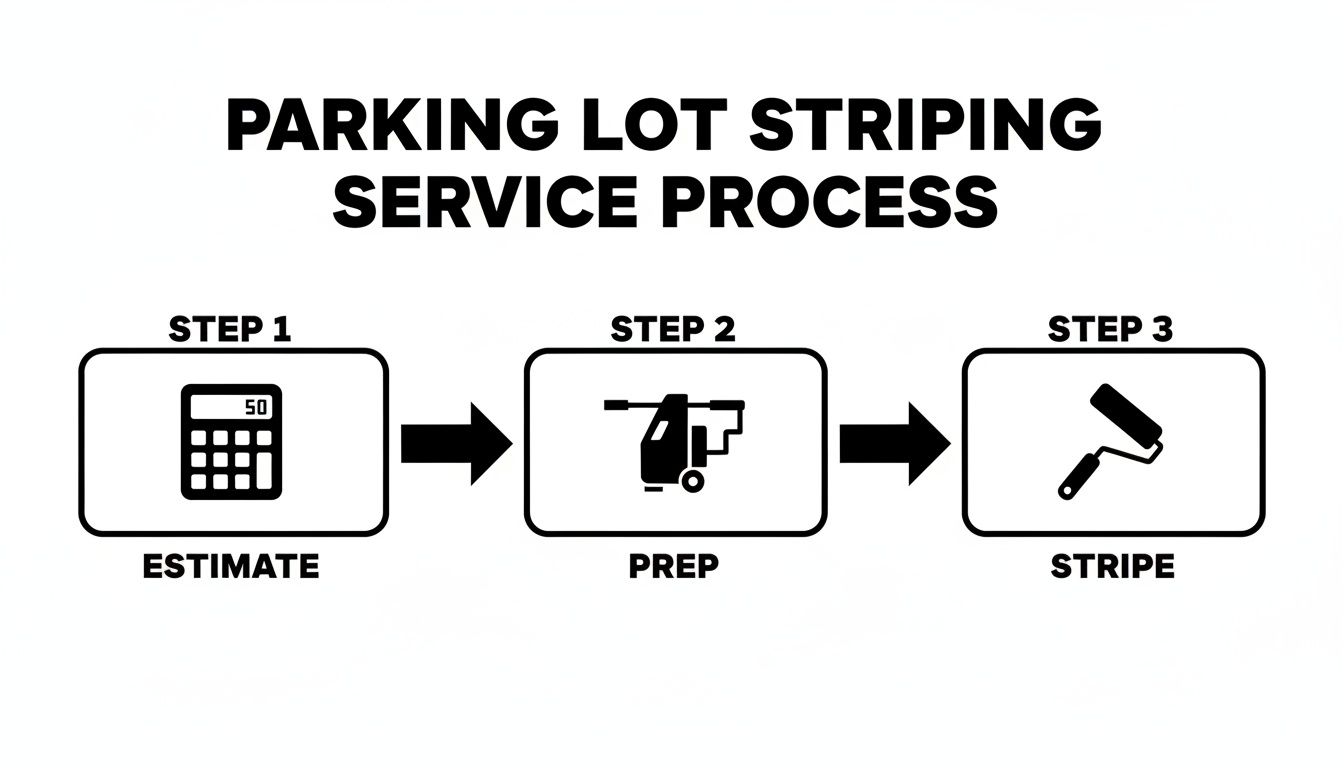
This methodical approach takes the guesswork out of the equation and is the key to a high-quality, lasting finish.
The Key Factors That Shape Your Quote
When we come out for an on-site evaluation, we're looking at several specific variables that directly influence the final cost. A transparent quote should account for all of them.
- Project Scope (Re-stripe vs. New Layout): Is this a refresh or a complete overhaul? Tracing over existing, faded lines is a re-stripe and is much more affordable. A new layout on fresh asphalt requires precise measurement, chalking, and a lot more labor, which naturally increases the price.
- Surface Condition: What are we working with? If the pavement is covered in dirt, debris, or oil stains, it needs to be thoroughly cleaned before any paint goes down. This prep work, often involving power washing, is crucial for proper paint adhesion and will be part of the estimate.
- Line Removal: If you're changing the layout or fixing a previous bad job, the old lines have to go. This is usually done by grinding the paint off the asphalt or blacking it out. Both methods add labor and material costs to the project.
- Type of Paint: Not all paint is created equal. Standard water-based traffic paint is a great, cost-effective option for many properties. But for high-traffic zones like drive-thrus or loading docks, you might want to invest in a more durable (and more expensive) material like chlorinated rubber or oil-based paint for longer-lasting results.
How We Price Our Striping Services
To make things clear and easy to understand, contractors generally use a couple of common pricing models. This helps you see exactly where your money is going when you compare quotes.
The most common pricing methods are per linear foot for lines and per unit for stencils. This approach provides a clear, itemized breakdown, so you know the cost associated with every single element of the job.
A per linear foot model means you pay for the total length of every line we paint. For example, each standard 18-foot parking stall line has a set rate. Markings like ADA symbols, directional arrows, and fire lane lettering are different—those are typically priced per unit or per stencil. For a deeper dive into the numbers, check out our guide on how much parking lot striping costs.
This isn't just an expense; it's an investment with a real return. The global parking management market is expected to grow from $7.93 billion in 2026 to $14.24 billion by 2032. Why? Because property managers know that faded, confusing lines can lead to 15-20% lost revenue from inefficient parking. A well-marked lot, on the other hand, can improve vehicle turnover rates by as much as 25%, making your property more profitable and efficient.
Answers to Your Top Parking Lot Striping Questions
If you’re looking up "parking lot striping near me," you probably have a few practical questions. As a property manager or business owner, you need to know what you're getting into. We've been in this business a long time, so we’ve heard just about every question there is. Here are the answers to the ones that come up the most.
How Long Will the New Paint Actually Last?
This is usually the first thing people ask, and for good reason. A professional striping job, done with high-quality traffic paint, should hold up for about 18 to 24 months. But that's a ballpark figure—real-world conditions play a huge role.
Think of it like the tires on your car. The lifespan depends on how you drive, and the same principle applies here.
- Traffic Volume: A packed retail center's parking lot gets a lot more action than a small office park. The more cars driving over the lines, the faster they'll wear down.
- Weather Exposure: Here in Houston, the sun is intense and the rain can be heavy. Both elements work together to break down the paint over time.
- Pavement Condition: This is a big one. Paint sticks beautifully to a smooth, clean, well-maintained surface. If your asphalt is cracked, crumbling, or dirty, the paint simply won't last as long.
For those high-traffic zones, we often recommend tougher materials like chlorinated rubber paint to get more life out of your stripes. Another pro tip? Sealcoating your lot before we stripe it. That creates a fresh, protective surface that helps both the asphalt and the paint last significantly longer.
How Much Downtime Should I Plan For?
We get it—your business can't afford to be out of commission. The good news is that the painting itself is pretty quick. The real factor is the drying time. You have to let the paint cure properly, otherwise, the first car that drives over it will leave ugly smudges and ruin the whole job.
Water-based traffic paint is usually dry to the touch in about 30 minutes, but it needs a bit more time before it can handle a car. You should expect to block off the area for 2 to 4 hours. The exact time can change based on the temperature, humidity, and even how much of a breeze there is.
To keep your business running, we’re flexible. We’ll work around your schedule—early mornings, late evenings, or weekends. For bigger lots that can’t shut down completely, we can tackle the job in sections, keeping part of your lot open for customers at all times.
When Is the Right Time to Stripe Fresh Asphalt or a New Sealcoat?
Timing is absolutely critical here. If you paint too soon on new pavement, the job is doomed to fail.
On brand-new asphalt, you have to be patient. Freshly laid asphalt "cures" by releasing oils, and if you paint over those oils, the paint will never stick. It'll just peel right off. You need to wait a minimum of 14 to 30 days for the asphalt to cure completely.
For a freshly sealcoated surface, the wait is much shorter but just as important. The sealant needs to fully harden before it's ready for paint. Give it at least 24 hours after the sealcoat has been applied. This ensures a strong bond that will last.
Do You Do More Than Just Paint Lines?
Absolutely. While crisp, clean lines are our specialty, a truly functional parking lot needs more than that. We handle everything you need to make your property safe, compliant, and look its best. Think of us as your one-stop shop for pavement marking.
Our other services include:
- Line Removal: We can grind off old, faded lines or use blackout paint to cover them up.
- Hardware Installation: Need concrete wheel stops, steel bollards, or new traffic signs? We install all of it.
- Custom Stencils: From "RESERVED" spots and company logos to unique directional markings, we can create and paint any custom stencil you need.
- Lot Maintenance: We also offer services like power washing to blast away dirt and grime, and of course, sealcoating to protect your asphalt investment.
Working with a single contractor who can do it all just makes life easier. It saves you the headache of coordinating multiple vendors and ensures everything on your property looks consistent and professional.
Ready to make your property’s first impression count? The team at Houston Parking Lot Striping has the experience and equipment to give your lot a clean, compliant, and durable finish. Get your free, no-obligation estimate today by visiting us at https://houstonparkinglotstriping.com.